Two Forests, One Bird
Read the transcript of “Two Forests, One Bird”
Film transcript: Two Forests, One Bird
If a bird lays its eggs earlier every spring, is it keeping up? The first film measured a gap in space, between a species and its isotherm. This film measures a similar gap in time. The seasonal timing of life events is called phenology. Leafing, flowering, migration and egg laying are all phenology. As springs have warmed, many of these now come earlier.
Now one bird and its food. The gold curve is the caterpillar peak, the food supply. The green bar is when nestlings need feeding most. Here they start in step. Warm the springs. The gold peak slides earlier. The green bar slides earlier too, but by less. A red bracket can open between them. That gap is trophic mismatch.
Demand now peaks after the food peak has passed. So an earlier date, on its own, cannot show keeping up. Does mismatch cost birds? Christiaan Both and colleagues compared nine Dutch populations of the pied flycatcher. It winters in Africa and breeds in European woods. In some of the forests, caterpillars peaked early. In others they peaked late, and birds that bred early were still well timed. Where food peaked early, flycatcher numbers fell by about ninety percent over two decades. Where it peaked late, declines were weak at most. The early forests lost about nine pairs in every ten. Does that comparison prove that mismatch caused the loss?
Not yet. It supports a cost of mismatch, but it compares sites. The forests were not assigned their caterpillar timing, so something else could differ between them. A second question. What tells a bird when to lay? In the field, warm springs bring early laying, but they also bring early food. The pattern alone cannot separate them. Marcel Visser and colleagues kept breeding pairs of great tits in climatized aviaries. Every aviary had food freely available. Only the temperature pattern differed, warm or cold. The warm aviaries generally laid earlier. With food unlimited, the authors read temperature as likely acting as a cue, a signal the birds respond to.
Each design answers its own question. A trend suggests a change. Testing it against chance and natural variation is detection. The forest comparison links food timing to decline, but sites can differ in other ways. The aviaries show temperature acting on laying, in great tits. Through all of it, the date alone never answered the question. What counted was the gap between the food and the family.
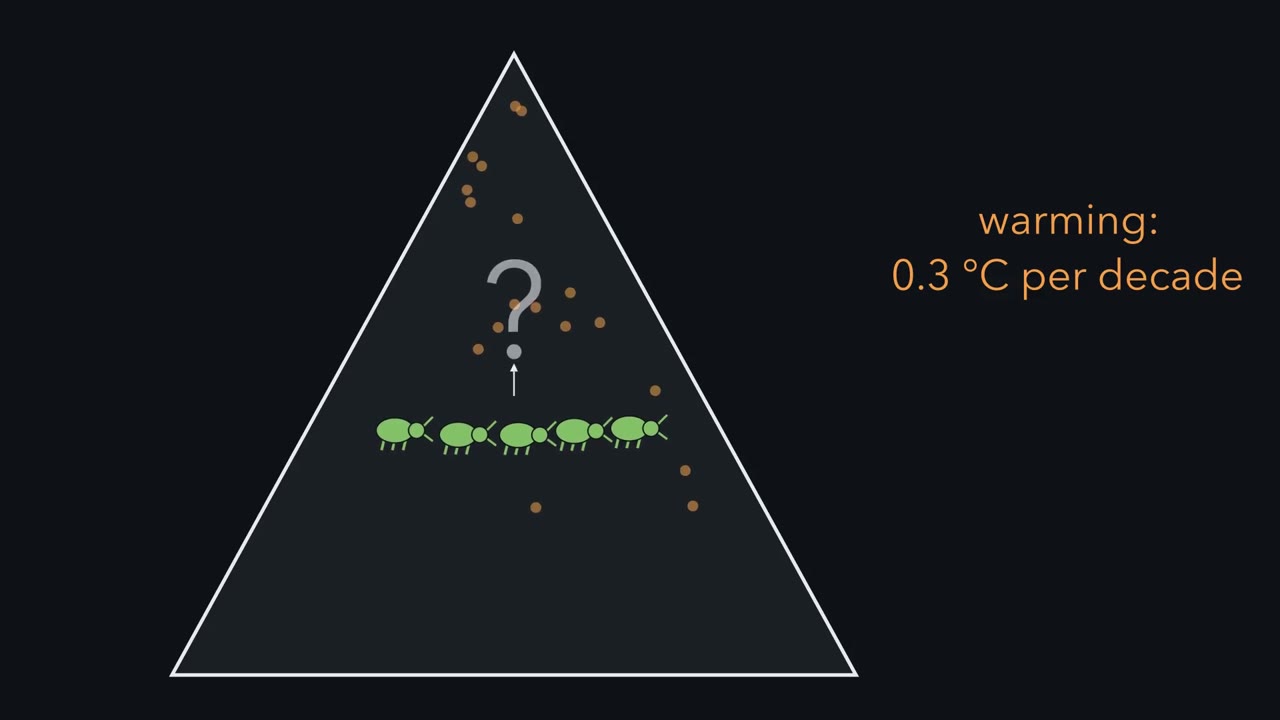
A mountain warms 0.3 C in a decade. How far uphill must a beetle's range shift to stay as cool as before?
Continue in the lesson: Global Change: Species on the Move →
3:24 · Free, with captions and a transcript. The lesson has the full text, the questions and the sources.
More films from this lesson
How this film was made. Narration: an AI narrator voice (Kokoro, af_heart) reading narration written from this lesson's text. Animation: AI-generated in code (Manim) by Claude, a schematic with no drawn molecular structures. Captions come from the narration script. See something wrong? Report it.