Press play to start at .
What Did the Work?
From the film
- Buchner held that the fermenting activity came from a dissolved substance, undoubtedly a protein, which he named zymase.
- Some ferments already worked outside cells, and in 1877 Kühne named them enzymes.
- Berthelot remade fats from glycerol and fatty acids by reversible equilibrium chemistry, the same kind that governs the mineral world.
- Harden and Young split zymase into enzymes plus small heat-stable cofactors, chief among them NAD.
- The catalysts of life are nearly all proteins, and they can be lifted out of the cell and studied.
Read the transcript of “What Did the Work?”
Film transcript: What Did the Work?
Tap a sentence to play from there.
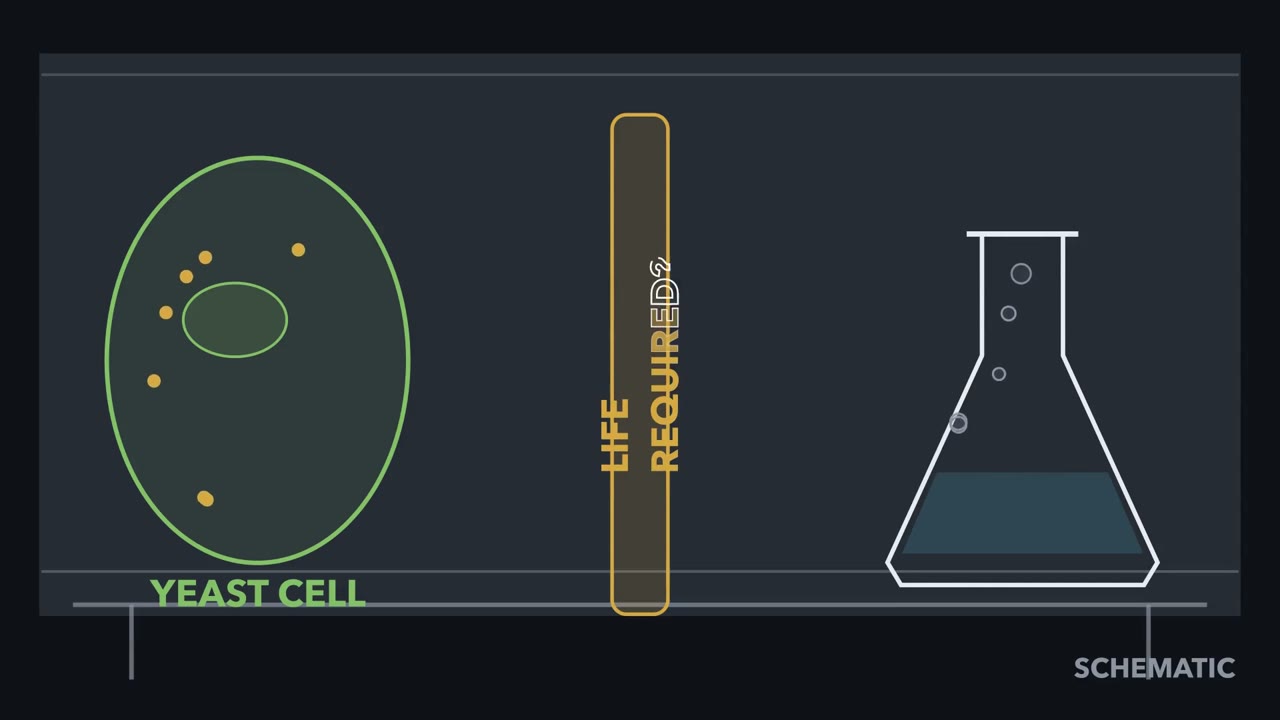
- 0:00 Last time, juice pressed from yeast fermented sugar, and controls showed no living cell was needed. So if not life, what in that flask was doing the work?
- 0:14 Buchner's answer lay in the juice itself.
- 0:18 The carrier of the activity, he wrote, must be a dissolved substance, undoubtedly a protein. He named it zymase.
- 0:27 His 1907 Nobel Prize is often called the first for a fundamentally biochemical discovery.
- 0:35 His worker had relatives.
- 0:38 Some ferments, such as pepsin and the invertase of yeast, already worked outside cells. In 1877, Wilhelm Kühne named them enzymes, from the Greek for "in leaven".
- 0:51 Kühne studied digestion and vision, and believed both were chemistry waiting to be lifted out of the cell.
- 0:58 His word named the chemical worker, not the cell or the tissue.
- 1:03 Workers are half the story.
- 1:06 The other half is the rules.
- 1:08 In 1854, Marcellin Berthelot joined glycerol to fatty acids and remade natural fats, releasing water. Add water, and the reaction runs back.
- 1:21 That back-and-forth is equilibrium chemistry, the same kind that governs reactions in the mineral world.
- 1:29 The body's molecules needed no special law.
- 1:32 Berthelot also made new fats that nature does not.
- 1:36 So here is the one idea.
- 1:39 Where vitalists placed a force, chemists found ordinary chemistry.
- 1:45 Its catalysts can be lifted out of the cell.
- 1:48 And they follow the same rules as everything else.
- 1:51 Buchner gave his worker one name.
- 1:55 Predict: when chemists later took zymase apart, did they find a single substance, or several?
- 2:06 Several. Harden and Young split zymase into enzymes plus small, heat-stable cofactors. Chief among them was cozymase, now known as NAD.
- 2:19 Together they run glycolysis, plus two steps that make ethanol.
- 2:24 A whole process had become a set of reactions, open to study one at a time.
- 2:30 The catalysts Kühne named and Buchner freed are, nearly all of them, proteins.
- 2:36 Even Wöhler's urea, made in a flask with no kidney, has its own team.
- 2:42 Your liver builds it right now with five enzymes, working in a loop called the urea cycle.
- 2:48 In the chemistry of the cell, the vital force had nowhere left to hide.
- 2:54 In its place: workers you can pull out and study, obeying the same rules that govern rocks and salts.
Vitalism and its fall: the same idea, other levels
A level is a place to start, not a rank. If this loses you, the rung below teaches the same idea, told more simply.
College, upper level · the level you chose
Vitalism: How Chemistry Captured Life · this lesson
Wöhler's urea in 1828 to Buchner's cell-free fermentation in 1897.
Biochemistry · about 24 min · film 3:15 · 2 practice questions
Next door
- The urea cycle: Choose, Recycle, Split · 3:27 Urea, first made in a flask in 1828, is the same molecule the liver makes from ammonia.
- Enzymes: Lower the Ridge, Not the Valleys · 3:18 Cell-free extract could still ferment sugar, so living chemistry needed enzymes, not a life force.
- Fermentation: Glycolysis: The Investment-and-Payoff Pathway Whether fermentation needed living cells was a central question in the argument over vitalism.
More films from this lesson
Continue in the lesson: Vitalism: How Chemistry Captured Life →
Free, with captions and a transcript. The lesson has the full text, the questions and the sources.
How this film was made. Narration: an AI narrator voice (Kokoro, af_heart) reading narration written from this lesson's text. Animation: AI-generated in code (Manim) by Claude, a schematic with no drawn molecular structures. Captions come from the narration script. See something wrong? Report it.