Reading Where Cargo Stops
Read the transcript of “Reading Where Cargo Stops”
Film transcript: Reading Where Cargo Stops
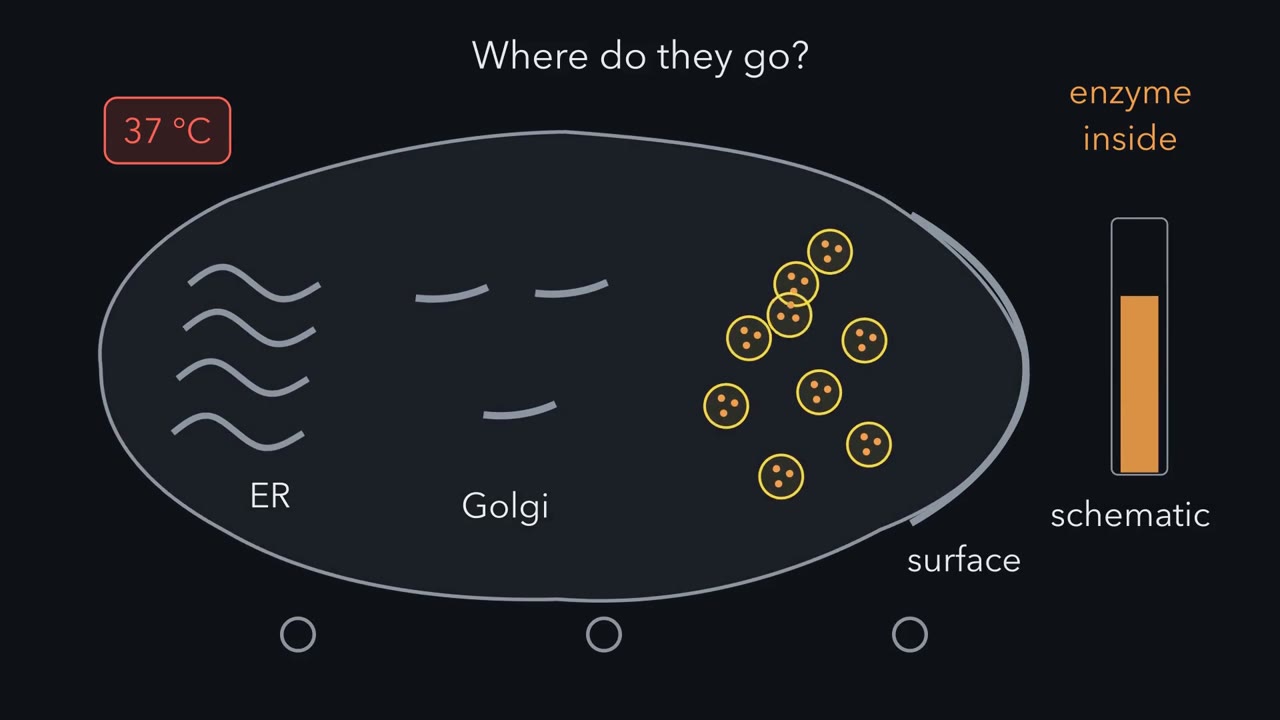
Chapter one followed a vesicle through three handoffs: bud, catch, fuse. But how did anyone put those handoffs in order? What can a pile of stuck cargo tell you? First, measure the block. Yeast secrete an enzyme called invertase. The fraction secreted is the enzyme outside the cell, divided by all of it. Is the trapped enzyme dead, or only waiting?
Return the cells to 25 °C, with new protein synthesis blocked. If the trapped enzyme moves outside, it was waiting to be delivered. At 37 °C, these secretion-blocked cells become dense. In 1980, Novick, Field and Schekman used that to enrich new mutants.
Electron microscopy then showed what each one piled up. Chapter one's rule applies here: on a linear route, cargo piles up in the last place it reached. In 1981, double mutants put the blocks in a broad order. Now a harder case. An enzyme called NSF resets SNAREs at many steps along the route. Where would a heat-sensitive NSF mutant pile up its cargo?
At its earliest blocked step. In classical sec18 experiments, ER and small ER-derived vesicles piled up, not late secretory vesicles. A pile shows where transport stops, not when or where else a protein acts. Test tubes add what a pile cannot. Cell-free assays mix donor and acceptor membranes with cytosol and ATP. Then each step can be timed, removed or rebuilt. Is catching enough to fuse? Yeast HOPS is a tether that binds the Rab Ypt7. Separate forms missing the beta propeller of Vps11 or Vps18 still tethered Ypt7-bearing lipid spheres. But they failed to promote fusion. So read stuck cargo in two ways. Where cargo stops gives the order; test tubes split catch from fuse.
A yeast mutant keeps making secretory enzymes at 37 °C but cannot release them. Which step of delivery broke, and how could you tell?
Continue in the lesson: Vesicle Budding, Targeting and Fusion →
2:31 · Free, with captions and a transcript. The lesson has the full text, the questions and the sources.
More films from this lesson
How this film was made. Narration: an AI narrator voice (Kokoro, af_heart) reading narration written from this lesson's text. Animation: AI-generated in code (Manim) by Claude, a schematic with no drawn molecular structures. Captions come from the narration script. See something wrong? Report it.