Three Handoffs for a Vesicle
Read the transcript of “Three Handoffs for a Vesicle”
Film transcript: Three Handoffs for a Vesicle
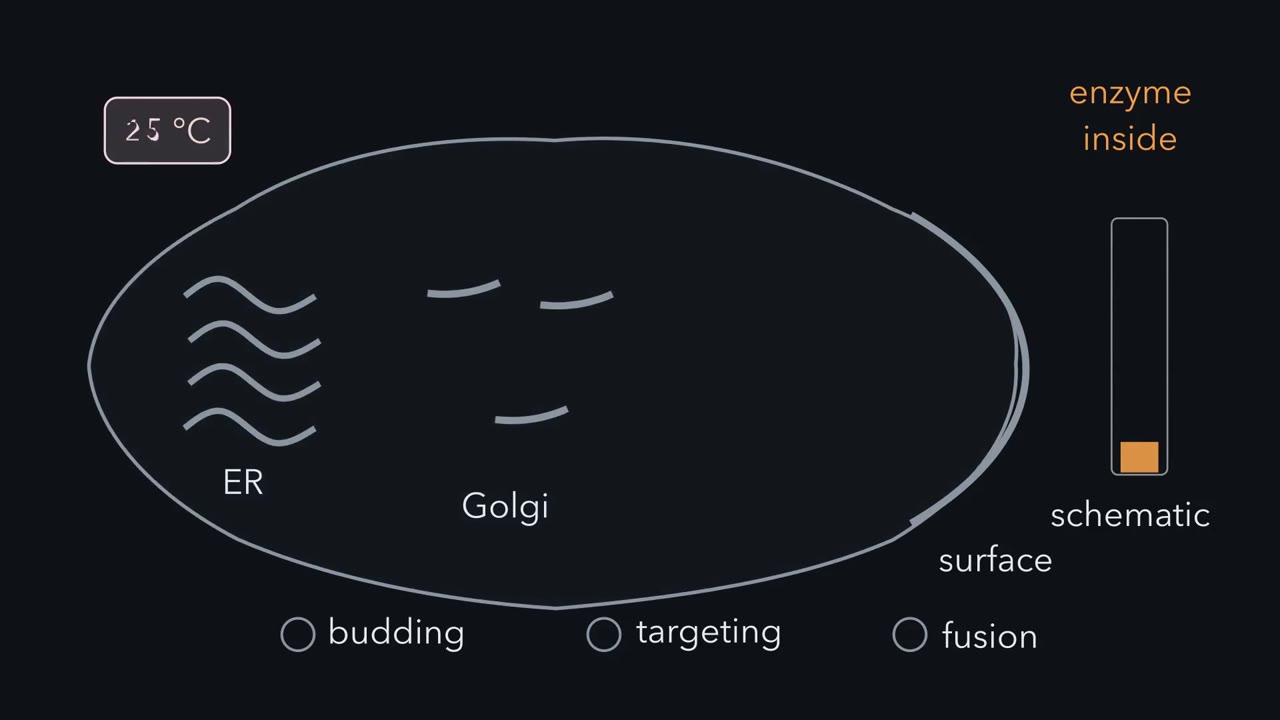
Where do the enzymes go? This yeast mutant keeps making them at 37 °C. But it releases little. Yeast secrete enzymes along a route: ER, then Golgi, then vesicles, then the cell surface. Small membrane spheres called vesicles carry the cargo. This mutant is called sec1. At 25 °C it grows and secretes. At 37 °C, its enzyme pool inside rises up to eightfold. The enzymes sit in membrane-bound vesicles that fail to fuse with the surface.
Back at 25 °C, with protein synthesis blocked, the cells secrete them. Every vesicle on that route has three jobs. Budding: pick up cargo and pinch off. Targeting: be caught by the right membrane. Fusion: merge with it. Back to sec1. For the last vesicle on the route, which job worked? And which could have failed?
Budding worked, because the vesicles exist. Targeting or fusion failed. A pile of vesicles alone cannot tell you which. Budding first. A coat of proteins assembles on a patch of membrane. Think of a cookie cutter with hands: it bends a bud and grabs the cargo. At the ER this coat is COPII. A switch called Sar1, holding GTP, pulls it on. When Sar1 hydrolyzes that GTP, the coat begins to let go. In a test tube, vesicles made with a GTP analogue that cannot be hydrolyzed still budded. But they kept their coat, and failed to target and fuse. Making a vesicle and delivering it are separate steps. Here is the one idea. A vesicle's trip is three handoffs, and each can fail on its own.
A coat buds it. A Rab and a tether catch it. SNAREs, guided by an SM protein, fuse it. Targeting next. A Rab is a small switch with a lipid tail. Holding GDP, it can be carried in the cytosol by GDI. At the right membrane, an exchange factor loads GTP, and the Rab holds on. Rab with GTP is one lit sign over a loading bay. It recruits tethers, which catch the vesicle. It is one sign among several. Fusion last. Two membranes resist merging, so SNARE proteins supply the pull. Four strands, called Qa, Qb, Qc and R, come from the two membranes. They zip into one rope, toward the membrane anchors. The zipping pulls the two bilayers together until they fuse.
The zip itself uses no ATP. In the main fusion steps studied, SNAREs also need an SM protein. It binds them and helps the right four zip together. Sec1 is the SM protein for the last step of secretion. That step is fusion of secretory vesicles with the plasma membrane. So at 37 °C, vesicles still bud and pile up. Back at 25 °C, Sec1 works again, and the stored vesicles fuse. But the pile alone never named fusion. A failed Rab, tether or SNARE for that step gives the same pile. Sec1's known job names it. On a linear route, cargo piles up in the last place it reached. Double mutants used that rule to put the steps in order. Test tubes add timing.
GDI, which pulls GDP-bound Rabs off membranes, blocks fusion when added at the start. What if it is added after vesicles dock? Its effect fades. Once vesicles had docked, fusion was no longer sensitive to GDI. A fast, specific inhibitor stops working once the state it targets is past. So each vesicle on this route relies on three separate handoffs: bud, catch, fuse. Any one can fail on its own. Where cargo stalls, and when an inhibitor stops mattering, help place the break.
A yeast mutant keeps making secretory enzymes at 37 °C but cannot release them. Which step of delivery broke, and how could you tell?
Continue in the lesson: Vesicle Budding, Targeting and Fusion →
4:58 · Free, with captions and a transcript. The lesson has the full text, the questions and the sources.
More films from this lesson
How this film was made. Narration: written from this lesson's text and read by an AI narrator voice (Kokoro, af_heart). Animation: AI-generated in code (Manim) by Claude, a schematic with no drawn molecular structures. Captions come from the narration script. See something wrong? Report it.