Reading Selection in a Population
Read the transcript of “Reading Selection in a Population”
Film transcript: Reading Selection in a Population
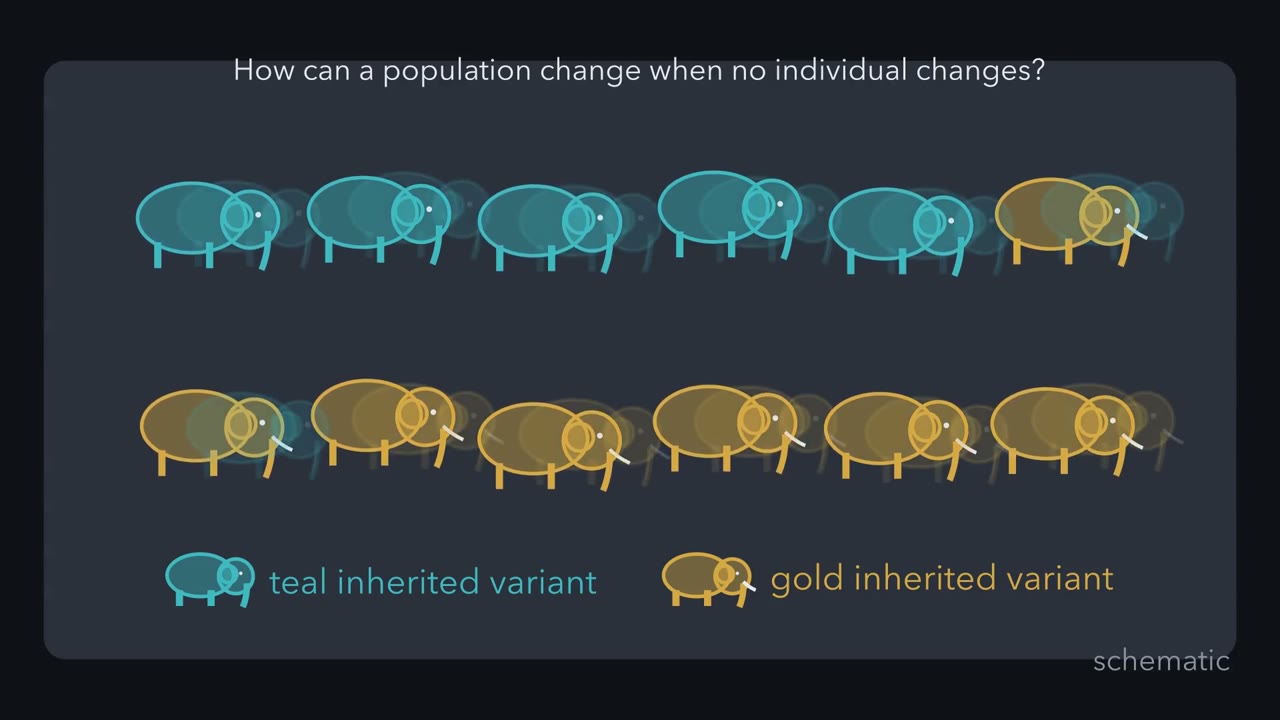
The first film followed inherited variants across generations. How can data show that selection, rather than chance, shaped a population shift? Return to the same teal and gold map, now tied to Gorongosa elephants. Teal marks tuskless females, and gold marks tusked females.
Historical film and photographs give the prewar group. Later sightings give the survivors. The bars use the reported group sizes and percentages. The teal share is higher among survivors. What changed? Did individual elephants lose tusks, or do the two groups contain different shares of elephants born with each trait?
Track two schematic animals between panels. A gold animal stays gold, and a teal animal stays teal. The survivor group contains more teal because tuskless females survived poaching more often. Ivory poaching was a selective pressure because it affected the variants differently. Tusked elephants were killed more often. The data support a change in the population's makeup, not a choice or transformation by elephants. A severe population crash can also change shares by chance.
Researchers modeled the crash with equal survival for tusked and tuskless females. The observed rise was far beyond what that chance model usually produced. Daughters born later kept tusklessness above the prewar share. That pattern fits an inherited trait and a response to selection. It still does not identify the exact allele or prove what happened to every elephant. Now widen the picture. Populations usually produce more young than their environments can support. A female blue crab carries an enormous egg mass. An elephant mother invests years in a calf. Most crab young die before reproducing. These are endpoints on a range, not two rigid boxes.
One strategy makes many young with less investment in each. The other makes fewer young with more care. Many species fall between them. For selection, count offspring that survive and reproduce. Strength, effort, and need are not the score. The conditions decide whether an inherited variant changes reproductive success. When inherited variations affect reproductive success, populations change across generations. In Gorongosa, the trait pattern, selective pressure, survival difference, and daughters all support that rule together. Before-and-after data show a pattern. The selective pressure, survival estimate, chance comparison, and later daughters make the selection explanation stronger.
Good evidence supports a claim while keeping its limits visible. Read the bars as population snapshots, not biographies. Read the filter as a comparison, not a promise. Then ask whether inherited differences changed who left the next generation.
How can a population change when no elephant changes the tusk trait she was born with?
Continue in the lesson: Variation and Survival →
3:40 · Free, with captions and a transcript. The lesson has the full text, the questions and the sources.
More films from this lesson
How this film was made. Narration: an AI narrator voice (Kokoro, af_heart) reading narration written from this lesson's text. Animation: AI-generated in code (Manim) by Claude, a schematic with no drawn molecular structures. Captions come from the narration script. See something wrong? Report it.