Which Channel, and What the Test Can Prove
Read the transcript of “Which Channel, and What the Test Can Prove”
Film transcript: Which Channel, and What the Test Can Prove
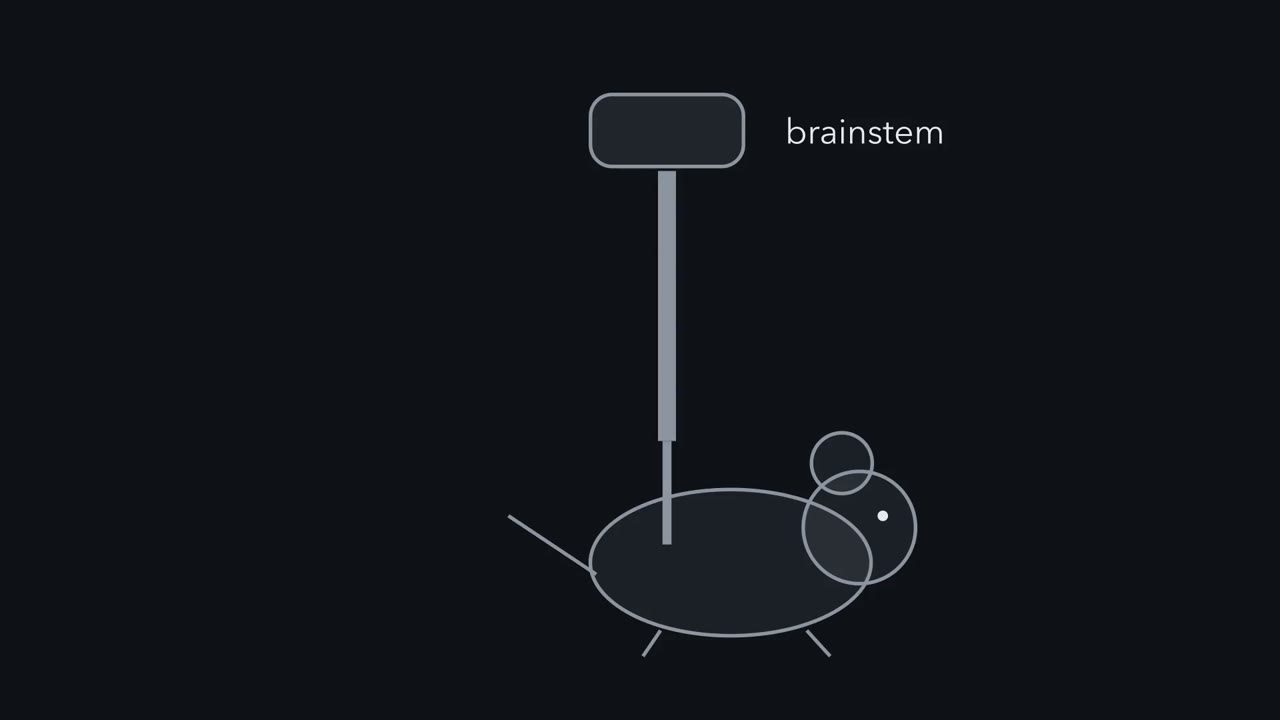
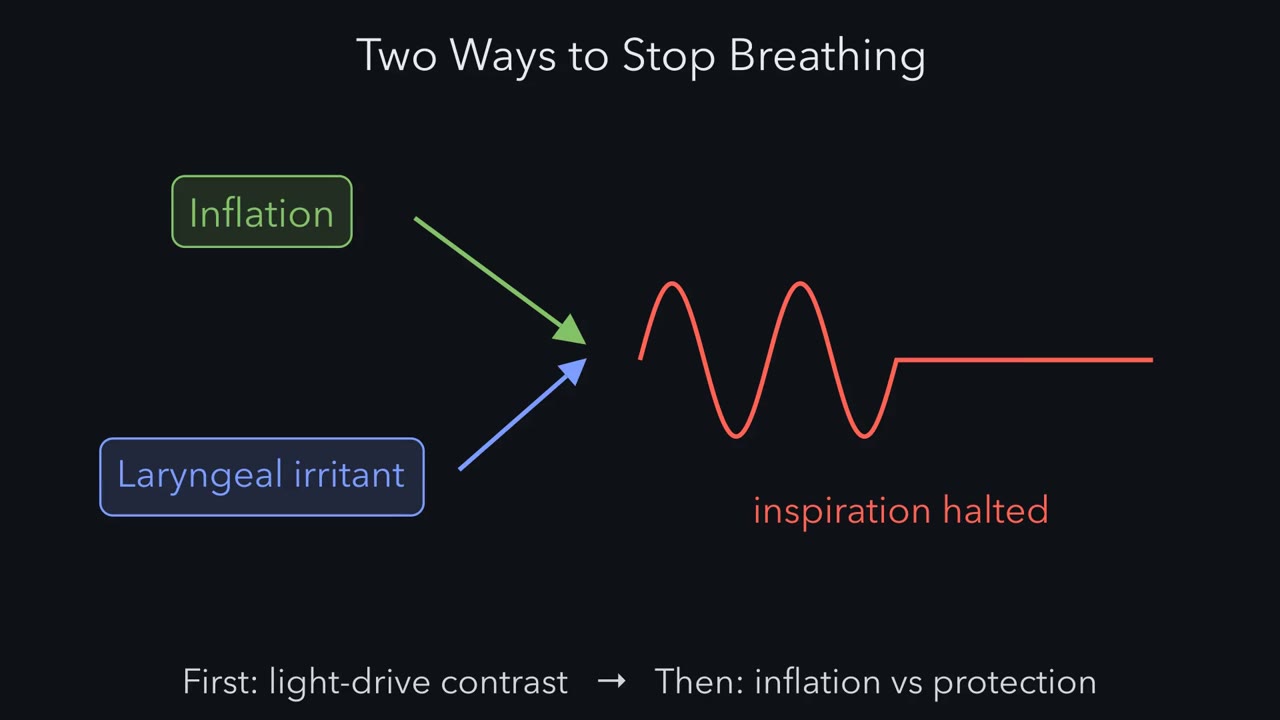
Stretch has to become electrical current somewhere. Which channel does that, and how would a deletion show it? This is the second question. Deleting a channel tests whether the reflex needs it. Showing that it converts force to current needs recordings. Force can open a mechanosensitive channel. Inward current depolarizes the terminal, and if it reaches threshold the afferent fires. Deleting Piezo2 in adult mouse sensory neurons impaired the lung inflation reflex. And driving Piezo2-positive vagal neurons with light caused apnoea. That uses Piezo2 as a handle. The artery was harder. The baroreflex is the reflex by which a rise in blood pressure slows the heart.
Channels were deleted from nodose and petrosal neurons. Blood pressure was raised with a drug in anaesthetized mice. Deleting Piezo one alone: no statistically detectable difference against littermate controls. Deleting Piezo two alone: no statistically detectable difference either.
Deleting both essentially abolished the drug-evoked baroreflex. The magnitude of its sensitivity fell from about five to under one beat per minute per millimetre of mercury. in conscious double knockouts, blood pressure in the active period was higher than in controls. The tempting reading is that every baroreceptor neuron carries both channels. Predict. Does that follow from these three rows?
It does not follow. Either picture could fit, if the input that remains can hold the reflex up. One possible explanation is a nonlinear relation between sensory input and the reflex. This curve is a hypothesis, not a measurement. On this chosen curve, halving the input costs one point two three. An illustrative cutoff is one point four one. Neither number tells you what the real experiment could detect. Losing all of it goes to zero on the curve, and the measured drop is easy to see.
So the experiment shows a collective channel requirement. It does not measure summed current, or prove coexpression inside a cell. Separating them needs identified baroreceptors. Measure channel expression and mechanosensitive current cell by cell, under controlled mechanical stimulation. The channels are required collectively in the targeted population. The result does not show that each neuron carries both.
Light on one set of vagal sensory axons stops an anaesthetized mouse breathing, and light on another set makes it breathe fast and shallow. What does each set report, and how would you know?
Continue in the lesson: Vagal Sensory Neurons: The Body Reports to the Brain →
2:52 · Free, with captions and a transcript. The lesson has the full text, the questions and the sources.
More films from this lesson
How this film was made. Narration: an AI narrator voice (Kokoro, af_heart) reading narration written from this lesson's text. Animation: AI-generated in code (Manim) by Claude, a schematic with no drawn molecular structures. Captions come from the narration script. See something wrong? Report it.