Where the Signal Runs Out
Read the transcript of “Where the Signal Runs Out”
Film transcript: Where the Signal Runs Out
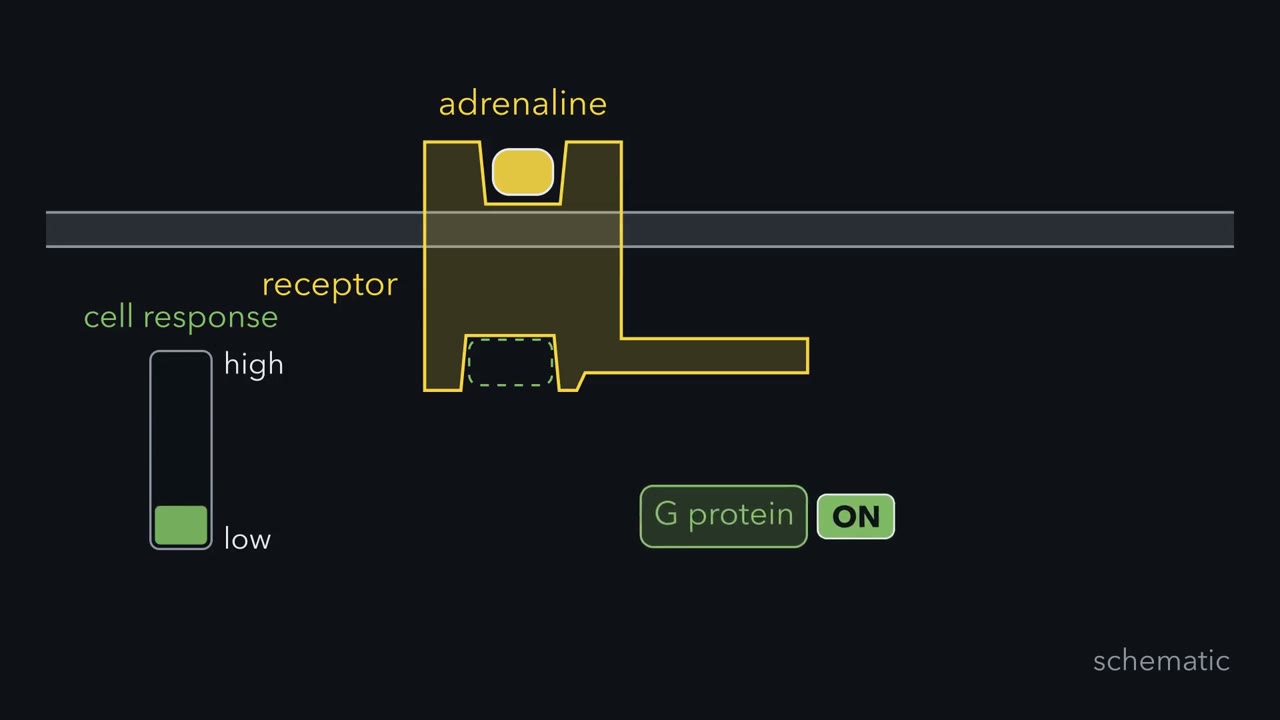
The first film stopped new G-protein activation with a mark and its reader. What ends the active signal already downstream? Each layer is an active pool with an input and an exit. Receptors produce active G proteins. Active G proteins help produce second messenger.
Messenger activates a kinase, which adds phosphate marks to targets. These pools overlap in time. Stopping new receptor output does not instantly erase GTP, messenger, or target phosphate already present. Each pool keeps changing until its own input and exit settle the balance. G-alpha carries GTP while active and hydrolyzes it to GDP. An RGS protein speeds that reaction for compatible G proteins.
Faster hydrolysis shortens the lifetime of the active green pool. A phosphodiesterase drains a cyclic-nucleotide pool by opening the messenger's phosphate ring. When synthesis and breakdown match, the pool holds steady. Slower breakdown makes the same input build a higher, longer-lasting pool. Now shut messenger synthesis off, then inhibit the drain. Can protecting the remaining messenger create a new signal?
No. No new messenger is made. An empty pool stays empty. Messenger already present is protected and decays more slowly. With continuing input, inhibition raises and prolongs the pool. The last pool here is phosphorylated target protein. A kinase adds each gold phosphate badge. A protein phosphatase removes it. The phosphorylated pool fades when removal overtakes new phosphorylation. If that phosphate activates the target, its activity fades too. Changing an exit changes both amplitude and timing. A narrow exit allows an active pool to accumulate. A wide exit keeps its level lower and clears it sooner after production stops. The same bookkeeping shapes time.
Under constant input, an active pool rises toward a balance. When input stops, removal makes it decay. A faster removal process lowers the balance and clears the pool sooner. Some systems also build a slower adaptive brake while stimulation continues. A gap can let that brake reverse.
Separated pulses offer recovery intervals that one steady input never provides. Separated pulses can preserve responsiveness because each gap allows recovery. Constant input gives no such interval. Pituitary responses to gonadotropin-releasing hormone show this contrast. In gonadotrope cells, the main adaptation appears to lie downstream of the receptor. Receptor uncoupling is therefore only one timer. GTP hydrolysis, messenger breakdown, and dephosphorylation set later timers. Each downstream layer fades when removal outruns production, and the slowest surviving layer can outlast the receptor's activity.
The hormone is still bound and the response has faded. What switched the receptor off?
Continue in the lesson: Turning the Signal Off: Arrestins, RGS Proteins and Phosphodiesterases →
3:53 · Free, with captions and a transcript. The lesson has the full text, the questions and the sources.
More films from this lesson
How this film was made. Narration: an AI narrator voice (Kokoro, af_heart) reading narration written from this lesson's text. Animation: AI-generated in code (Manim) by Claude, a schematic with no drawn molecular structures. Captions come from the narration script. See something wrong? Report it.