Films · Genetics and Molecular Biology
Two Ways to Start, Several Ways to Stop
Read the transcript of “Two Ways to Start, Several Ways to Stop”
Film transcript: Two Ways to Start, Several Ways to Stop
The first film followed strand choice into a growing RNA. Why do bacteria and nuclei use different teams to start that same reaction? Keep watching the promoter. The team assembled there decides where polymerase begins, and in the nucleus, which polymerase.
Both systems must solve the same physical jobs. They must recognize a promoter, place polymerase, open DNA, and start RNA. After productive synthesis, they must release the RNA and polymerase. The parts differ, but those jobs remain. In E. coli, core polymerase performs nearly all cellular transcription.
Core can join RNA nucleotides, but it finds promoters poorly. A sigma factor docks onto core, forming holoenzyme. Sigma recognizes promoter elements and positions the active site over the start. Imagine removing sigma while leaving core intact. Which ability fails most directly: joining RNA nucleotides, or starting accurately at promoters?
Accurate starting fails. Core remains catalytically capable, yet it chooses promoter starts poorly. Restore sigma, and the holoenzyme forms a closed complex. DNA then opens around the start. Short RNAs may be released before polymerase escapes into elongation. A eukaryotic nucleus divides transcription among its main polymerases. Pol I makes the large rRNA precursor.
Pol II makes mRNA precursors, most snRNAs, and microRNA precursors. Pol III makes tRNAs, a separate rRNA, and other small RNAs. Follow Pol II, the enzyme that makes mRNA precursors. General transcription factors assemble at its core promoter. Some recognize promoter DNA. Others position polymerase and help open the template. The classic sequence is useful, although living complexes exchange parts rapidly. Both lanes now converge on the same motion.
DNA opens, a green RNA begins, and polymerase escapes the promoter. The first film's direction rule still applies. Different proteins chose the start, but chemistry fixes how the RNA grows. Bacteria can end transcription through different routes. In one, the RNA folds into a hairpin followed by a U-rich tract.
Together they destabilize the complex. In another, Rho binds the RNA, advances toward polymerase, and promotes release. Pol II couples termination to RNA processing. After it copies a poly(A) signal, the RNA is cut. A following enzyme degrades the attached RNA toward polymerase. Evidence supports this pursuit working with changes that make polymerase ready to stop. Starting and stopping are therefore separate control problems. Initiation machinery chooses a usable start and places the enzyme. Termination signals and factors destabilize or remodel the elongation complex.
Between them, polymerase carries out the same directional chemistry.
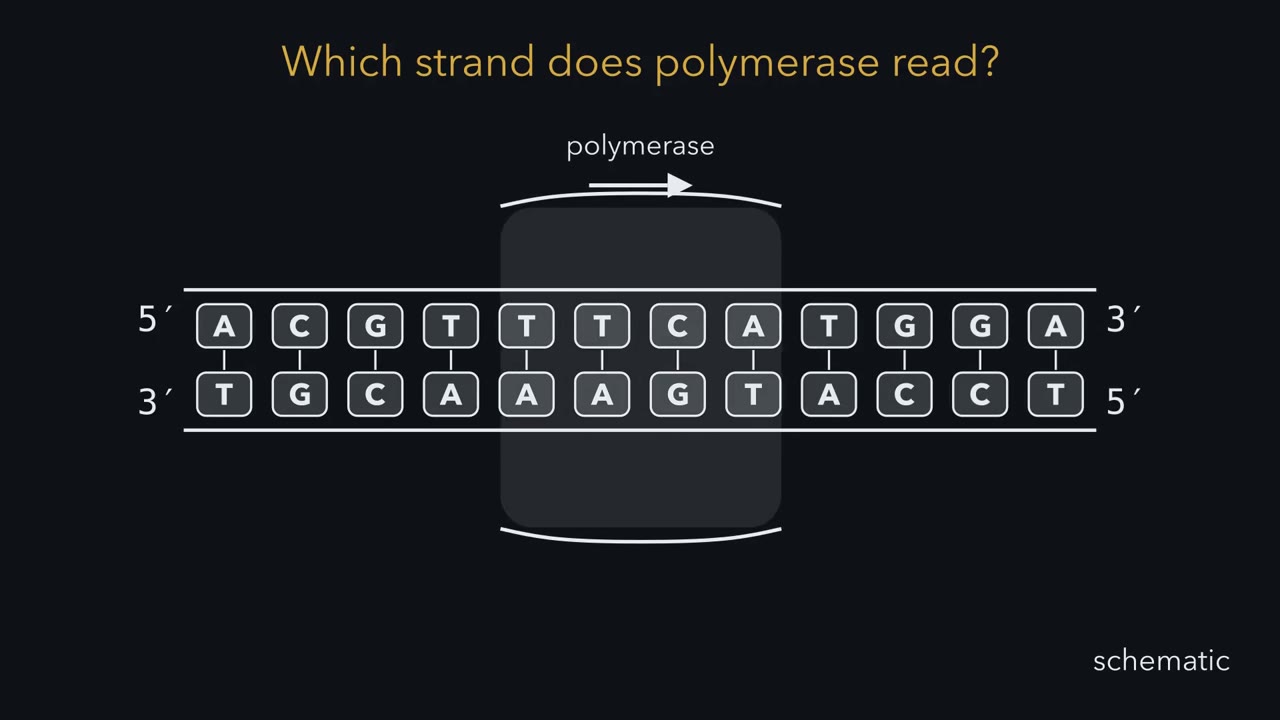
A gene has two DNA strands. What chooses which one the polymerase reads?
Continue in the lesson: Transcription: From DNA to RNA →
4:04 · Free, with captions and a transcript. The lesson has the full text, the questions and the sources.
More films from this lesson
How this film was made. Narration: an AI narrator voice (Kokoro, af_heart) reading narration written from this lesson's text. Animation: AI-generated in code (Manim) by Claude, a schematic with no drawn molecular structures. Captions come from the narration script. See something wrong? Report it.