One Touch Behaviour, Several Routes
Read the transcript of “One Touch Behaviour, Several Routes”
Film transcript: One Touch Behaviour, Several Routes
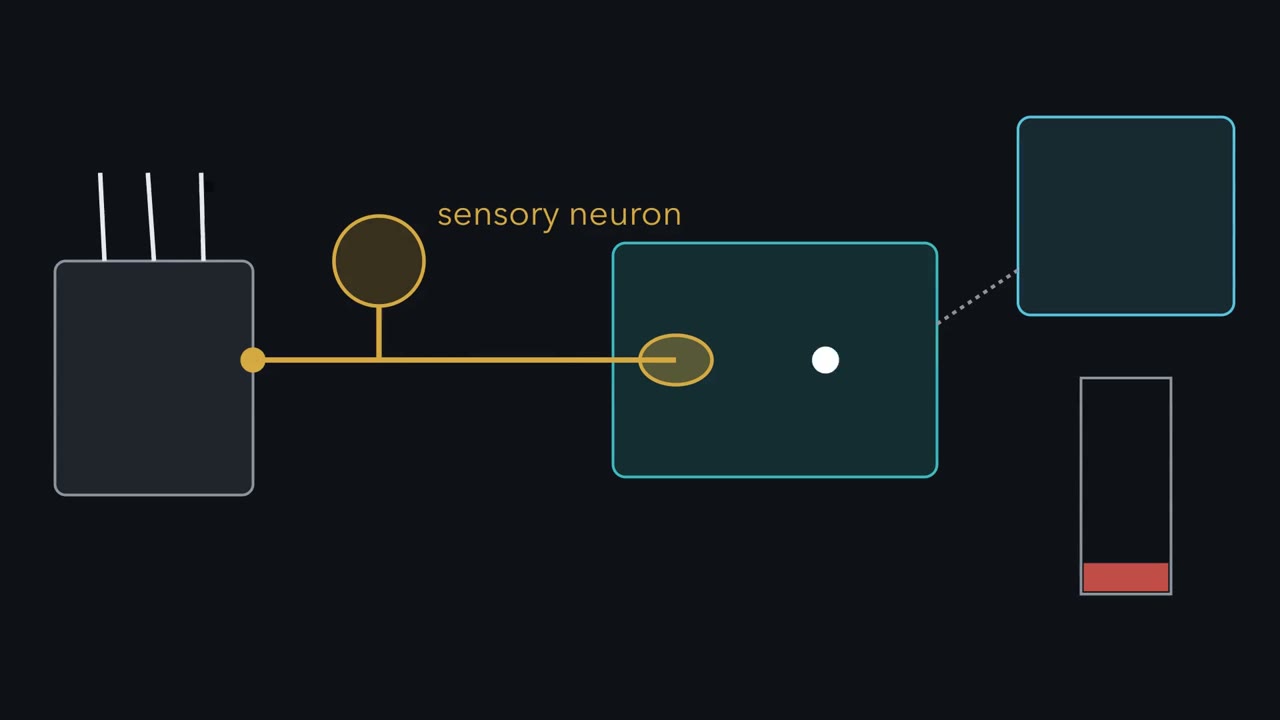
Chapter one located one contribution in the first touch neuron without making it the whole story. If several mice over-react to the same puff, did the same circuit defect cause it? Keep the colour map: gold sensory neuron, teal dorsal horn, blue brain. Start at the gold neuron's terminal inside the teal dorsal horn. In Mecp2 and Gabrb3 models, evidence supported reduced GABA-A-receptor-dependent presynaptic inhibition. Receptor-associated puncta fell, afferent-evoked quantal release rose, and dorsal root potentials shrank. Reset the pathway. The Shank3 model did not show that terminal GABRB3 change. Cultured large sensory neurons instead had reduced Ih and greater excitability.
The Shank3 model therefore reached a similar tactile endpoint through a different measured defect. The same tactile endpoint can arise from different defects in these mouse models. Mecp2 and Gabrb3 models support a reduced presynaptic GABA-A inhibition account. The Shank3 model instead showed reduced Ih and greater sensory-neuron excitability. Mechanism is only one axis.
Slide a timeline beneath four mouse-model lanes, from postnatal day four to adult testing. Every lane later shows a tactile abnormality. Must every adult tactile phenotype already be present at postnatal day four? No. Gabrb3 and Mecp2 loss-of-function pups were already more reactive at P4. Nlgn2 and Rorb mutants were not, although both showed tactile abnormalities as adults. Two sampled ages separate early from later onset, but do not identify the onset day. Nlgn2 also changed the locus. Deleting it from dorsal-horn neurons was sufficient for adult tactile alterations.
Emphasise the teal spinal block, not the gold afferent. Across these models, early reactivity tracked selected later behaviours, but that association did not prove causation. Locus, mechanism and developmental timing must be tested separately. A shared mouse movement cannot choose among them. Conditional genetics locates a sufficient contribution. Physiology tests a mechanism. Measurements at different ages map a schedule without turning association into a human developmental rule. The map explains why one endpoint cannot name its cause. It does not turn air-puff movement into perception, or mouse development into a human window. Those translation questions need their own measurements.
In one experiment, deleting a gene from peripheral sensory neurons, but not from the brain, was enough to change a mouse's behaviour in anxiety-like and social assays.
Continue in the lesson: Touch Over-reactivity in Autism Models →
3:23 · Free, with captions and a transcript. The lesson has the full text, the questions and the sources.
More films from this lesson
How this film was made. Narration: an AI narrator voice (Kokoro, af_heart) reading narration written from this lesson's text. Animation: AI-generated in code (Manim) by Claude, a schematic with no drawn molecular structures. Captions come from the narration script. See something wrong? Report it.