Delete Here, Learn Where
Read the transcript of “Delete Here, Learn Where”
Film transcript: Delete Here, Learn Where
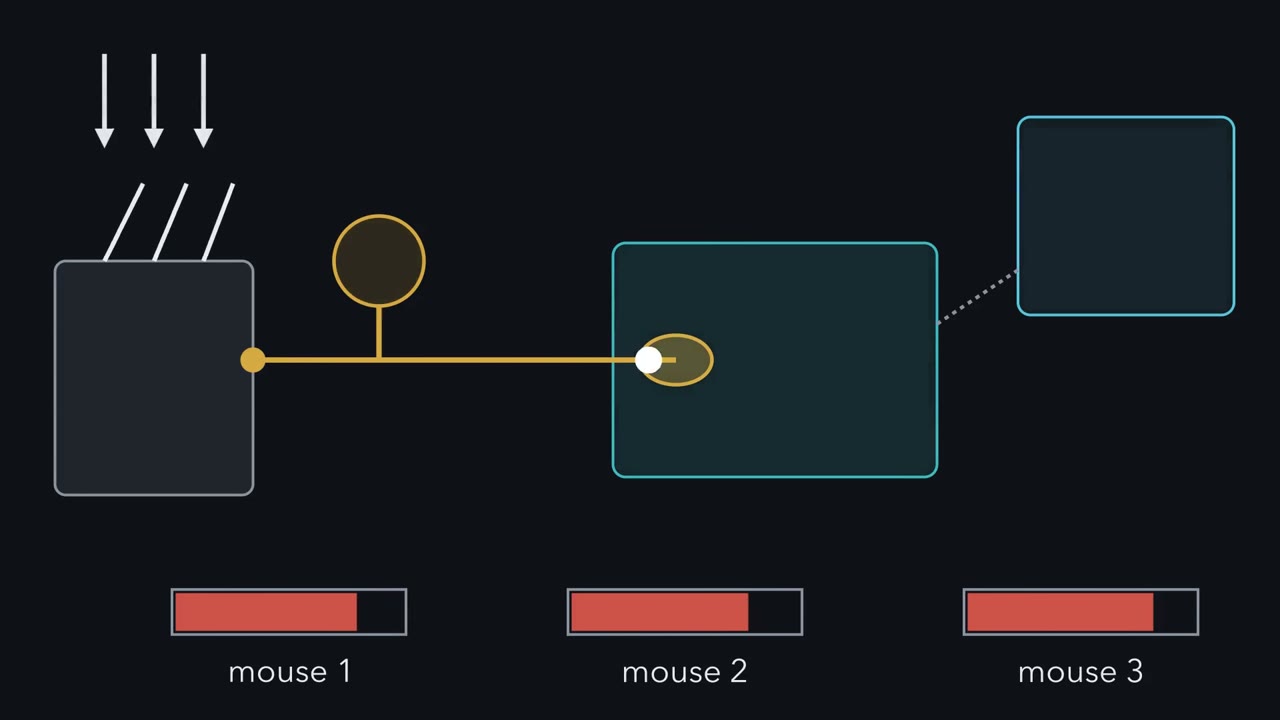
If the brain keeps its gene, can changing the first touch neuron still change a mouse's response? A gentle air puff bends hairs on the back. A gold sensory neuron carries the signal through a teal spinal cord toward a blue brain. The mouse's movement becomes our readout. In these mouse experiments, a fixed air puff measured movement, not perception. The puff stays constant while the movement gauge changes. That differs from a detection threshold. It also cannot tell us how the animal experiences touch. Now place a gene badge in every cell. Advillin-Cre removes a floxed gene from dorsal-root and trigeminal sensory neurons. The driver also reaches sympathetic ganglion neurons.
Resident spinal and brain cells keep their badges. The sensory neuron's central terminal does not. Deleting Mecp2 or Gabrb3 occurs only in that targeted population. The resident central nervous system copies remain intact. If the first neuron contributes to the measured outcome, what should happen after the restricted deletion?
The response became stronger. Texture discrimination and tactile prepulse inhibition also changed. Developmental deletion shifted selected anxiety-like and social-interaction assays. Gene loss in the Advillin-targeted population was sufficient for selected mouse outcomes. Sufficient does not mean exclusive. The reverse test started with an otherwise null mouse.
Researchers restored Mecp2 mainly in the Advillin-targeted population. Tactile sensitivity and selected anxiety-like and social measures shifted toward control. Lethality, memory deficits and motor deficits did not. Restoring Mecp2 mainly in that population rescued selected outcomes but left others unchanged. The rescue therefore draws a boundary around the claim. A peripheral sensory neuron can contribute to part of this mouse phenotype. It does not explain every feature, or establish the same mechanism in people. Now gather what those restricted tests earned. A restricted manipulation can locate one contribution without explaining the whole phenotype. Keep the full pathway in view, and ask exactly which cells each experiment changed.
This logic does not ask whether the brain matters. It asks whether one targeted population can move one measured outcome while other cells remain unchanged. The answer is bounded by the cells, assay, species and developmental schedule.
In one experiment, deleting a gene from peripheral sensory neurons, but not from the brain, was enough to change a mouse's behaviour in anxiety-like and social assays.
Continue in the lesson: Touch Over-reactivity in Autism Models →
3:15 · Free, with captions and a transcript. The lesson has the full text, the questions and the sources.
More films from this lesson
How this film was made. Narration: written from this lesson's text and read by an AI narrator voice (Kokoro, af_heart). Animation: AI-generated in code (Manim) by Claude, a schematic with no drawn molecular structures. Captions come from the narration script. See something wrong? Report it.