Films · Genetics and Molecular Biology
Do Crossovers Act Independently?
Read the transcript of “Do Crossovers Act Independently?”
Film transcript: Do Crossovers Act Independently?
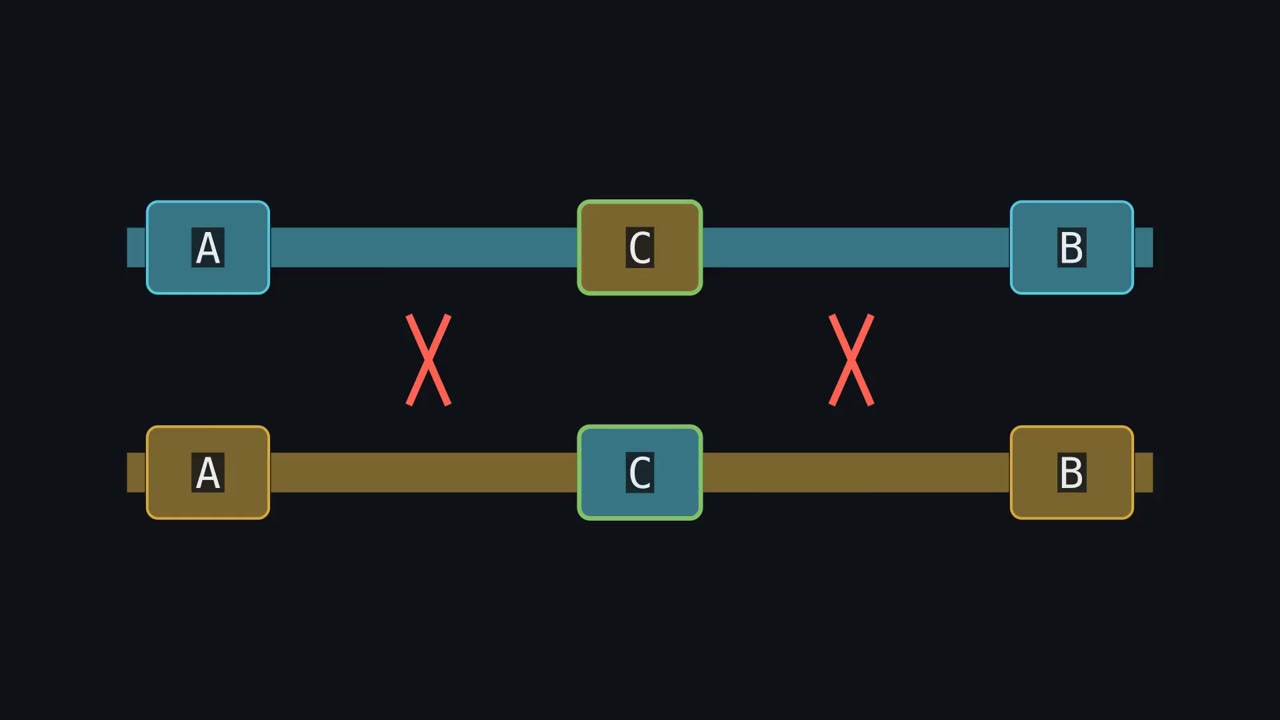
The first film used a middle marker to expose double crossovers. Do those doubles occur as often as independent intervals predict? Keep the same blue and gold chromosomes, green middle marker, and red crossover points. Treat a crossover in each interval as an event. Under independence, multiply the two interval frequencies to predict double crossovers. The product fills an expected bar, marked schematic. Now compare an observed bar from the offspring with that expectation. Suppose the observed bar is shorter. Does that mean positive or negative interference?
Fewer doubles appeared than independence predicted. That is positive interference: a crossover in one interval is associated with fewer in its neighbour. The chromosome picture shows association, not a molecular cause. The coefficient of coincidence is observed doubles divided by expected doubles. Interference is the complement of coincidence.
Keep the pair together: coincidence measures what appeared; interference measures the departure from independence. Three comparisons organize the signs. Observed below expected gives positive interference. Equal bars give no interference. Observed above expected gives negative interference, an excess of doubles. That has been reported in some fungal and phage crosses. No single value holds everywhere. Interference usually weakens as the intervals lie farther apart. Observed doubles then approach the independent expectation. So the measurement belongs to one pair of intervals in one organism, not to a whole species. One cross gives an estimate, not a law.
A zero observed bar may reflect strong interference, a small sample, or missing classes. Check survival and scoring, then collect more offspring before claiming complete interference. Doubles have answered one question: how crossovers are spaced relative to each other. A second question is where along the DNA they fall. Answering it needs a second ruler. A genetic map records crossover frequency. A DNA ruler records physical length. Align them, and their spacing can disagree. Crossovers are not spread evenly, so equal DNA lengths can have different genetic distances. In humans and mice, many crossovers cluster in hotspots. A hotspot is a short DNA stretch with more recombination than nearby DNA.
The text below explains how hotspot positions are chosen and why that scope is not universal. Maps also change with the gamete maker and chromosome region. Female and male maps can differ. Some regions suppress crossovers. These patterns move the genetic marks without moving the underlying DNA sequence. Return to the two bars. Their comparison turns a hidden event into a spacing test, with scope limited to this interval pair. Comparing observed and expected doubles reveals crossover spacing.
If two crossovers restore the outer genes' parental arrangement, how can offspring counts reveal them?
Continue in the lesson: Three-Point Crosses: Gene Order and Double Crossovers →
3:51 · Free, with captions and a transcript. The lesson has the full text, the questions and the sources.
More films from this lesson
How this film was made. Narration: an AI narrator voice (Kokoro, af_heart) reading narration written from this lesson's text. Animation: AI-generated in code (Manim) by Claude, a schematic with no drawn molecular structures. Captions come from the narration script. See something wrong? Report it.