Films · Genetics and Molecular Biology
The Marker in the Middle
Read the transcript of “The Marker in the Middle”
Film transcript: The Marker in the Middle
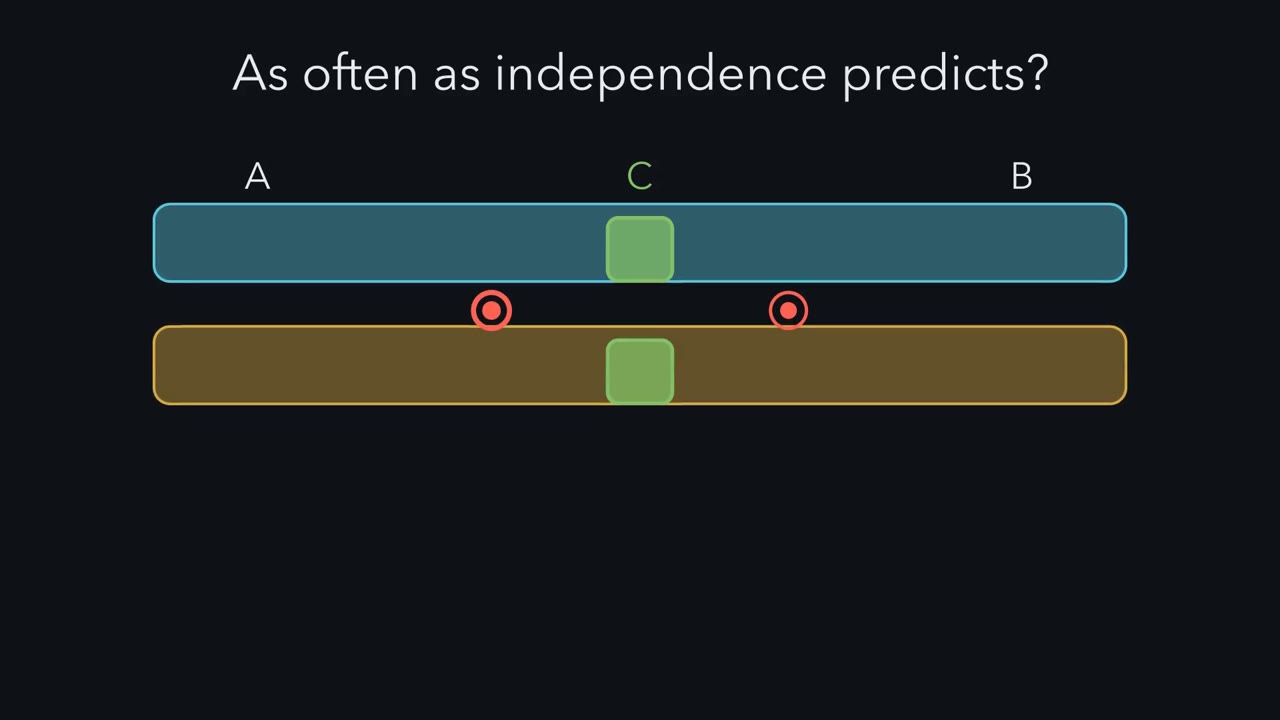
Two crossovers can leave the outer markers looking untouched. How can offspring reveal a chromosome that switched twice? Follow one blue chromosome and one gold chromosome. Each carries three marker blocks in the same order. A red crossover point swaps the chromosome tails. One crossover changes the outer-marker combination. A second swap can restore it. Now place a green marker between the outer markers. After two swaps, the outer colours again match a parental chromosome. The green middle marker does not. It records the hidden double crossover. Cover the middle marker, and the double-switch product looks parental. Uncover it, and the mismatch appears.
The chromosome did not change between views. The third observation changed what the cross could detect. A test cross turns these chromosome patterns into offspring classes. The recessive tester contributes the same alleles every time.
Therefore each offspring phenotype reports one gamete from the heterozygous parent. Eight possible gametes become eight bars. The largest pair is provisionally parental, with no detected crossover. Two middle pairs represent single crossovers. The smallest pair is provisionally double crossovers. Rarity is a clue, not proof. Here are two parental patterns and two rare patterns from a schematic cross. Which marker must be in the middle?
Compare each rare pattern with the parental it resembles most. Only marker C differs in each matched pair. So C belongs in the middle, even though it is written last. The changed marker decided the order, not the written order. Unequal survival could still make another class unusually small. Move the changed marker into the centre, then rewrite every class in map order. Each single-crossover pattern now changes colour in one interval. Each double changes in both intervals. The class list has become a map. Count each single crossover in its own interval. Count every double crossover in both intervals, because each double crossed both. Divide each interval count by the total offspring, and express it in centimorgans.
The two adjacent distances then add along the map. Hide the green marker again. Both swaps restore the outer parental combination, so those doubles vanish from a two-point count. The map becomes too short. The middle marker is the witness that prevents that loss. This works when the classes are scorable and adjacent intervals are short. Long intervals can hide more.
Rarity is a clue, not proof. Check that rare classes survive and form a reciprocal pair. A middle marker makes double crossovers visible.
If two crossovers restore the outer genes' parental arrangement, how can offspring counts reveal them?
Continue in the lesson: Three-Point Crosses: Gene Order and Double Crossovers →
3:35 · Free, with captions and a transcript. The lesson has the full text, the questions and the sources.
More films from this lesson
How this film was made. Narration: written from this lesson's text and read by an AI narrator voice (Kokoro, af_heart). Animation: AI-generated in code (Manim) by Claude, a schematic with no drawn molecular structures. Captions come from the narration script. See something wrong? Report it.