Three Brakes on a Strong Signal
Read the transcript of “Three Brakes on a Strong Signal”
Film transcript: Three Brakes on a Strong Signal
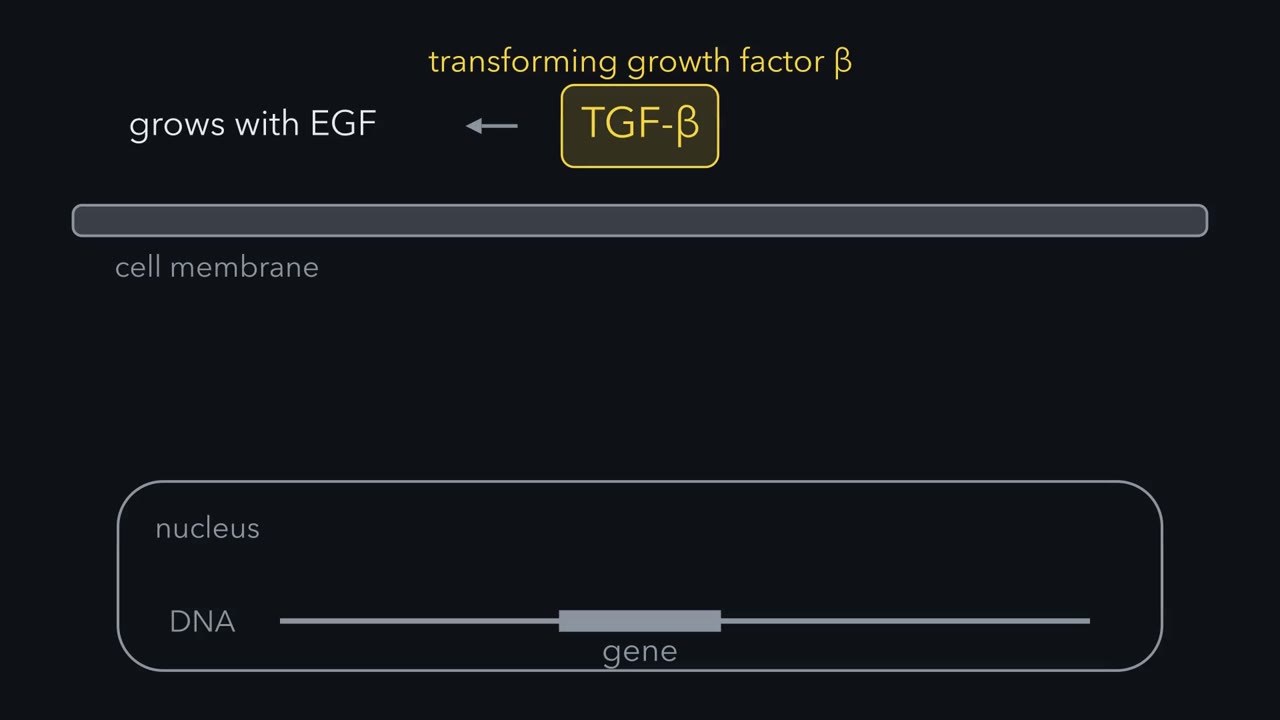
A signal this strong has to be kept off most of the time. First brake: the ligand is stored locked. TGF-β is secreted still wrapped in the front part of its precursor chain. It stays bound and covers the surfaces receptors need. It is usually tethered to the extracellular matrix. For example, a cell's integrins can pull on the wrapper, or a protease can cut it. Active ligand is released locally. Second brake: the signal makes its own inhibitor. One of the genes that Smads switch on encodes Smad7. Smad7 binds the active type I receptor, and keeps the receptor's Smads away. That is negative feedback. Third brake: the parts are destroyed. Smad7 brings ubiquitin ligases called Smurfs to the receptor.
Smurfs tag the receptor, and some Smads, with ubiquitin for destruction. Scott Kern's laboratory found Smad4. It is inactivated in about half of pancreatic cancers. Mice made without the myostatin gene, in Se-Jin Lee's laboratory, have muscles two to three times the normal weight. In fibrodysplasia ossificans progressiva, muscle and connective tissue turn to bone. Nearly all patients with the classic form carry the same one amino acid change. It sits in the GS domain of a BMP type I receptor.
Why does the protein that tells healthy cells to stop dividing end up helping late tumours?
Continue in the lesson: TGF-β and Smads →
1:48 · Free, with captions and a transcript. The lesson has the full text, the questions and the sources.
More films from this lesson
How this film was made. Narration: an AI narrator voice (ElevenLabs, Sarah) reading narration written from this lesson's text. Animation: AI-generated in code (Manim) by Claude, a schematic with no drawn molecular structures. Captions come from the narration script. See something wrong? Report it.