Films · Developmental Neuroscience
The Focal Block
Read the transcript of “The Focal Block”
Film transcript: The Focal Block
If starting size alone does not decide, what does? Is it silence, or being quieter than a neighbour? In newborn rat muscle, blocking nerve impulses with tetrodotoxin slows elimination. Chronic electrical stimulation, with some patterns, speeds it up. So activity sets the pace. But these tests changed every input at once. They could not say whether a quiet input is lost because of its neighbours. Two rules were left to separate. Rule one. A silent synapse is removed. Rule two. A synapse is removed when it is less active than nearby synapses, if enough of them are active. To tell them apart, silence part of one junction, and leave the rest working.
Alpha-bungarotoxin, the snake toxin from the imaging, binds acetylcholine receptors almost irreversibly. It blocks each one it binds. Where it sits, the muscle stops responding. The axon above is untouched. So quieter here means the muscle responds less. In a living mouse, put toxin on one small patch of one endplate. At a second endplate, cover every receptor. Predict. Over the following weeks, what does each rule say will happen at each junction?
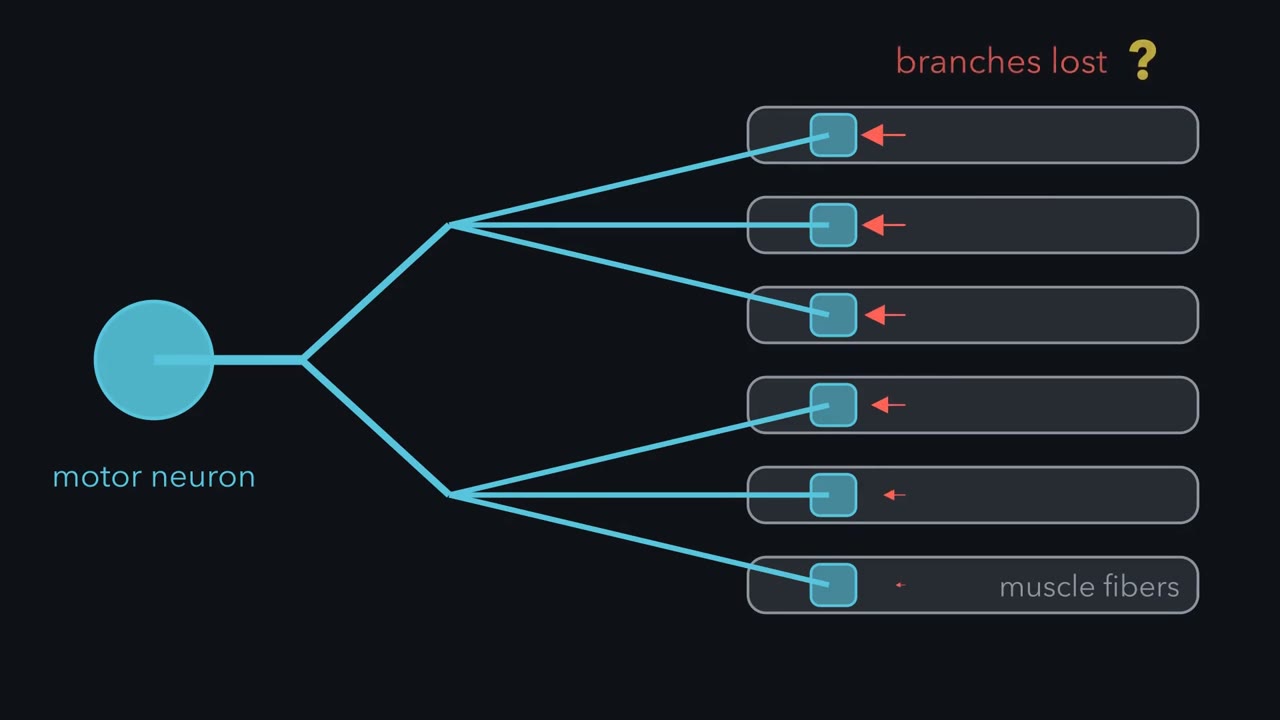
Rule one predicts loss at both junctions. Both have silent sites. Rule two predicts loss only at a partial block, where a small silent patch sits beside a larger working area. In 1994, Rita Balice-Gordon and Lichtman reported the result. At the partial block, the patch lost its receptors, and the nerve terminal withdrew from it. At the full block, nothing was eliminated.
At the full block, every site is equally silent. No site is quieter than its neighbour. Rule two wins. the loss stayed inside the patch. The signal behind it, and how far it travels, were not identified. The amount of active territory mattered. A large active area removed a small silent one. A small active area could not. The loss happened where the toxin was put. So a local difference in activity directs which sites go. Lo and Poo built the smallest contest, in cultures from the frog Xenopus. Two spinal neurons shared one muscle cell. A burst to one neuron immediately weakened the other's synapse. Predict. What if both neurons get the burst together?
The suppression was largely absent. Neither input was left quiet while the other was driven. This is heterosynaptic depression, a weakening within minutes. It fits rule two, but it is not removal of a synapse. For two whole axons, mice had one of two inputs made weaker. The more powerful inputs were strongly favoured. Still, it is a bias, not a verdict.
What carries the message is still open. In one model, the muscle punishes inactive sites and protects the active one. Without one form of PKC, elimination in mice is delayed, but it still completes. Mice lacking BDNF or p75 eliminate synapses on schedule. So none of these is yet shown to be the indispensable signal. So silence alone does not remove a synapse. Being quieter than its neighbours puts it at risk.
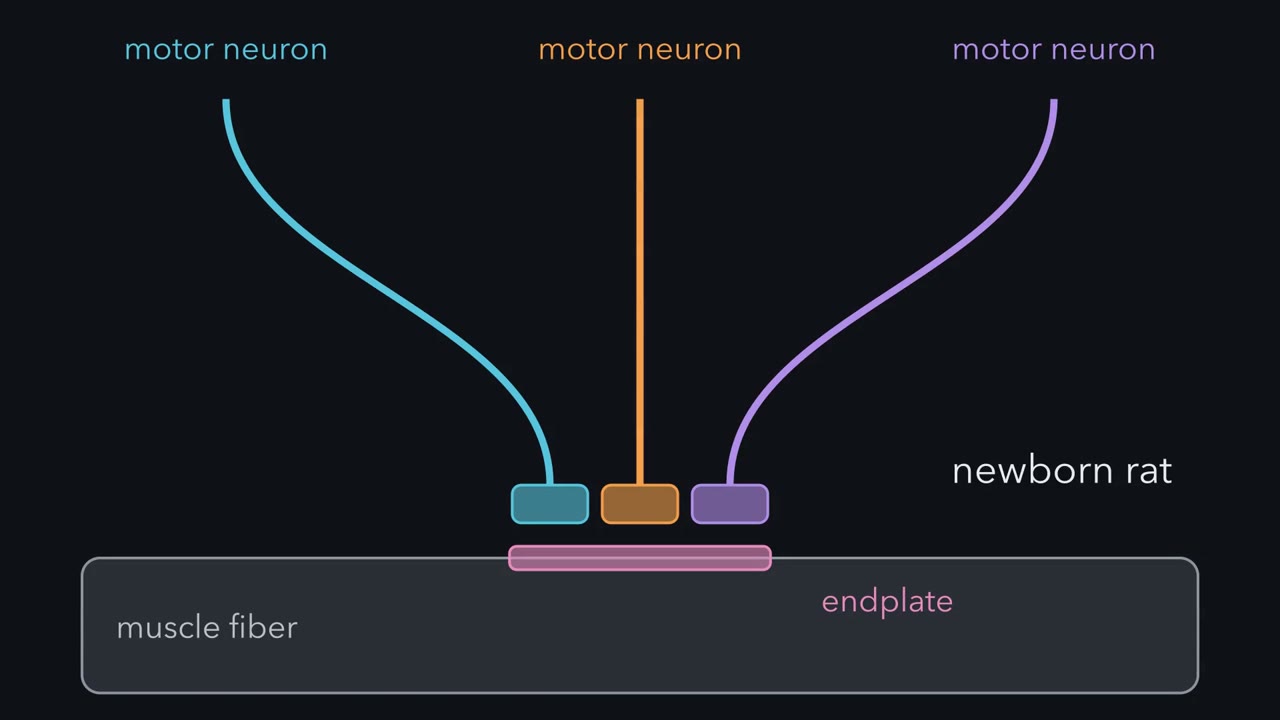
A newborn rat muscle fiber has two or more motor axons on one synapse, and every one of them works. Within weeks all but one are gone. What decides which one stays?
Continue in the lesson: Synapse Elimination: One Muscle Fiber, One Axon →
4:02 · Free, with captions and a transcript. The lesson has the full text, the questions and the sources.
More films from this lesson
How this film was made. Narration: an AI narrator voice (Kokoro, af_heart) reading narration written from this lesson's text. Animation: AI-generated in code (Manim) by Claude, a schematic with no drawn molecular structures. Captions come from the narration script. See something wrong? Report it.