Films · Developmental Neuroscience
Quieter Than Its Neighbour
Read the transcript of “Quieter Than Its Neighbour”
Film transcript: Quieter Than Its Neighbour
A newborn rat muscle fiber is wired to two or more motor neurons. Every one works. Within weeks, all but one are gone. What decides which stays? Each extra input releases acetylcholine and evokes an electrical response in the fiber. Nothing is wrong with them. Then they are removed. How do you count them? Put an electrode inside one fiber, and slowly turn up the stimulus to its nerve. Each axon in the nerve has its own threshold. It fires only once the stimulus passes that level. Predict. If three axons reach this fiber, what does the response look like as the stimulus rises?
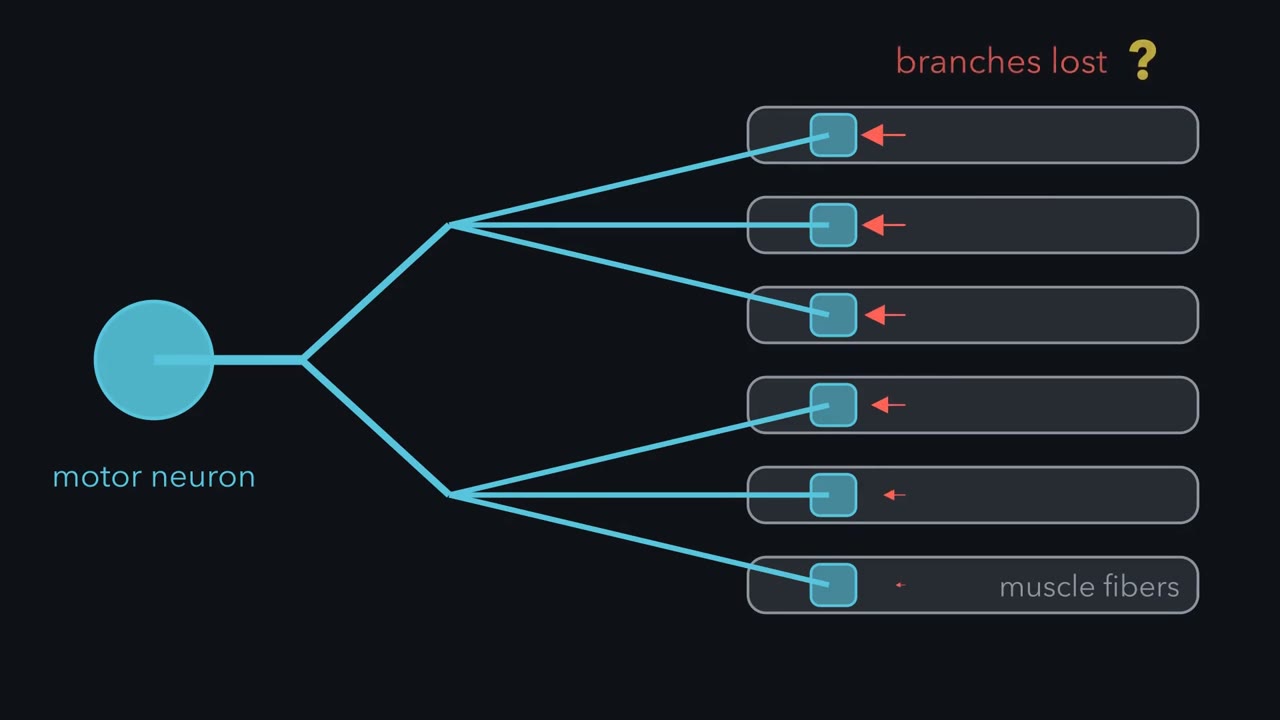
A staircase. Each threshold crossed adds one step. Three distinct steps mean three axons. One axon gives one step, at its own threshold. One action potential ordinarily reaches all its release sites at once. In 1970, Redfern did this in newborn rat diaphragm. Most responses at birth had two to four steps. By 16 to 18 days, single steps. So did the extra axons' motor neurons die? Two measures tell these apart. Count the motor neurons, and measure one motor unit's share of the twitch. A motor unit is one motor neuron and all the fibers it supplies. A twitch is the muscle's brief contraction to one impulse. Predict. If every fiber gives similar force, what happens to one unit's share if neurons die? And if they live?
If neurons died, and the survivors still reach every fiber, each keeps its fibers, so its share stays the same. If neurons live and trim branches, the count holds. Each unit's share falls. This assumes the muscle does not gain many fibers. In 1976, Brown, Jansen and Van Essen measured both, in rat soleus muscle. Each unit's share of the twitch fell sharply. The number of motor neurons did not change significantly. The neurons lived, and their branches went. Synapse elimination is branch loss, not neuron death. Here is the idea we will test through this lesson. A synapse is not removed just for being quiet. What puts it at risk is being quieter than its neighbours at the same junction.
The idea says which input goes. Overall activity sets how fast. Silence slows it, and some patterns of stimulation speed it. Quieter seems to mean weaker transmission, as the muscle sees it. And it is a bias, not a verdict. So the neurons stay, and each fiber holds a contest.
A newborn rat muscle fiber has two or more motor axons on one synapse, and every one of them works. Within weeks all but one are gone. What decides which one stays?
Continue in the lesson: Synapse Elimination: One Muscle Fiber, One Axon →
3:12 · Free, with captions and a transcript. The lesson has the full text, the questions and the sources.
More films from this lesson

How this film was made. Narration: an AI narrator voice (Kokoro, af_heart) reading narration written from this lesson's text. Animation: AI-generated in code (Manim) by Claude, a schematic with no drawn molecular structures. Captions come from the narration script. See something wrong? Report it.