Films · Developmental Neuroscience
Switch It Back On
Read the transcript of “Switch It Back On”
Film transcript: Switch It Back On
A circuit formed without one protein. Switch the protein on in an adult. Can that undo the damage? Rett syndrome puts this to the test. Girls with it seem to develop typically for many months. Then they lose purposeful hand use and speech. Most cases come from mutations in one gene, MECP2, on the X chromosome. Its protein binds methylated DNA, and is thought to help set the level of many genes.
Mice lacking the gene appear typical for several weeks. Then they develop tremor, breathing changes and reduced movement. Their neurons do not die in large numbers. They are smaller, with simpler dendrites. In 2007, Jacky Guy, Adrian Bird and colleagues built mice in which the gene is silent. A blocking sequence silences it. The mice also carry an enzyme, Cre. Cre enters the nucleus only after the drug tamoxifen is given. Then it cuts out the block.
Predict. If the circuit was built wrong for good, what does restoring the protein in a sick adult do? And if it only needs the protein to run? Many symptoms reversed, in young adult mice and in older adult mice. In typical mice, tamoxifen did nothing.
So circuits that formed without the protein can work again once it returns. That does not show their development was normal. Now the other test. In 2011, Huda Zoghbi's laboratory deleted the gene in adult mice. They developed symptoms like those of mice that never had it. The protein is needed continuously. Both late tests point the same way. The adult circuit still needs this protein. A building role is not ruled out. The balance of excitation and inhibition shifts too, and in one brain it runs both ways. The forebrain tends to be underactive. The brainstem tilts toward excitation.
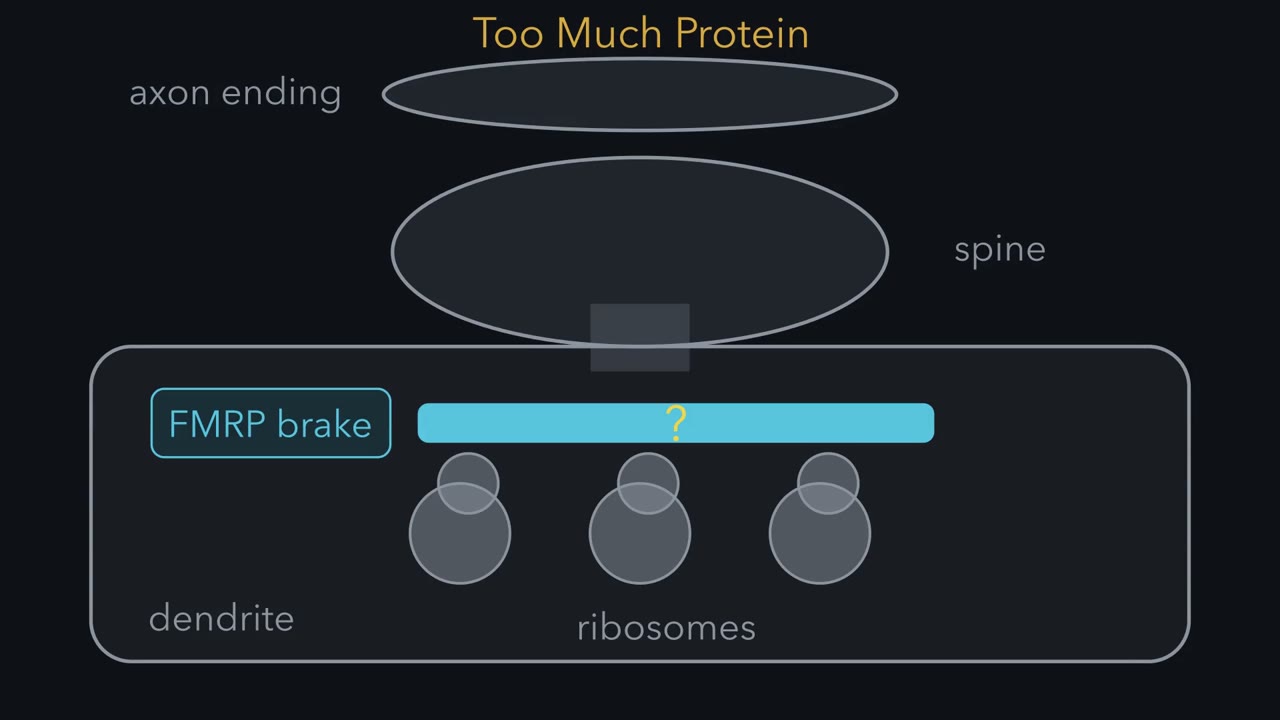
One limit. This is a mouse result. Whether it holds for an older person is not known. A second limit. The dose matters. Too much of this protein causes a separate syndrome in males. Takeaway: some traits can still be reversed, and some proteins are still needed in adults. The late tests ask both questions.
Switch a silenced gene back on in adult mice that already have symptoms, and many of the symptoms fade. If a circuit was built without a protein, is it wrong for good?
Continue in the lesson: Disorders of the Synapse: Built, Then Kept →
2:57 · Free, with captions and a transcript. The lesson has the full text, the questions and the sources.
More films from this lesson
How this film was made. Narration: an AI narrator voice (Kokoro, af_heart) reading narration written from this lesson's text. Animation: AI-generated in code (Manim) by Claude, a schematic with no drawn molecular structures. Captions come from the narration script. See something wrong? Report it.