Why Succession Stays Open
Read the transcript of “Why Succession Stays Open”
Film transcript: Why Succession Stays Open
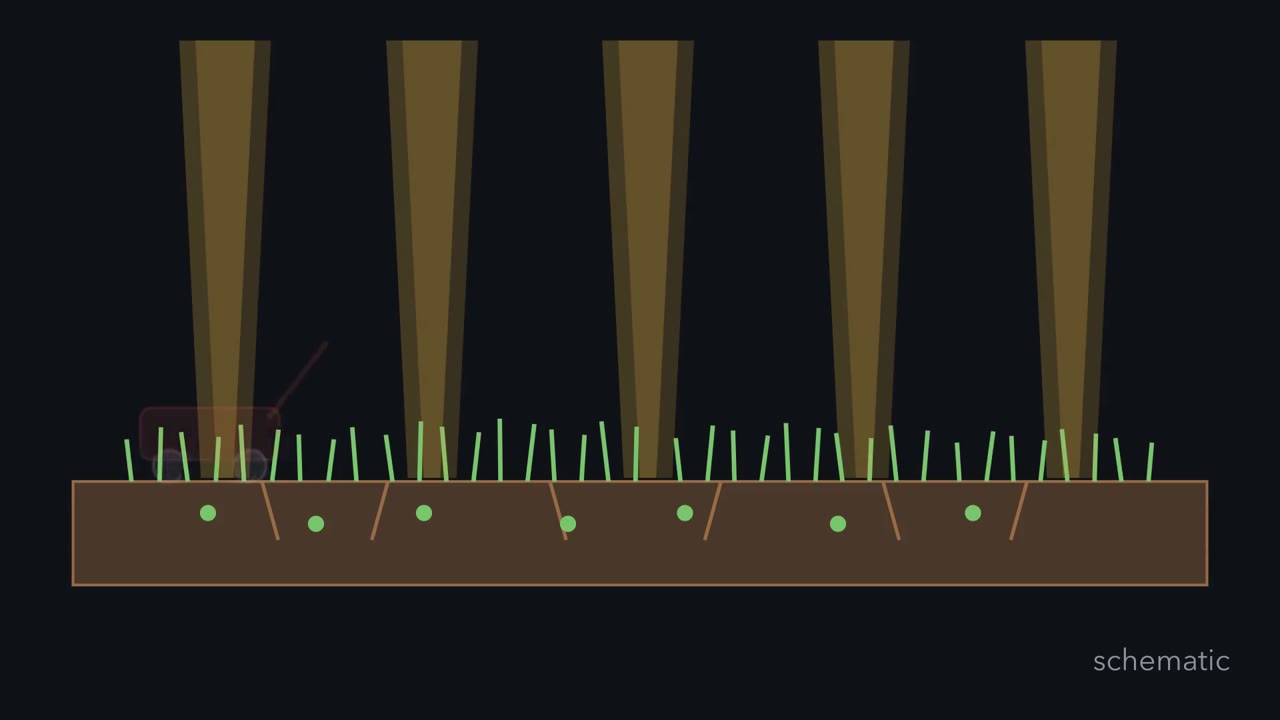
The first film followed plants changing the conditions around them. Why does a whole landscape rarely settle into one single final stage? Pull back from that field until the whole Virginia landscape fills the frame. Different patches carry different histories. A storm opens one canopy gap. Floodwater covers another patch. Fire crosses a third. People keep mowing one field. Each disturbance removes organisms differently, and each leaves different soil, roots, and seeds. Compare an unbroken canopy with the new storm gap. Which patch will receive more light at ground level? Watch the two light meters, then make your prediction.
The gap meter rises. Saplings already waiting below grow faster in the bright opening, while older trees remain around it. The forest now holds stages side by side. A disturbance can redirect part of succession without resetting the whole landscape. Storms, insects, floods, fires, and people keep making new starting points. Some patches change quickly. Others remain similar for decades.
Together they form a moving patchwork, not one community marching toward a shared finish line. Older models called a fairly stable late stage the climax community. For most of Virginia, that model names oak-hickory forest. It remains useful as a prediction. It is not a claim that forests stop changing. Without fire, shade-tolerant red maple can replace oaks in many eastern stands. Elsewhere, disturbance may favor certain species. The result depends on the disturbance, nearby organisms, and the conditions that remain. How can ecologists tell whether a path is common? One source presents a regional summary. It sketches the usual Piedmont route from old field to forest.
That summary gives a pattern, not one field's dated history. Another source marks one permanent plot and returns to the exact place. At Glacier Bay, resurveys found that plots did not share one timetable. Early arrivals sometimes held later plants back. One plot gives detail, not a universal schedule. Use each source for the claim it can support. A regional summary describes a broad tendency. A dated plot tests what happened at one place. Agreement can strengthen the model.
Differences reveal where its scope must narrow. Succession also changes biodiversity, the variety of living things in an area. A species count can rise or fall between stages. Scientists must name the measure and the patch they sampled before comparing results. Do not ask only, What stage comes next? Ask what changed, what remained, and what evidence tracks the change. This connects succession to causes while leaving room for different routes.
If you stopped mowing a field in the Virginia Piedmont and walked away for a hundred years, what would be standing there when you came back?
Continue in the lesson: Succession in Virginia →
3:37 · Free, with captions and a transcript. The lesson has the full text, the questions and the sources.
More films from this lesson
How this film was made. Narration: an AI narrator voice (Kokoro, af_heart) reading narration written from this lesson's text. Animation: AI-generated in code (Manim) by Claude, a schematic with no drawn molecular structures. Captions come from the narration script. See something wrong? Report it.