What Keeps a Cell a Stem Cell?
Read the transcript of “What Keeps a Cell a Stem Cell?”
Film transcript: What Keeps a Cell a Stem Cell?
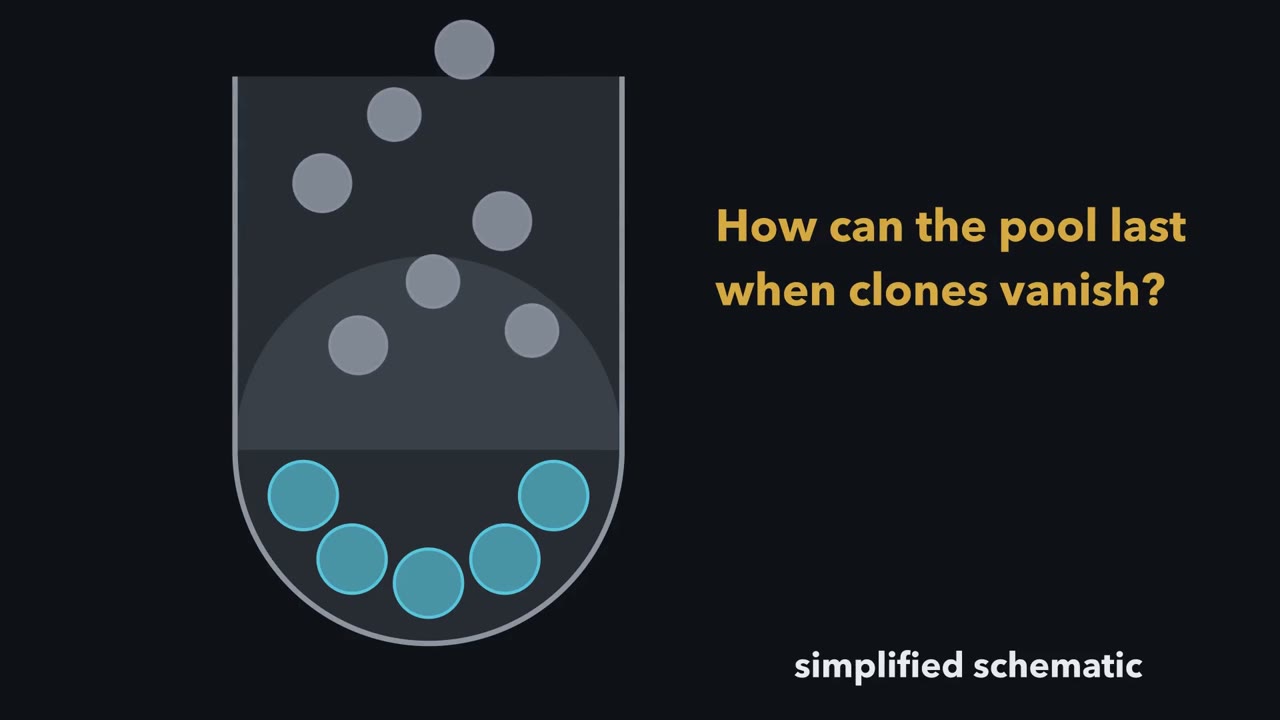
What keeps a cell in the stem-cell state? Chapter one showed a pool that lasts while its clones come and go. But the crypt base held only a few positions. What limits them? Watch the same crypt, now with its signals drawn in.
Start with the neighbourhood. A stem-cell niche is the local environment around stem cells. Its contact and signals bias whether a daughter keeps a stem-cell position or differentiates. In the mouse gut, Paneth cells in the lining and stromal cells beneath it both contribute. Two kinds of signal run in opposite directions.
Wnt is strongest at the crypt base and promotes self-renewal. R-spondin, EGF and Notch also support the base. BMP is strongest higher up, among differentiated cells, and it suppresses self-renewal. During cell turnover, a blue stem cell is displaced upward, away from the strongest Wnt. What do you expect it to do?
As cells move up, they become more likely to leave the stem-cell state. Less Wnt reaches them, and more BMP. The cell that remains at the base keeps its support. So the positions are limited because the support is local. Here is the key idea. In the mouse gut, being a stem cell looks less fixed. It looks more like a state that local signals support.
Chapter one's clones competed for places inside that support. A winner holds a place, not a permanent title. A dish tests how much surroundings matter. Single sorted Lgr5 cells grew into organoids with matrix and added factors. Organoids are crypt-villus structures grown in culture. They could be replated repeatedly. No stromal cells were present; the matrix and factors supplied a niche. If the state depends on support, a harder question follows. Could a cell that has already left the base come back? Injury tests that, when the usual stem cells are lost. Reprogramming pushes further, asking whether a specialized nucleus can be reset beyond its tissue.
So when you ask who is a stem cell, look at the place as well as the cell. Local niche signals help hold a cell in the stem-cell state. Whether a cell that left can return is the next test.
The lining of a mouse's small intestine is replaced every few days, yet it lasts for life. Stem cells do it by making new specialized cells while keeping up their own numbers. How would you prove which cells are the stem cells, and what keeps them that way?
Continue in the lesson: Stem Cells and Tissue Renewal →
2:55 · Free, with captions and a transcript. The lesson has the full text, the questions and the sources.
More films from this lesson
How this film was made. Narration: an AI narrator voice (Kokoro, af_heart) reading narration written from this lesson's text. Animation: AI-generated in code (Manim) by Claude, a schematic with no drawn molecular structures. Captions come from the narration script. See something wrong? Report it.