When Inhibition Changes Sign
Read the transcript of “When Inhibition Changes Sign”
Film transcript: When Inhibition Changes Sign
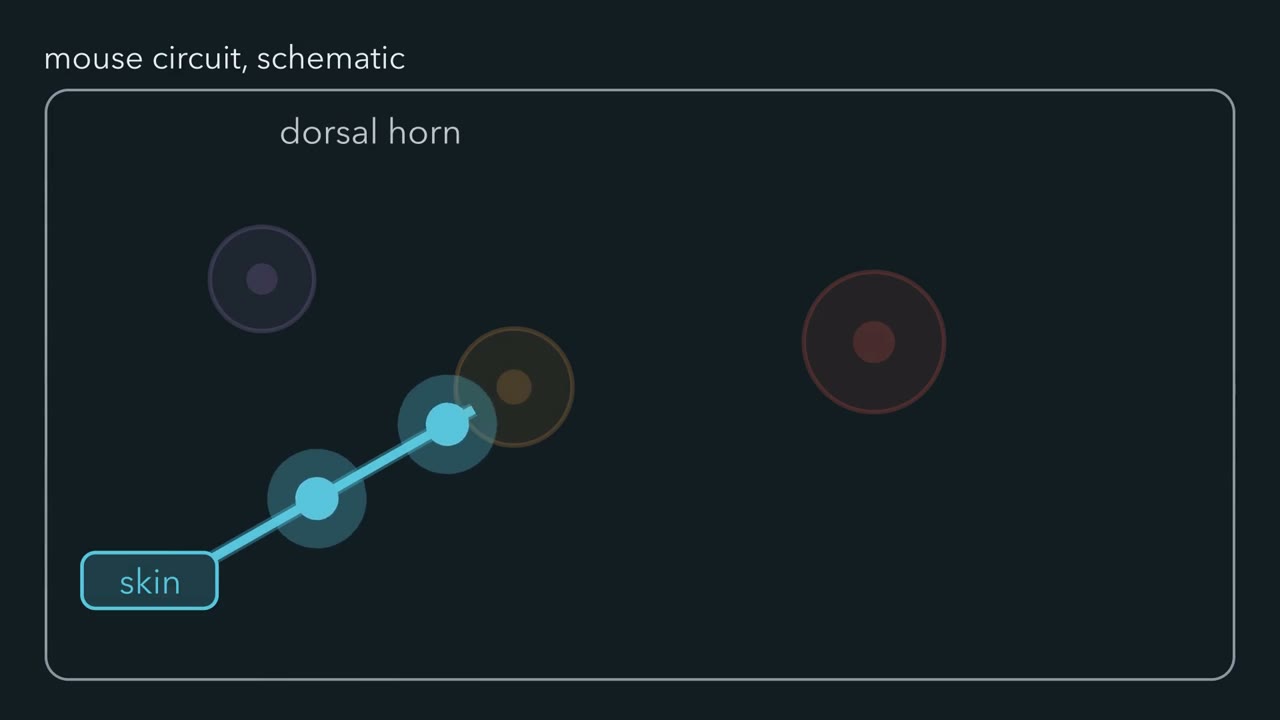
Can the gate from chapter one fail while every gatekeeper remains present? The purple inhibitory neuron, its ending, and the red target all remain. This time, the change occurs inside the target neuron. An inhibitory synapse opens channels permeable to chloride and bicarbonate. Its current depends on the difference between membrane potential and anion reversal potential. Teal KCC2 helps keep intracellular chloride low in these spinal neurons. In adult male rats, nerve injury reduced dorsal-horn KCC2. In acute lamina I slices, anion reversal shifted in the depolarizing direction. The same synaptic conductance now produced current with a different sign.
Use one computed case at a membrane potential of minus −65 mV. Reversal at minus −75 gives plus +10 mV of driving force. Move reversal to minus −50 and driving force becomes minus −15 Conductance stayed fixed. Current direction changed. Current reversal is not the whole claim. An open anion conductance can still shunt other current. A depolarizing response becomes excitatory only if its net effect raises firing. The rat experiments measured increased excitability too. Now predict the diagnostic pattern.
Cell counts remain stable after injury. Which added measurement can reveal a changed postsynaptic effect: more counting, an evoked output recording, or anion reversal measured without replacing chloride? Measure anion reversal with a gramicidin perforated patch. It gives electrical access while preserving the cell's chloride.
Stable counts test survival. Evoked inhibitory events test output. Reversal tests the target's response to that output. The rat studies also traced the signal upstream. ATP-stimulated microglia released BDNF. Gold BDNF blocks then reached TrkB on the red target. Gold BDNF then moved the reversal marker in the target. These rat transfer experiments did not measure KCC2 afterwards. The purple synapse remained present throughout the shift. Compare three pure patterns. Cell death lowers the count and evoked events.
Lost output leaves counts stable but reduces events. A changed postsynaptic effect leaves counts stable and events present while reversal moves. Real mechanisms can coexist. This route was established in adult male rats. It is not automatically obligatory across species or sexes. Keep the experimental rule instead. Count cells, test output, then measure reversal in the target neuron.
Light touch can start to hurt when a spinal gate fails. A gate can fail because the gatekeeper dies, or because the gatekeeper is still there and its signal has changed sign. In adult male rat lamina I, nerve injury was shown to do the second.
Continue in the lesson: Spinal Circuits That Gate Pain →
3:34 · Free, with captions and a transcript. The lesson has the full text, the questions and the sources.
More films from this lesson
How this film was made. Narration: an AI narrator voice (Kokoro, af_heart) reading narration written from this lesson's text. Animation: AI-generated in code (Manim) by Claude, a schematic with no drawn molecular structures. Captions come from the narration script. See something wrong? Report it.