Taste: The Cell Decides
Read the transcript of “Taste: The Cell Decides”
Film transcript: Taste: The Cell Decides
If three kinds of taste cell send the same chemical signal, how does the brain tell them apart? In the taste bud, type II cells detect sweet, umami and bitter. Sweet and umami cells carry T1R receptors. Bitter cells carry T2R receptors. After the receptor, all three use the same steps. An enzyme, PLCβ2, leads to a calcium rise. Calcium opens a channel, and the cell depolarizes. Then ATP flows out through a channel onto the nerve fibre. So the signal is the same. The rule's answer: what differs is which cell the nerve listens to. Zhang and colleagues deleted PLCβ2 from the whole mouse. Nerve responses to the tested sweet, amino-acid and bitter stimuli were lost.
In lick tests, sweet preference was strongly reduced, and bitter avoidance was lost. Sour and salty responses remained, because those cells use other routes. Then they put it back only in cells with bitter receptors. Which responses come back? Bitter only, all three, or none?
Bitter only, in the nerve and in behaviour. Sweet and amino-acid responses did not return. The shared enzyme works only for its own cell's quality. The lines are separate. Does the cell also decide what a line means? Put a receptor in the wrong cell. Mueller and colleagues put a human bitter receptor into the sweet cells of mice. Its ligand is a bitter compound that normal mice ignore. Will these mice avoid it, or drink it?
They drink it, while normal mice stay indifferent. The receptor detects the molecule, but the sweet cell decides what that means. In mouse taste, each kind of cell acts like a labeled line. One consequence: a bitter cell pools many receptors. By its rate alone, that cell cannot say which bitter compound it met. Not every bitter cell carries the same receptors, so the pathway may keep some distinctions. Still, pooling fits a sense that mostly answers: eat it, or reject it? Keep the scope. These are mouse experiments on the periphery. Some taste cells and nerve cells respond to more than one quality. Smell reads a pattern across many lines. Taste reads mainly which kind of cell is active.
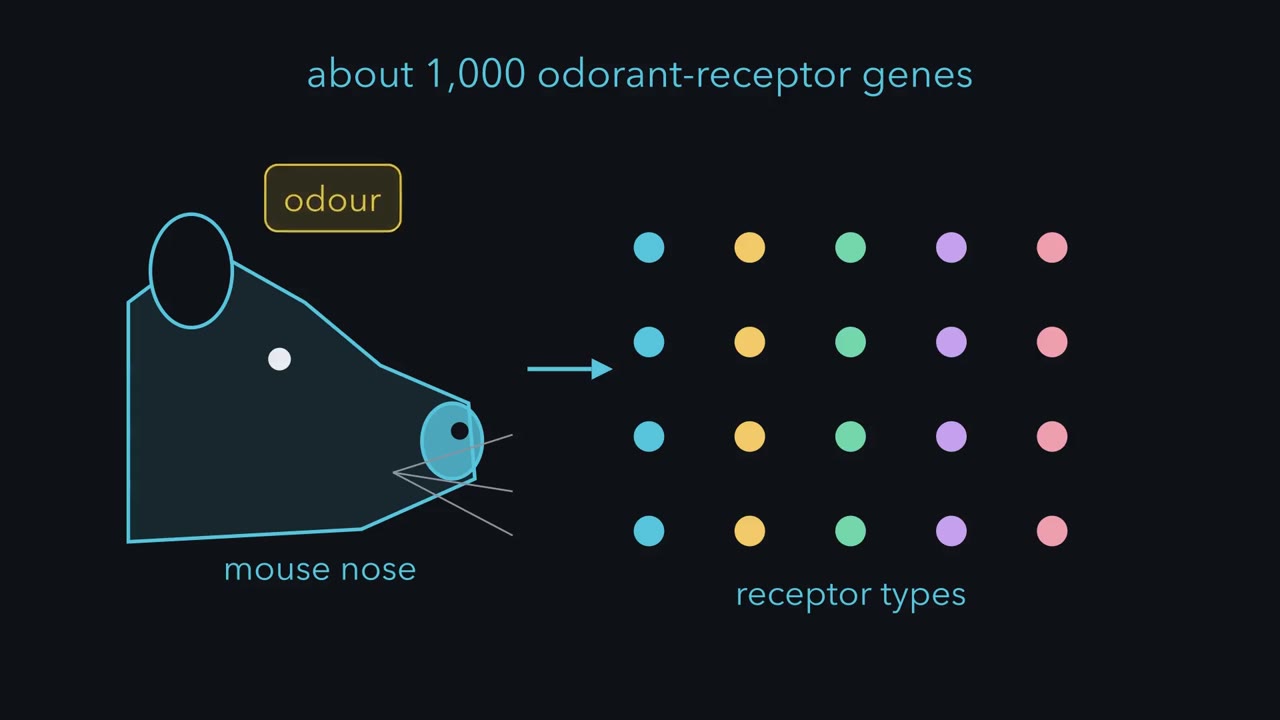
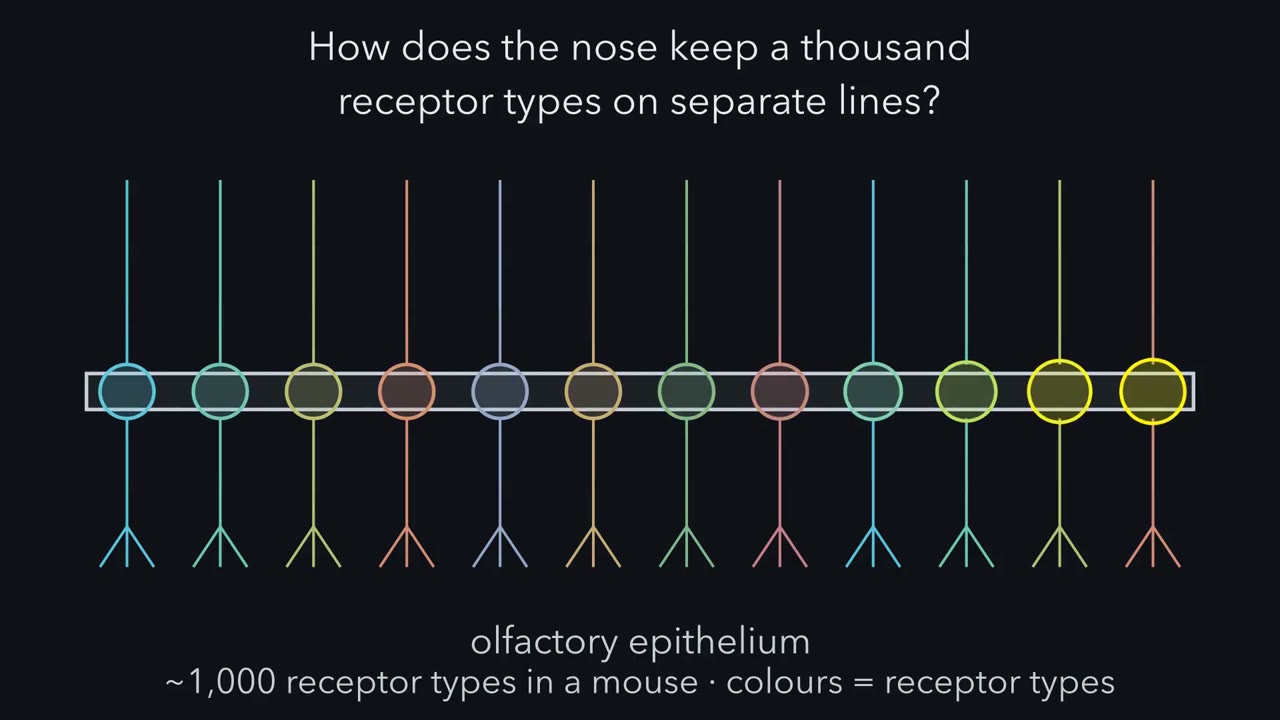
One mouse olfactory neuron, one receptor gene out of about a thousand. One bitter cell, one job. Why do the two chemical senses code so differently?
Continue in the lesson: Smell and Taste →
2:51 · Free, with captions and a transcript. The lesson has the full text, the questions and the sources.
More films from this lesson
How this film was made. Narration: an AI narrator voice (Kokoro, af_heart) reading narration written from this lesson's text. Animation: AI-generated in code (Manim) by Claude, a schematic with no drawn molecular structures. Captions come from the narration script. See something wrong? Report it.