Why a Slow Off Switch Can Count
Read the transcript of “Why a Slow Off Switch Can Count”
Film transcript: Why a Slow Off Switch Can Count
How can a cell count? Calcium often rises in brief spikes. In many cell types, a stronger stimulus gives more frequent spikes of about the same height. To read that, a cell needs a part that switches on fast and off slowly. Picture a bucket with a small hole, topped up by one cup of water at each spike. Fill it rarely, and it drains between cups. Fill it often, and the level climbs. Take a decoder that loses its activity with a fixed half-time. The fraction left at the next spike is one half, raised to the gap between spikes divided by the half-time. With a half-time of 20 seconds, spikes a minute apart leave one eighth of the activity. Spikes 10 seconds apart leave about 70 percent to build on.
In 1998, Ricardo Dolmetsch, Keli Xu and Richard Lewis tested human T cells. They imposed calcium spikes of chosen spacing on a line of these cells. Closely spaced spikes activated three transcription factors, NFAT and NF-κB among them. Widely spaced spikes activated only NF-κB. A likely reason is how fast each one switches off. NFAT leaves the nucleus within minutes once calcium falls. In B cells, NF-κB was found to stay in the nucleus. It stayed for more than 16 minutes after a brief calcium spike. So a decoder that holds on between spikes can count.
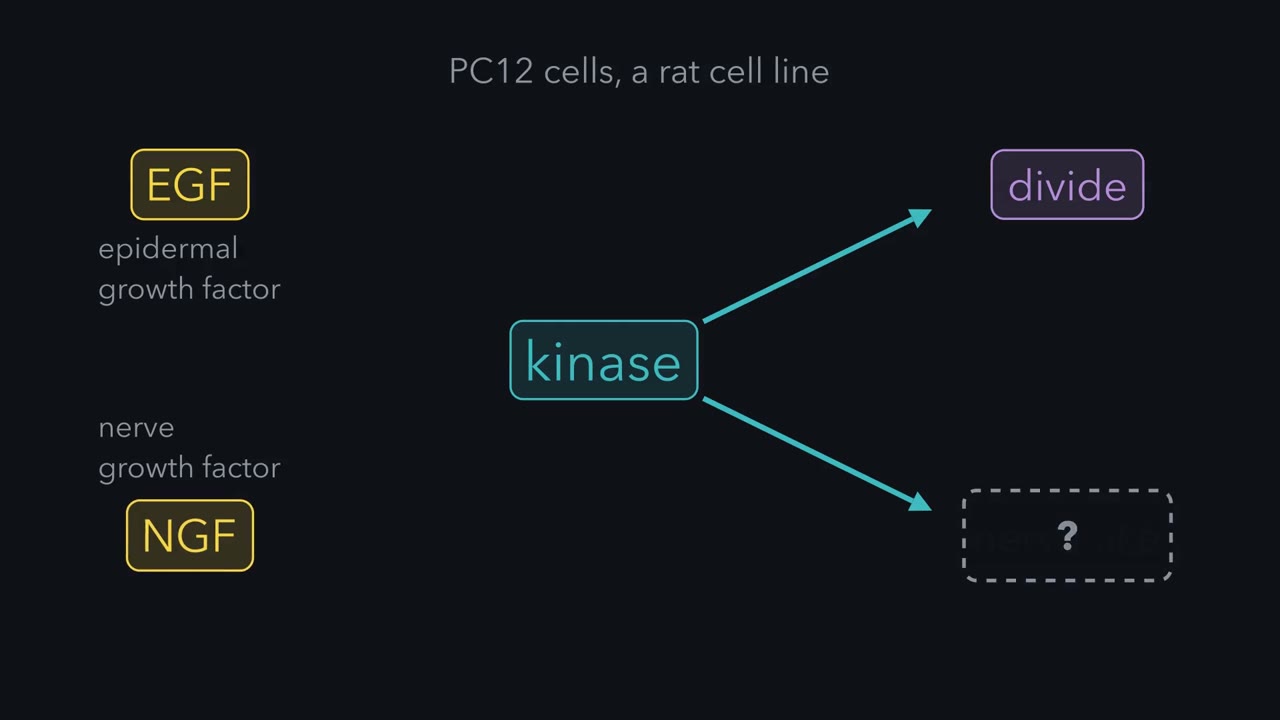
EGF and NGF both switch on ERK in the same cell. How does the cell tell them apart? It reads the shape of the signal: how much, how long, how often and where.
Continue in the lesson: The Shape of a Signal: Size, Duration, Frequency and Place →
1:52 · Free, with captions and a transcript. The lesson has the full text, the questions and the sources.
More films from this lesson
How this film was made. Narration: an AI narrator voice (Gemini, Charon) reading narration written from this lesson's text. Animation: AI-generated in code (Manim) by Claude, a schematic with no drawn molecular structures. Captions come from the narration script. See something wrong? Report it.