Films · Genetics and Molecular Biology
Two Ways Parent of Origin Matters
Read the transcript of “Two Ways Parent of Origin Matters”
Film transcript: Two Ways Parent of Origin Matters
The first film followed an allele because it sat on the X. Can parent of origin matter beyond the sex chromosomes? It can, in two different ways. The key is to ask whether transmission or expression changed. In the first lane, organelle inheritance changes which DNA arrives. In the second, genomic imprinting changes which parental nuclear allele is expressed. Keep transmission and expression separate. Both mechanisms make pedigrees depend on parent, but for different physical reasons. Mitochondria and chloroplasts carry small genomes outside the nucleus. An egg supplies abundant cytoplasm and organelles. A male gamete usually contributes far less cytoplasm.
That difference gives maternal organelles an enormous numerical head start. Many species also exclude, deplete, or destroy paternal organelles or their DNA. Organelle genomes are therefore generally inherited from the mother. The mother's organelle pattern reaches sons and daughters. Some species instead show paternal or biparental organelle transmission. Both sexes can inherit a maternal organelle variant. Each child now carries the mother's organelle DNA. But carrying a variant is not the same as passing it on. Imprinting is different. An imprinted gene is nuclear. Both parents transmit a copy, but only one parental copy is expressed. A parent-of-origin mark decides which.
The mark does not change the DNA sequence. The marks are set during egg or sperm formation, then reset in the next generation. Both a daughter and a son inherit the same maternal organelle variant. Each carries it. Which child can place that variant into the next generation's eggs? Trace the lineage, not the child's own phenotype. The question is about transmission, not expression.
The daughter can usually pass it through eggs into another generation. The son can carry the variant, but his sperm usually do not transmit those organelles. The children can therefore share a variant while only one sex continues its lineage. Now compare the lanes. Organelle inheritance usually filters transmission through the egg. Imprinting transmits both nuclear copies, then filters expression by parental origin. These mechanisms can produce different pedigrees. Inheritance patterns depend on allele identity, chromosome location, and parental origin. Here, parent of origin can decide which DNA arrives or which allele acts. Most nuclear genes use both parental copies, so imprinting is a special case.
When a pedigree depends on the mother, ask what is moving. Is organelle DNA traveling through eggs? Or are both nuclear alleles present while a parental mark controls expression?
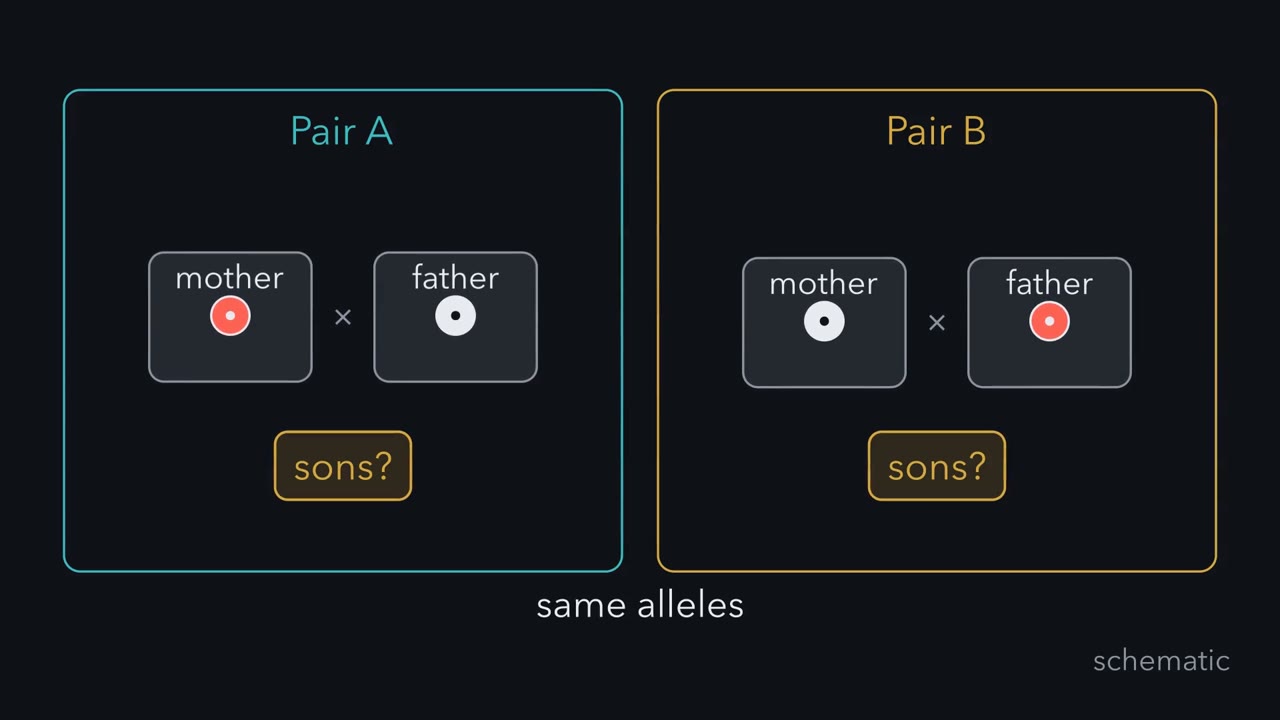
Why can swapping which parent has white eyes change every son?
Continue in the lesson: Sex Linkage, Dosage Compensation and Non-Mendelian Inheritance →
3:40 · Free, with captions and a transcript. The lesson has the full text, the questions and the sources.
More films from this lesson
How this film was made. Narration: an AI narrator voice (Kokoro, af_heart) reading narration written from this lesson's text. Animation: AI-generated in code (Manim) by Claude, a schematic with no drawn molecular structures. Captions come from the narration script. See something wrong? Report it.