Films · Genetics and Molecular Biology
Why Reciprocal Crosses Split
Read the transcript of “Why Reciprocal Crosses Split”
Film transcript: Why Reciprocal Crosses Split
Why can swapping which parent has white eyes change every son? Morgan's reciprocal fly crosses looked almost identical at the start. Their offspring did not. The difference points to a chromosome route, not a new inheritance law. Start inside the flies. A female has a pair of X chromosomes. A male has an X and a Y. The white gene sits on the X, not the Y. Gene location decides which chromosome carries an allele through egg or sperm. A male fly has one X, so he is hemizygous for white. His Y carries no white gene. A recessive white allele therefore shows in a male. No dominant allele can mask it. A female can carry white without showing it when a red allele is present.
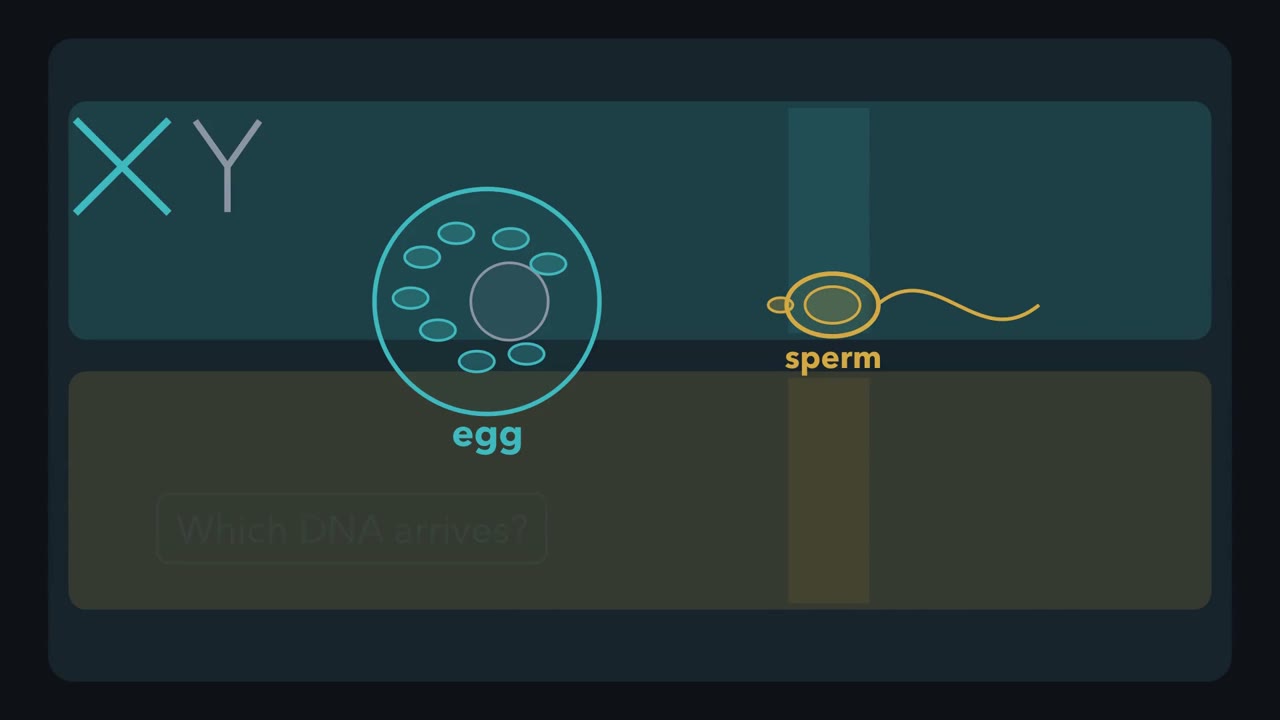
Now follow the chromosomes, not the eye colours. Sons receive their only X from their mother, while daughters receive their father's X. The father's Y makes the other route into sons. That unequal route is the key to the reciprocal-cross puzzle. Begin with a red-eyed mother carrying only red alleles. Every child receives her red X. The white-eyed father's X reaches daughters, where her red allele masks it. Every offspring is red-eyed. The daughters carry white, but their red maternal allele determines eye colour. Reverse only the parental eye colours. The mother now carries white alleles, and the father carries red. Before the chromosomes move, which offspring will have white eyes?
Every daughter gets the father's red X and a maternal white X. She is red-eyed. Every son gets a maternal white X and the father's Y. He is white-eyed. This is criss-cross inheritance: father to daughter, mother to son. The two crosses use the same red and white alleles. Only the carrier's sex changed. Yet their first offspring differ. Reciprocal crosses can separate X-linked inheritance from ordinary autosomal inheritance. An ordinary autosomal allele would not change routes when the carrier's sex changes. This pattern does not replace Mendel's segregation. It adds chromosome location to the bookkeeping.
Inheritance patterns depend on allele identity, chromosome location, and parental origin. Here, location changes the route. Parent of origin matters here because sex determines the chromosome route. Read the family board from the son backward. His X points to his mother. Read a daughter backward, and one X points to each parent. Swapping the carrier therefore changes where the allele can go. The allele itself behaves the same; its possible destinations have changed.
Why can swapping which parent has white eyes change every son?
Continue in the lesson: Sex Linkage, Dosage Compensation and Non-Mendelian Inheritance →
3:27 · Free, with captions and a transcript. The lesson has the full text, the questions and the sources.
More films from this lesson
How this film was made. Narration: written from this lesson's text and read by an AI narrator voice (Kokoro, af_heart). Animation: AI-generated in code (Manim) by Claude, a schematic with no drawn molecular structures. Captions come from the narration script. See something wrong? Report it.