Films · Genetics and Molecular Biology
When Reads Become a Genome
Read the transcript of “When Reads Become a Genome”
Film transcript: When Reads Become a Genome
The first film turned molecular events into reads. How do millions of reads become one genome? Some overlap unique places. Others seem to fit several. The computer must separate missing evidence from evidence that cannot be placed.
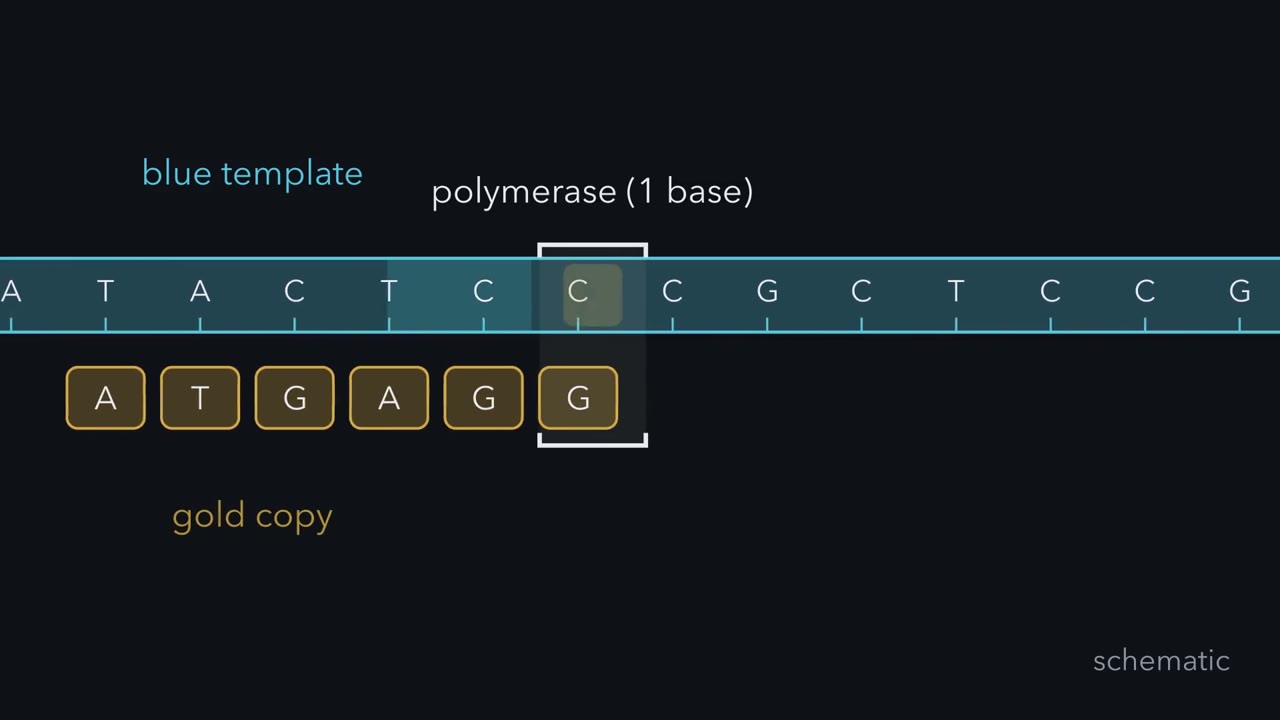
Start with sampling. Coverage is the mean number of reads lying over each base. As more gold reads land at random, blue gaps shrink. The mean does not promise equal stacks everywhere. A position can still receive many reads, few reads, or none. Under ideal random sampling, the unread fraction falls exponentially as mean coverage rises. Adding reads therefore attacks a sampling problem. It makes an unseen position less likely, although real libraries are less even. Now the same red repeat block appears at two places along the blue ribbon. A short gold read from inside that block matches both places equally. Its bases may be accurate, yet its address is ambiguous.
More copies of that same short evidence do not create a unique address. Another pile of short reads is ready to land on the repeats. Will a deeper pile tell which flanking regions belong together? The pile grows, but both placements remain possible. More reads fill sampling gaps; reads that span a repeat place it. Now one long gold read crosses the red repeat and reaches blue unique sequence on both sides. That span links the repeat copy to its flanks. De novo assembly joins reads without a reference, first producing contigs or an assembly graph. Reference alignment asks where reads fit on a reference path or graph already chosen. Now the reference branches.
A read missing from one path can fit another. What counts as a reported difference changes with the reference. Long accurate reads and ultra-long spans closed difficult gaps in one human assembly. A pangenome then added alternative paths from many chromosome copies. Completeness asks whether sequence is missing. Representation asks whether one path captures human variation. Reference choice changes two stages. First, it changes whether a read has a close place to align. Then it changes which base or segment is labelled different. A variant call is therefore a comparison, not a claim about rarity, selection, or health. Genome results depend on what each read records and where it fits.
Was the region sampled, and was the evidence placed uniquely? Extra reads help the first. Reads that span the repeat help the second. A richer reference gives reads from missing sequence a place to land. Those are different limits, and they need different fixes.
A deeply sequenced genome can have almost no random gaps and still break at one repeat. How can both be true?
Continue in the lesson: Sequencing and Genomes →
3:31 · Free, with captions and a transcript. The lesson has the full text, the questions and the sources.
More films from this lesson
How this film was made. Narration: an AI narrator voice (Kokoro, af_heart) reading narration written from this lesson's text. Animation: AI-generated in code (Manim) by Claude, a schematic with no drawn molecular structures. Captions come from the narration script. See something wrong? Report it.