Films · Genetics and Molecular Biology
How Chemistry Becomes a Read
Read the transcript of “How Chemistry Becomes a Read”
Film transcript: How Chemistry Becomes a Read
How can a machine read DNA when a polymerase handles only the next base? Watch one blue template cross the frame. A gold copy grows beside it. The machine never sees an entire chromosome. It must turn local copying events into an ordered read.
Sanger sequencing makes many copies from the same starting primer. Most copies take ordinary nucleotides and keep growing. Occasionally, a red dideoxynucleotide joins the copy. It lacks the usable end needed for another addition. That copy stops permanently, while other copies stop at other positions. The stopped copies now sort from shortest to longest. Each red endpoint carries the identity of its last base. Reading those endpoints in length order spells the newly made strand. The template runs in the opposite direction, so finding its sequence also requires reversing the complement.
Now imagine replacing the permanent red stop with a removable teal pause. What must happen before polymerase can copy the next base? The machine images the colour while every copy in a cluster is paused. Then it removes both the dye and the block. The free end can accept another nucleotide. Repeating this add, image, and reset cycle reports one new base from every cluster each time. This is not Sanger sequencing performed in parallel.
Sanger reads a permanent ladder of fragment lengths. Short-read sequencing follows temporary pauses through repeated cycles. Millions of clusters can work together, and both ends of each fragment can be read. Yet each reported stretch remains short. Long-read methods follow single molecules instead. In one method, a polymerase circles the same template repeatedly, letting repeated passes support a consensus.
In the other, a strand moves through a pore while changing ionic current. Software converts that moving signal into bases. Both approaches preserve longer-range context. These methods do not merely differ in speed. The chemistry, the DNA fragments loaded, and base-calling software together shape read length, error pattern, and context. A read is still evidence from one fragment, not a chromosome.
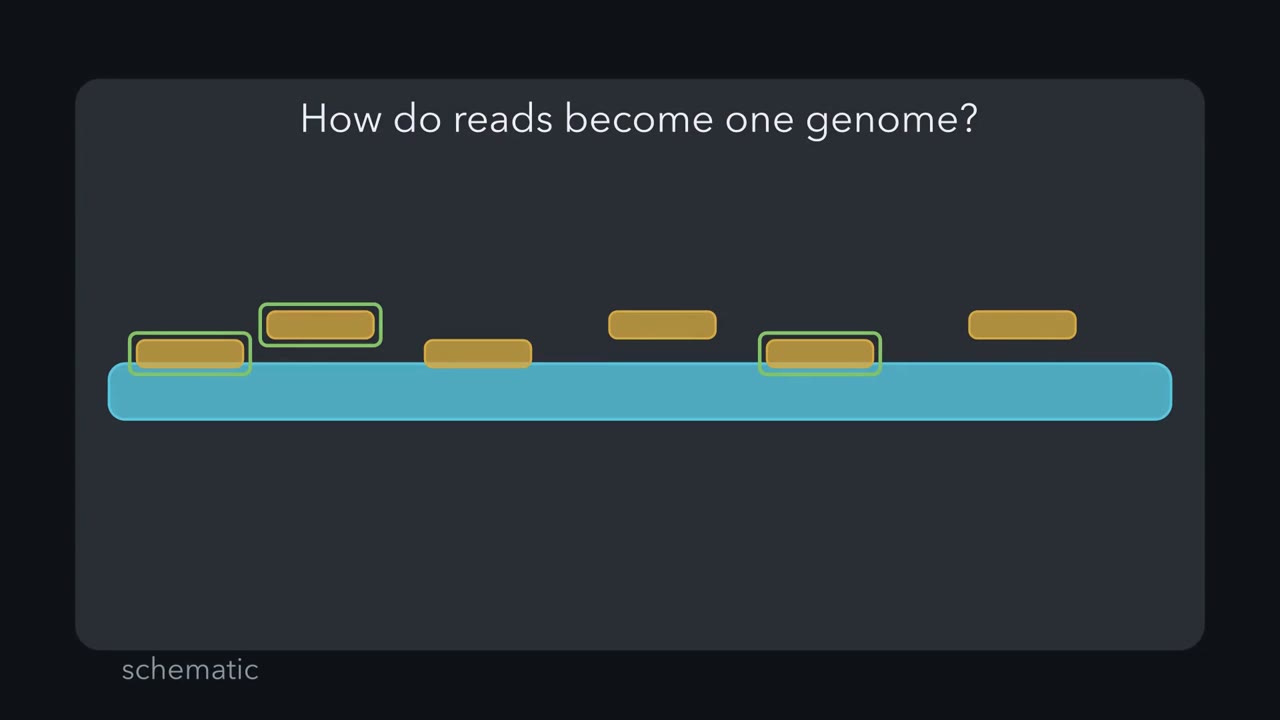
Later analysis must decide where it belongs. Genome results depend on what each read records and where it fits. Sequencing turns molecular events into ordered base calls. A polymerase stop, a cycle of coloured pauses, or a changing current becomes an ordered string. The chemistry shapes what evidence reaches the computer. That distinction will guide every calculation and genome comparison that follows. The next question is whether those strings fit one genomic path or several.
A deeply sequenced genome can have almost no random gaps and still break at one repeat. How can both be true?
Continue in the lesson: Sequencing and Genomes →
3:32 · Free, with captions and a transcript. The lesson has the full text, the questions and the sources.
More films from this lesson
How this film was made. Narration: written from this lesson's text and read by an AI narrator voice (Kokoro, af_heart). Animation: AI-generated in code (Manim) by Claude, a schematic with no drawn molecular structures. Captions come from the narration script. See something wrong? Report it.