The Flank and the Monkey
Read the transcript of “The Flank and the Monkey”
Film transcript: The Flank and the Monkey
A neuron fires most at the peak of its tuning curve. Is that where it best tells two stimuli apart? Here is a made-up neuron, tuned to the angle of a bar. Its rates are on screen, and each carries noise from trial to trial. Show two nearby angles many times, and draw a histogram of spike counts for each. Overlapping histograms are hard to tell apart. What matters is the gap between the means, measured in units of noise. That gap is called d′. prime. Compare a pair near the peak with a pair on the steep flank, the same angle apart. Which pair is easier to tell apart?
The flank pair. The curve is steeper there, so the means sit about twice as far apart in noise units. The peak is where a neuron fires most, not where it discriminates best. Behaviour has its own curve. In a two-choice task, guessing gives fifty percent correct. So fifty percent is chance, and a common threshold is seventy-five percent. Now assume the counts are bell-shaped, independent, and equally noisy for both stimuli. Then an ideal observer comparing one neuron's counts from two intervals scores by d′ prime alone. That gives the neuron a neurometric curve, on the animal's scale. Britten, Shadlen, Newsome and Movshon made that comparison.
Rhesus monkeys judged which way a field of dots drifted. While a monkey worked, they recorded one neuron in area MT, with the display fitted to that neuron. From its spike counts on the same trials, they built the neuron's curve. Under those conditions, most neurons were about as sensitive as the monkey. So did that one neuron make the monkey's choice?
No. It holds about as much signal as the monkey used. That is signal, not cause. Many neurons respond to the same dots. A good readout of many similarly informative neurons, with independent noise, could be far more sensitive than any one of them. The monkey shows much less improvement. In the group's model, part of their noise is shared. Shared noise rises and falls together, so averaging cannot cancel it. The causal test takes a manipulation. Microstimulating area MT biased the monkeys' choices. Last, is a taste coded by one line, or by a pattern across many? That argument continues. Keep the one idea. A spike means what its neuron is tuned to.
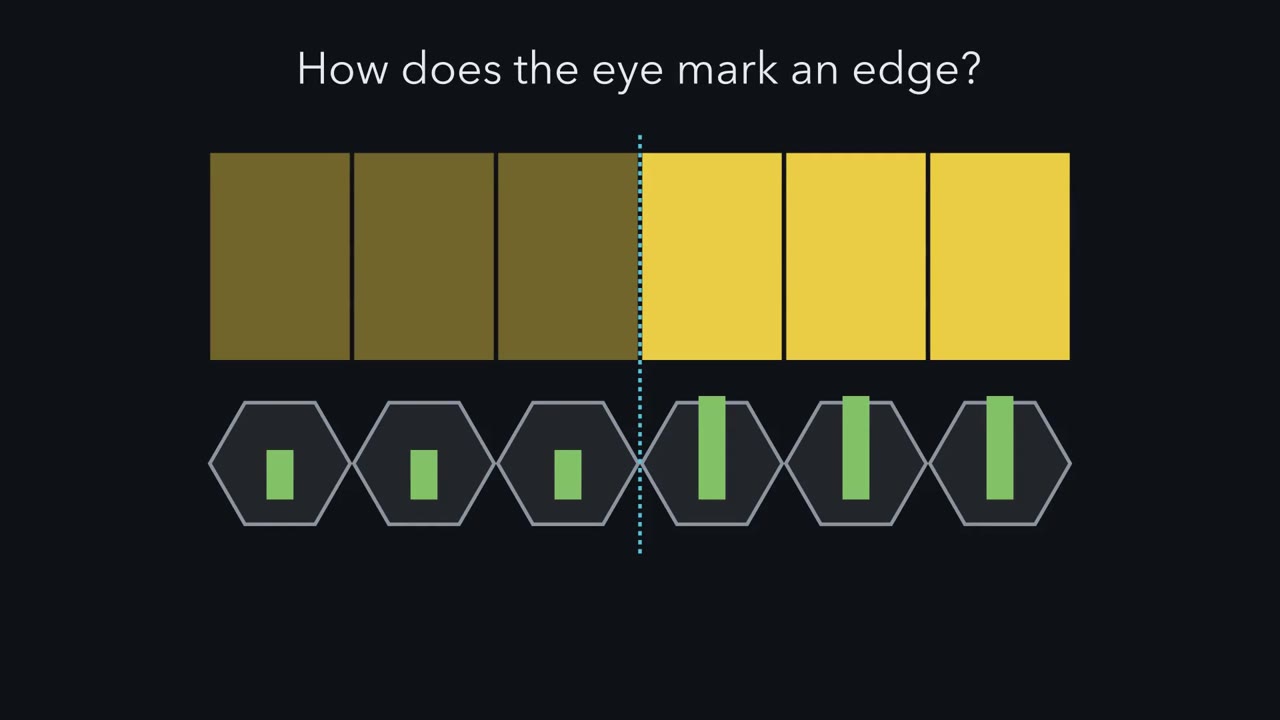
Small changes are easiest to see where the rate changes a lot against the noise.
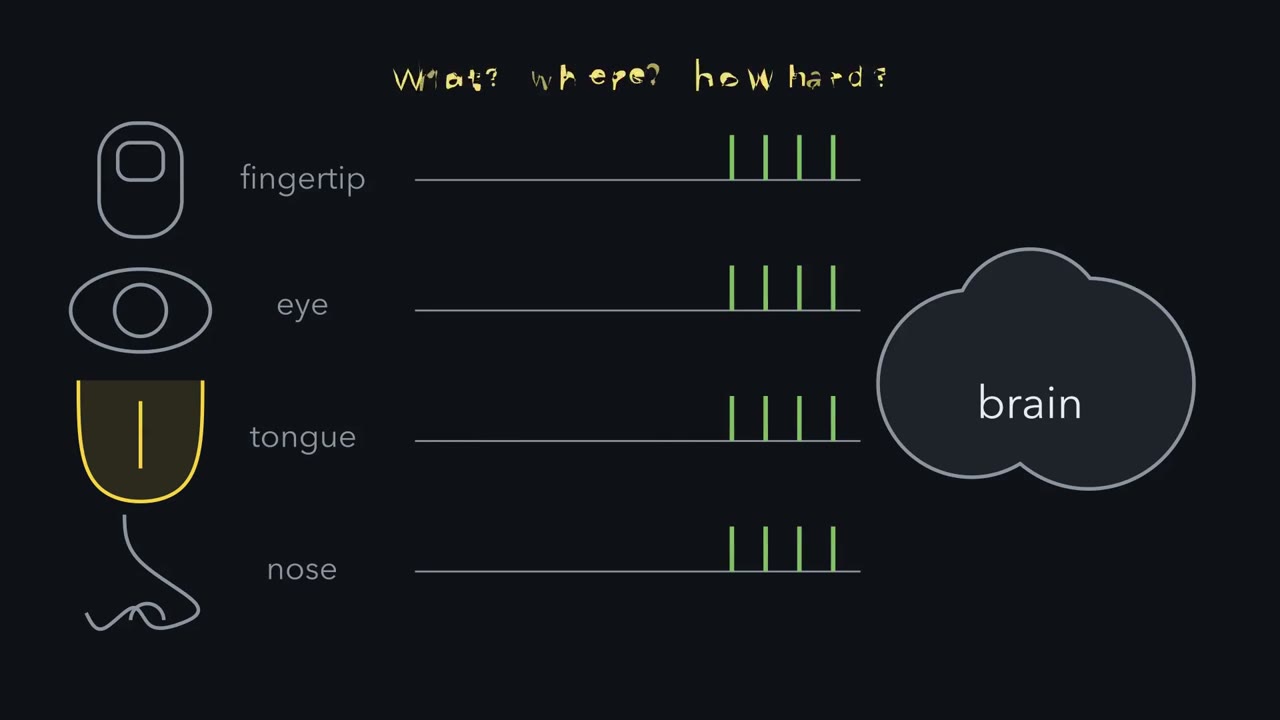
A heavier weight on a frog's muscle receptor did not make bigger impulses, only more of them. How do identical spikes carry a whole world?
Continue in the lesson: Principles of Sensory Coding →
3:00 · Free, with captions and a transcript. The lesson has the full text, the questions and the sources.
More films from this lesson
How this film was made. Narration: an AI narrator voice (Kokoro, af_heart) reading narration written from this lesson's text. Animation: AI-generated in code (Manim) by Claude, a schematic with no drawn molecular structures. Captions come from the narration script. See something wrong? Report it.