Films · Developmental Neuroscience
One Input, Many Ages
Read the transcript of “One Input, Many Ages”
Film transcript: One Input, Many Ages
Why can't a young songbird catch up on a song it never heard? A male white-crowned sparrow raised without adult song still sings. But its song is simple and abnormal. The right song played later does little to fix it. Yet the bird is not deaf, and its voice works.
It missed an experience at the right age. Peter Marler asked when it must come. He raised young sparrows in sound-isolated chambers. He played them recorded song at chosen ages. Then he waited, and recorded what they sang as adults. Predict. Some birds heard the tape early, some later, some never. Which ones sing a good copy?
Birds that heard song early sang good copies, though months passed before they first sang. Tapes played to older birds had little effect. Birds that heard no adult song sang simple, abnormal songs. The same tape, at different ages, left very different marks.
Marler's result splits learning into two phases. First, a sensory phase: the bird listens and memorizes. Then a sensorimotor phase: it practices, shaping rambling sounds until they match the memory. What does practice need? Masakazu Konishi deafened young sparrows after they heard a tutor, but before they practiced. Their songs were extremely abnormal, no better than those of birds deafened before ever hearing a tutor. So a bird must hear itself, to match its practice to a stored memory: a template.
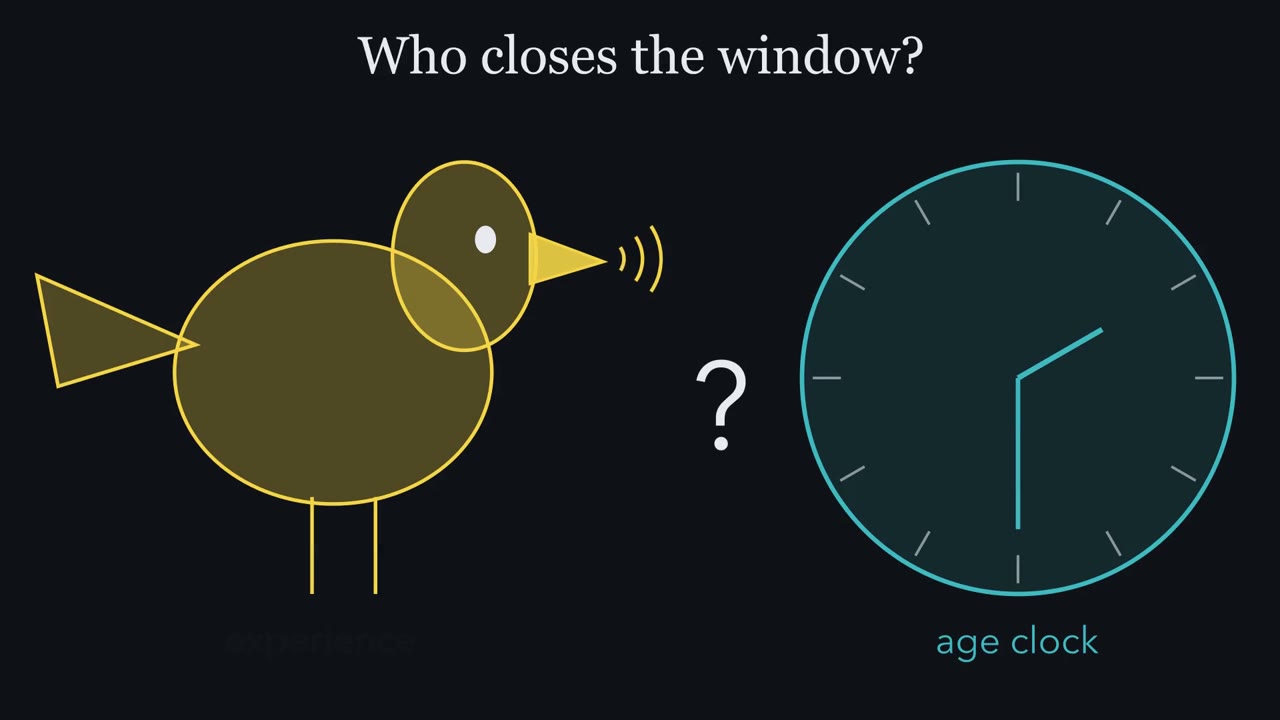
That defines a window. Plot what lasts against the age at which the input was given. This course calls a window that ends abruptly a critical period, like a door. A window that fades gradually it calls a sensitive period, like a tide. Researchers also use these terms in other ways. The clearest human case here, second-language grammar, is a tide in the outcome. Telling them apart takes the whole curve. So here is the one idea to carry. Same input, different ages: measure what lasts. In zebra finches, the expected input itself seems to help end the window. A window is a range of ages when the same experience leaves an unusually strong, lasting mark.
A young songbird that never hears an adult sing grows up singing a simple, abnormal song. Why can't it catch up later?
Continue in the lesson: Sensitive Periods in Behavior: Song, Language and Sight →
2:44 · Free, with captions and a transcript. The lesson has the full text, the questions and the sources.
More films from this lesson
How this film was made. Narration: an AI narrator voice (Kokoro, af_heart) reading narration written from this lesson's text. Animation: AI-generated in code (Manim) by Claude, a schematic with no drawn molecular structures. Captions come from the narration script. See something wrong? Report it.