Press play to start at .
When cGMP Rises: Arteries and Drugs
From the film
- When rising cGMP carries the signal, blocking breakdown amplifies it.
- Acetylcholine acts on the artery's endothelial lining, which makes short-lived nitric oxide gas that diffuses directly into neighboring smooth muscle.
- Nitric oxide activates soluble guanylyl cyclase to raise cGMP, turning on protein kinase G to relax the muscle while PDE5 ends the signal.
- Nitroglycerin supplies nitric oxide from outside, and sildenafil blocks PDE5 so each burst of cGMP lasts longer.
Read the transcript of “When cGMP Rises: Arteries and Drugs”
Film transcript: When cGMP Rises: Arteries and Drugs
Tap a sentence to play from there.
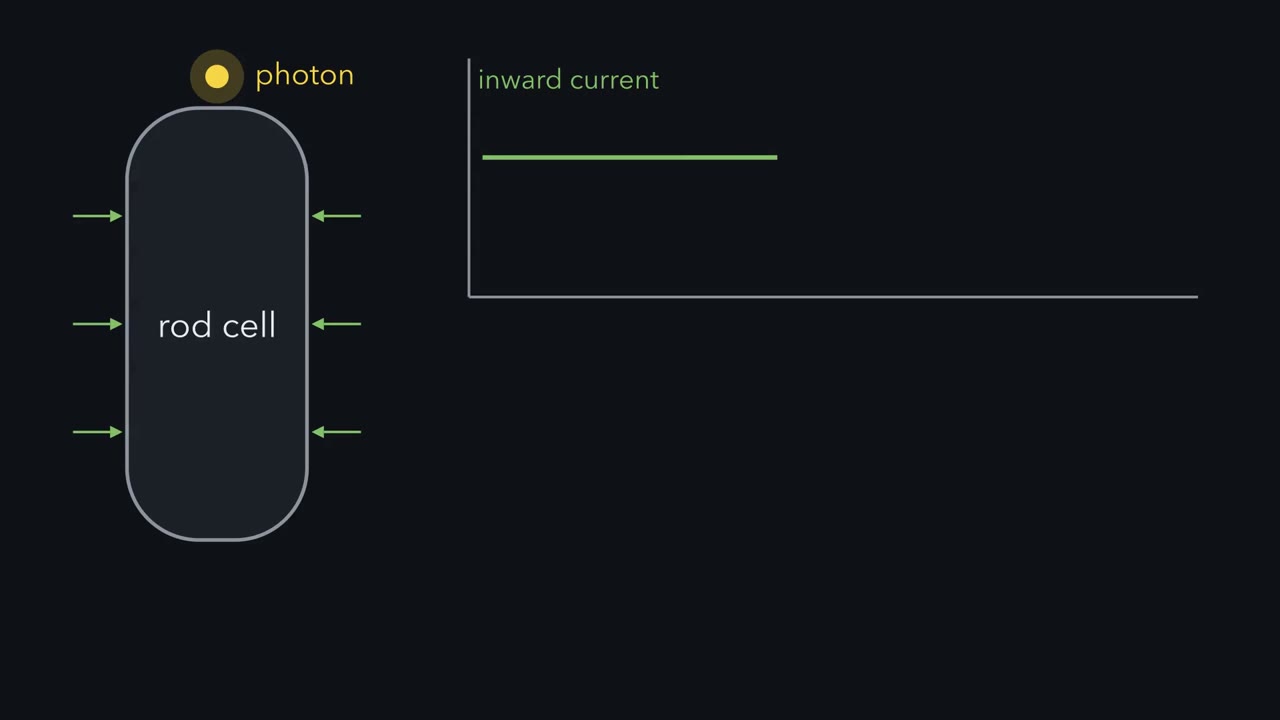
- 0:02 In the first film, a rod reported light by driving cGMP down from baseline.
- 0:09 Why does that exact same molecule rise to relax an artery, and how do drugs alter it? A classic vessel experiment pointed the way.
- 0:19 Mount a ring of rabbit artery in warm oxygenated salt solution and add acetylcholine. When the thin inner lining, the endothelium, stays intact, the artery ring relaxes and widens.
- 0:34 Rub that lining off, and acetylcholine no longer relaxes the ring.
- 0:39 The lining must pass a signal to the muscle beneath.
- 0:43 On an endothelial cell, acetylcholine binds its receptor and raises its calcium.
- 0:50 Calcium switches on nitric oxide synthase, which makes nitric oxide gas from arginine. Small and uncharged, this gas needs no vesicles or channels.
- 1:02 It diffuses freely across both membranes and reacts away within seconds, reaching only near neighbors.
- 1:09 In smooth muscle, nitric oxide binds the heme iron of soluble guanylyl cyclase.
- 1:16 The enzyme switches on, and cGMP climbs sharply.
- 1:21 That rise activates protein kinase G, which works against contraction.
- 1:27 The muscle relaxes, and the artery widens.
- 1:31 But nitric oxide does not last.
- 1:34 Once it stops arriving, the cyclase falls quiet.
- 1:38 Think back to the rod, where an enzyme destroyed this same messenger.
- 1:43 What could bring cGMP back down, so the muscle tightens again?
- 1:53 A phosphodiesterase, just as in the rod.
- 1:57 Here it is called PDE5, and it breaks cGMP into inactive GMP.
- 2:03 Relaxation lasts only while synthesis keeps up with this breakdown.
- 2:09 When synthesis stops, the muscle tightens again.
- 2:12 Two familiar drugs act on opposite sides of this balance.
- 2:18 Nitroglycerin, given for chest pain since the nineteenth century, is converted in tissue into nitric oxide.
- 2:26 It drives synthesis up even without endothelial signals.
- 2:31 Sildenafil sits inside the catalytic pocket of PDE5.
- 2:36 By slowing hydrolysis, it lets each burst of the messenger last longer.
- 2:41 Now place the rod from the first film beside this smooth muscle cell.
- 2:47 Both use teal cGMP and a rose phosphodiesterase, yet wiring reverses the enzyme's role. In the rod, its breakdown enzyme creates the light signal.
- 2:59 In the artery, breakdown ends relaxation.
- 3:03 Because arteries signal by raising cGMP, slowing breakdown strengthens the response to every burst of nitric oxide.
- 3:13 Same molecule, opposite direction, different meaning.
- 3:17 Keep this rule alongside the first.
- 3:20 When rising cGMP carries the signal, blocking breakdown amplifies it.
Nitric oxide signaling: the same idea, other levels
A level is a place to start, not a rank. If this loses you, the rung below teaches the same idea, told more simply.
Graduate · the level you chose
Sensing the World: Vision, Smell, Nitric Oxide and cGMP · this lesson
Furchgott and Zawadzki's aorta rings: nitric oxide raises cGMP and relaxes the artery.
Cell Signaling · about 21 min · 3 practice questions
Next door
- Smooth muscle: Smooth muscle force is a balance · 2:42 · College: going further The gas tells smooth muscle in a vessel wall to relax, which widens the vessel.
- Blood flow resistance: Resistance, Compliance and Local Blood Flow · College: going further A wider vessel lowers resistance, so more blood flows through it.
- Diffusion: Why Far Signals Ride the Blood · 2:38 A small gas slips through membranes by diffusion, so it needs no receptor on the surface.
More films from this lesson
Continue in the lesson: Sensing the World: Vision, Smell, Nitric Oxide and cGMP →
Free, with captions and a transcript. The lesson has the full text, the questions and the sources.
How this film was made. Narration: an AI narrator voice (Kokoro, af_heart) reading narration written from this lesson's text. Animation: AI-generated in code (Manim) by Claude, a schematic with no drawn molecular structures. Captions come from the narration script. See something wrong? Report it.