Crossing the Golgi Stack
Read the transcript of “Crossing the Golgi Stack”
Film transcript: Crossing the Golgi Stack
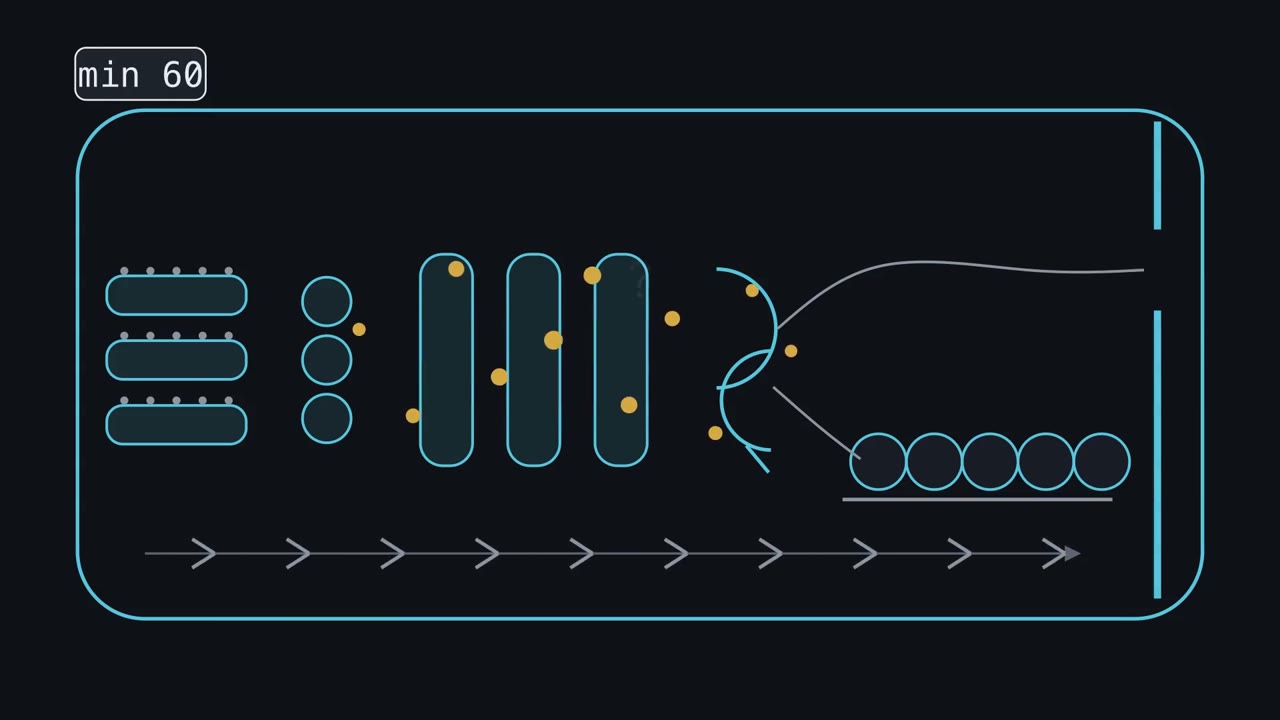
Cargo moves through the Golgi, yet its enzymes stay at their level. Chapter 1 showed the same problem. An ER chaperone drifted forward. A receptor used its KDEL tag to bring it back. Each flattened sac of the stack is a cisterna. The cis face receives cargo arriving from the ER. The trans face passes it on to the trans-Golgi network. Early sugar enzymes are enriched toward cis, later ones toward trans, and they overlap. Picture one is the stable-compartment model. Each cisterna is long-lived and keeps a characteristic set of enzymes.
Small vesicles bud from one sac and carry cargo forward to the next. The compartments keep their cis, medial, or trans identities as cargo passes through. Rothman's lab rebuilt Golgi transport without intact cells. VSV G began in donor Golgi from one cell population.
Acceptor Golgi from another population added a sugar after transfer. That sugar was the assay's readout. Transport needed ATP and cytosol. Now weigh what the assay showed. Does it prove vesicles carry cargo forward, sac by sac, inside one stack? Separate what the experiment measured from the mechanism its inventors proposed.
Not on its own. The assay inferred transfer between separate Golgi populations from the sugar readout. It did not watch cargo move within one stack. Nor did it identify the carrier that crossed between populations. And transfer between populations fits the second picture too. Picture two is the cisternal maturation model. Here the cisterna itself carries the cargo. It forms at the cis face with cargo inside. Then it moves through the stack and ends as trans Golgi and trans-Golgi network. The compartment changes identity while its cargo remains inside. So how do the enzymes stay at their level? They keep being carried backward, in COPI vesicles, to the younger cisterna behind.
Backward recycling replaces early enzymes with later ones, as each cisterna matures. The sacs flow forward, while the enzymes keep going back. That is the KDEL retrieval logic: recycling against the flow. The comparison is only the logic. Golgi enzymes use different retention and retrieval machinery, not the KDEL receptor. Put the two pictures side by side. In one, the sacs stay put and the cargo hops between them. In the other, the cargo stays inside a sac that changes character from cis to trans. Which is right? In the text, predict how fast one filmed cisterna should change. For stacked mammalian Golgi, the question remains open. Glick and Luini judged that no single model explains every observation.
They proposed maturation as the best candidate for a shared core. So how does cargo cross the stack while its enzymes stay put? Fixed sacs and moving vesicles, or moving sacs and recycled enzymes. Either way, the cargo goes forward.
Label a pancreas cell's new proteins for a few minutes, then watch them move: what route do they take, and how do you know?
Continue in the lesson: The Secretory Pathway →
4:03 · Free, with captions and a transcript. The lesson has the full text, the questions and the sources.
More films from this lesson
How this film was made. Narration: an AI narrator voice (Kokoro, af_heart) reading narration written from this lesson's text. Animation: AI-generated in code (Manim) by Claude, a schematic with no drawn molecular structures. Captions come from the narration script. See something wrong? Report it.