Films · Genetics and Molecular Biology
When the Joins Change
Read the transcript of “When the Joins Change”
Film transcript: When the Joins Change
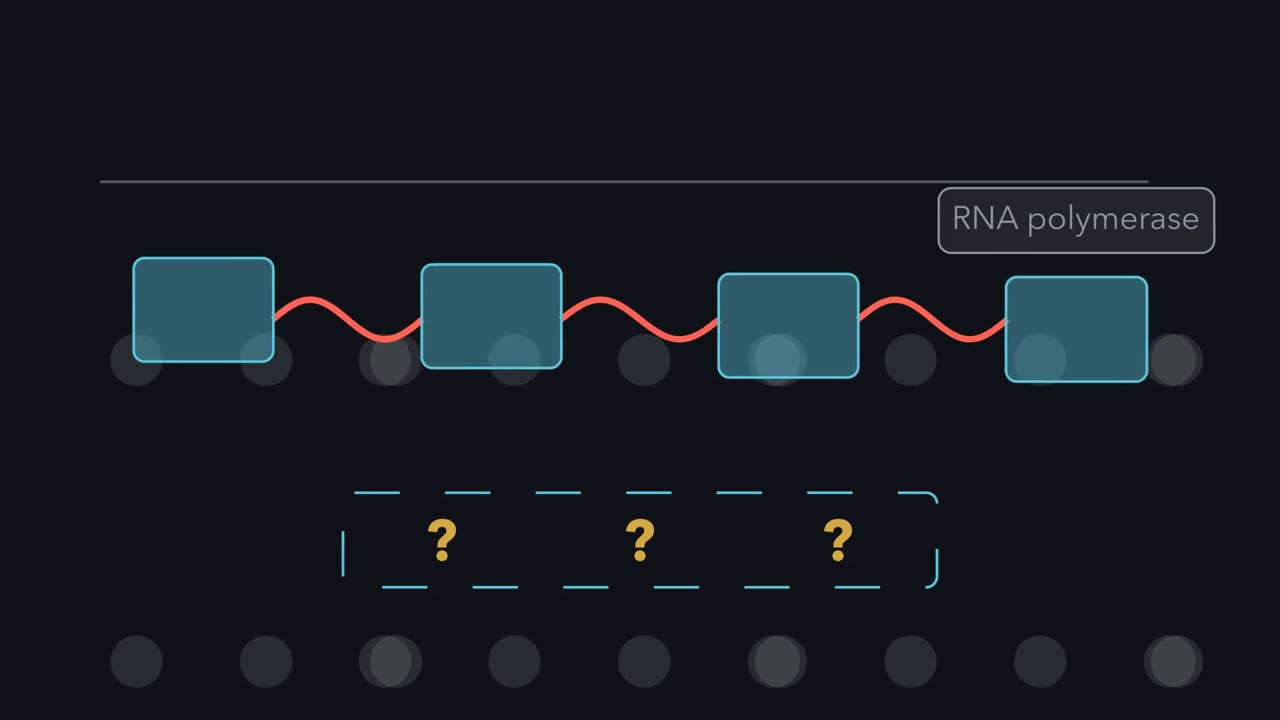
The first film marked both ends and joined blue exons. If those joins change, must the protein's reading frame change too? Follow different copies of one gene's transcript as each is spliced its own way. First, in a normal cell, regulatory signals can steer the spliceosome to different junctions.
Splicing need not make one pattern. A cell may skip an exon, shift a splice site, choose between exons, or retain an intron. Each choice makes a different messenger RNA. Regulatory signals can make these patterns differ among tissues. A sequence change can weaken a normal splice site. Nearby sites then compete differently. A weakened splice site most often causes exon skipping. Less often, a cryptic site takes over or the intron is retained. One allele can make several products at once. One studied beta-thalassemia allele made two abnormal RNAs in cultured cells. The main product kept part of an intron. A smaller amount joined nonadjacent exons.
One changed splice signal shifted competition in more than one way. Length is only the first consequence. In coding sequence, ribosomes read bases in groups called codons. Changing the length can shift every downstream group, changing many amino acids. A shift after one junction can change every later codon boundary. This outlined exon contains only complete codon groups. Imagine that splicing skips it. Use the ruler, not the exon count. Will the downstream groups stay aligned, or will every boundary move?
They stay aligned. Removing complete codon groups changes the message's length but not its downstream grouping. Whole triplets leave, so the next base begins a codon normally. The new junction can still matter, because sequence determines what it encodes. Now skip a coding segment with one extra base beyond complete groups. Every downstream boundary shifts. The reading marker now meets different base groups. A premature stop becomes likely, although only the sequence can show where one appears. The remainder test applies to net changes inside coding sequence. It does not predict effects of untranslated changes. It also cannot tell whether an RNA is exported, degraded, or translated.
Those fates require evidence beyond a length calculation. Processing still marks transcript ends and chooses which segments join into messenger RNA. For coding consequences, keep a second rule. Coding-length changes keep the downstream frame only in multiples of three. It applies only when the changed nucleotides are coding.
Sequence decides the actual protein outcome. That is the scope of this rule.
Why is a message copied from more than 5,000 nucleotides of DNA only 737 nucleotides long?
Continue in the lesson: RNA Processing: Caps, Tails and Splicing →
3:36 · Free, with captions and a transcript. The lesson has the full text, the questions and the sources.
More films from this lesson
How this film was made. Narration: an AI narrator voice (Kokoro, af_heart) reading narration written from this lesson's text. Animation: AI-generated in code (Manim) by Claude, a schematic with no drawn molecular structures. Captions come from the narration script. See something wrong? Report it.