Films · Genetics and Molecular Biology
From Transcript to Message
Read the transcript of “From Transcript to Message”
Film transcript: From Transcript to Message
Why can the RNA copied from a gene differ from the message a ribosome reads? Watch one new transcript grow. Some parts will stay, some will leave, and two new end marks will appear. These planned changes are RNA processing.
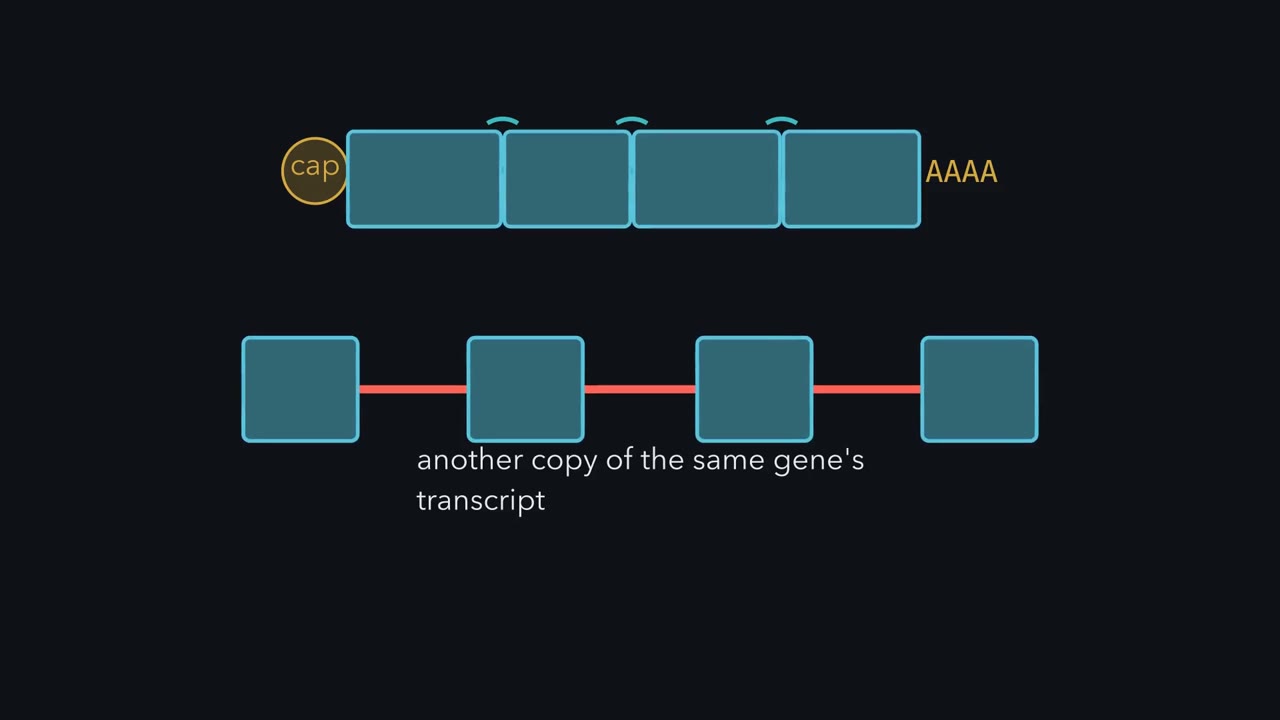
The first copy is a primary transcript, also called pre-mRNA. Blue exons are retained in the processed RNA. Red introns lie between them and will be removed. Each decision changes this same moving transcript. Processing can begin before transcription ends. A methylated guanosine cap attaches to the 5′ end through an unusual triphosphate bridge. That bridge leaves no ordinary exposed 5′ end for an exonuclease. The cap also recruits proteins for export and translation. Near the other end, an RNA signal guides a cut.
Poly(A) polymerase adds adenosines without copying DNA. The tail is added to RNA, rather than copied from the gene. Its binding proteins support stability and translation. Now zoom into one intron. In the major human class, its ends usually carry GU and AG. A branch point inside contains the adenosine that starts the reaction. A pyrimidine-rich stretch lies before the final site. Small nuclear RNAs help place these sites. U1 recognizes the 5′ splice site. U2 holds the branch region with its adenosine exposed. Other particles join and rearrange the assembly. Together, these RNAs and proteins form a spliceosome anew on each intron. The branch adenosine attacks the 5′ splice site.
The upstream exon comes free, and the intron bends into a lariat. Look at the free edge glowing gold. Which exposed end must move next to join the exons? The freed 3′ end of the upstream exon attacks the 3′ splice site. Both exons join, and the lariat leaves. Two attacks, two bond swaps, and the intron is gone. Pull back to the whole transcript. Introns leave as lariats, and exons meet in order. The transcript is shorter, but the retained exons are connected. The cap and tail remain at opposite ends. A processed message is now ready for later steps. Ends marked; segments chosen. That is how one primary transcript becomes a messenger RNA. The end marks also help protect and use the message.
The rule applies to protein-coding RNA polymerase II transcripts in eukaryotic nuclei. Processing marks transcript ends and chooses which segments join into messenger RNA.
Why is a message copied from more than 5,000 nucleotides of DNA only 737 nucleotides long?
Continue in the lesson: RNA Processing: Caps, Tails and Splicing →
3:24 · Free, with captions and a transcript. The lesson has the full text, the questions and the sources.
More films from this lesson
How this film was made. Narration: written from this lesson's text and read by an AI narrator voice (Kokoro, af_heart). Animation: AI-generated in code (Manim) by Claude, a schematic with no drawn molecular structures. Captions come from the narration script. See something wrong? Report it.