The tail's sequence picks the partner
Read the transcript of “The tail's sequence picks the partner”
Film transcript: The tail's sequence picks the partner
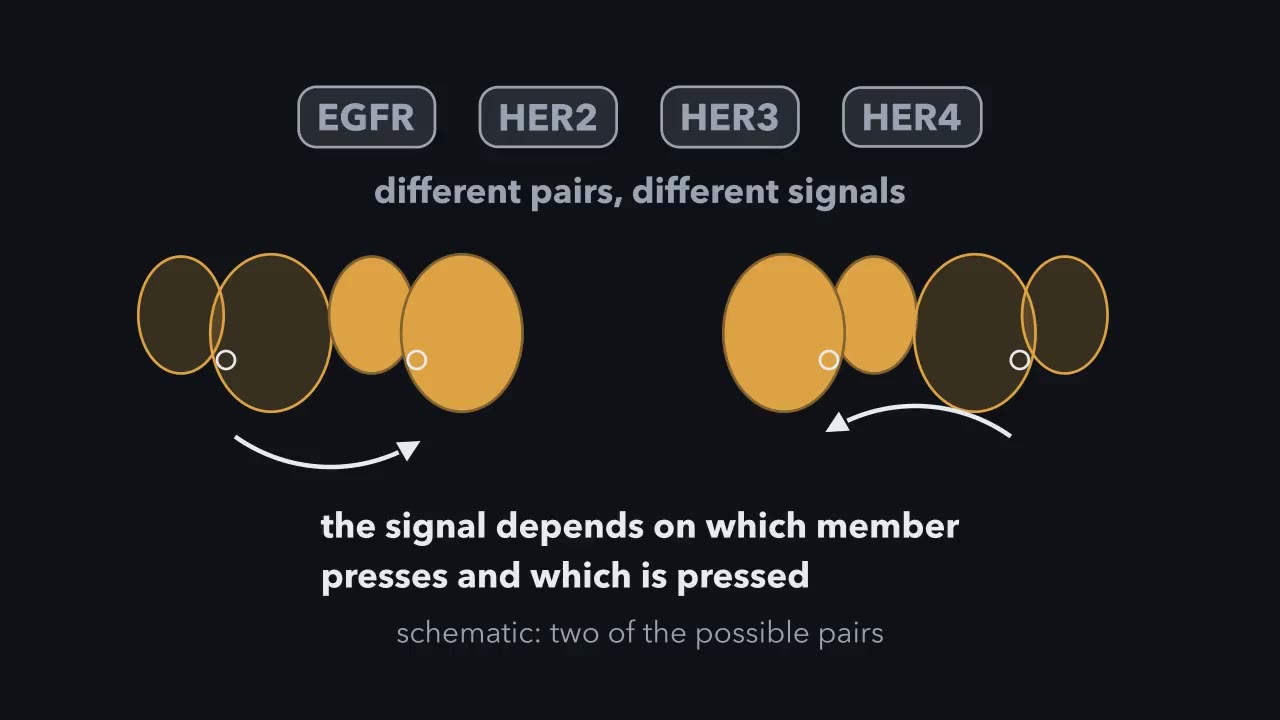
The two kinases are on. They add phosphate to tyrosines outside the kinase core, mostly on the two flexible tails. Each of those phosphates is a docking site. So how does a tail pick its partner? An SH2 domain binds a phosphotyrosine. It also checks the few residues that follow. So the sequence decides which protein binds. On the EGF receptor tail, phosphotyrosine 1068 has an asparagine two residues later. That suits the SH2 domain of Grb2, which leads to Ras and the MAP kinase cascade.
Phosphotyrosine 992, on the same tail, binds PLC-gamma. That enzyme makes IP3 and DAG. Now look at HER3. Its tail has six tyrosines, and each has a methionine three residues later. That suits the SH2 domains of PI 3-kinase, which leads to Akt. So one activated pair starts several pathways at once. The choice of partner changes the mix. Does each site serve its own protein? The PDGF receptor carries sites for all three proteins on a single chain. Researchers tested the sites one at a time. They changed a tyrosine to phenylalanine, which cannot be phosphorylated. That protein failed to dock, and the others still did. PI 3-kinase uses two such tyrosines.
One helix crosses the membrane. So how does a growth factor outside switch on a kinase inside?
Continue in the lesson: Receptor Tyrosine Kinases →
1:49 · Free, with captions and a transcript. The lesson has the full text, the questions and the sources.
More films from this lesson
How this film was made. Narration: an AI narrator voice (Gemini, Charon) reading narration written from this lesson's text. Animation: AI-generated in code (Manim) by Claude, a schematic with no drawn molecular structures. Captions come from the narration script. See something wrong? Report it.