Change Lives on the Branches
Read the transcript of “Change Lives on the Branches”
Film transcript: Change Lives on the Branches
The first film read relatedness at the nodes. This one follows the animals' features. Sharks and humans both have jaws. Did they get them from one ancestor, or twice? A character is a feature that varies among taxa, like jaws. Its forms are its states: jaws present, or jaws absent. A change of state happens somewhere along a branch. Which state came first? Take the outgroup's state as the starting point. Lamprey has no jaws, so absence is the ancestral state. That is an assumption, since the outgroup's lineage can change too.
Shark, trout, frog and human all have jaws. One gain, on the branch from the root to node J, explains all five tips. So, on this mapping, jaws in sharks and humans are homologous. That means similar because of a single origin in a common ancestor. Parsimony prefers the mapping that needs the fewest changes. It is a rule for choosing among explanations. It does not claim that evolution takes the shortest path. Now a made-up character, called X. Trout and human have it. Lamprey, shark and frog do not. Again, absence is the starting state. Here is one mapping.
X is gained on the branch into node B, then lost on the branch to frog. That is one origin, so trout and human share X by homology. Here is another. X is gained twice, once on the branch to trout and once on the branch to human. That is convergence. It means similarity that arose independently in separate lineages. Which mapping does parsimony prefer?
Count the marks on each tree in your head. What is the fewest changes that could explain X? Each needs two changes. No single branch leads to trout and human alone, so one change cannot do it. A gain on the branch into node J, with two losses, would need three. So the two mappings tie. Parsimony alone cannot choose between one origin and two. Homology or convergence stays an open question. To break the tie, you need more evidence. How X develops, or what genes build it. Fossils with intermediate states. Or more taxa on the tree. So map every change onto a branch. Two taxa share a state by homology when both inherit it from one gain on a shared branch. Other lineages may later lose it.
Separate gains are convergence.
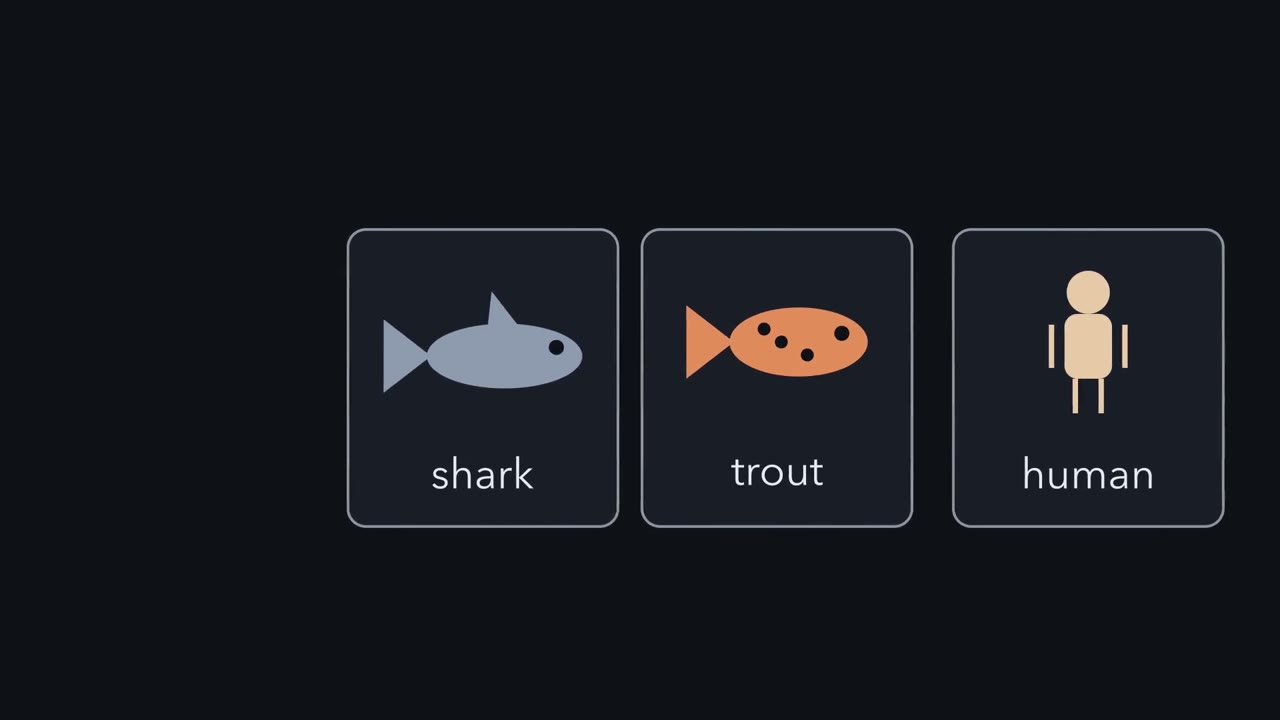
Is a trout more closely related to a shark, or to you?
Continue in the lesson: Reading Phylogenetic Trees →
3:18 · Free, with captions and a transcript. The lesson has the full text, the questions and the sources.
More films from this lesson
How this film was made. Narration: an AI narrator voice (Kokoro, af_heart) reading narration written from this lesson's text. Animation: AI-generated in code (Manim) by Claude, a schematic with no drawn molecular structures. Captions come from the narration script. See something wrong? Report it.