Relatedness Lives at the Nodes
Read the transcript of “Relatedness Lives at the Nodes”
Film transcript: Relatedness Lives at the Nodes
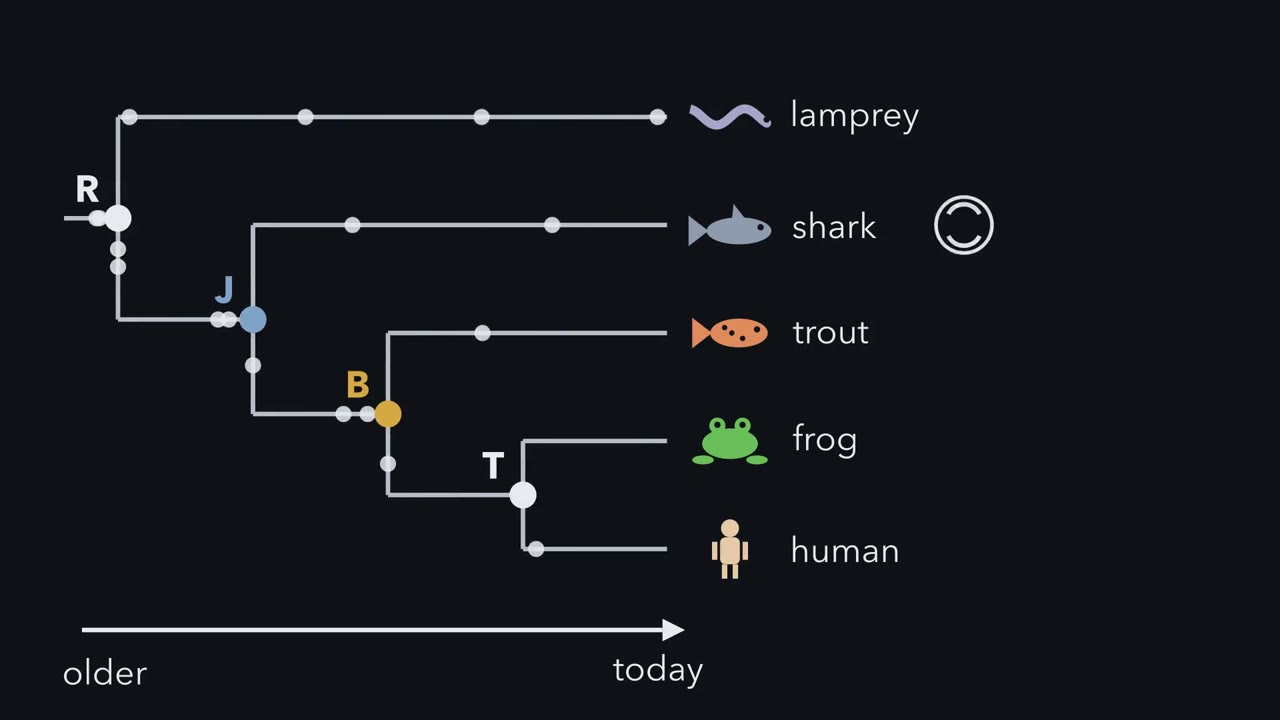
Is a trout more closely related to a shark, or to you? The two fish look alike. A tree gives a different answer. A phylogenetic tree is a hypothesis about ancestry. The living species sit at the tips. Here are five: lamprey, shark, trout, frog and human. Nobody watched these lineages split. The tree is estimated from characters, usually DNA or protein sequences. Each point where a branch splits is an internal node. It stands for an inferred ancestor of every lineage descending from it. The root, on the left, is the ancestor of everything on the tree. Lamprey is the outgroup, assumed to lie outside the rest. The root tells you which end is older.
So for two nodes on one lineage, you can say which is more recent. Now trace trout and shark back until their lines meet. They meet at node J. Then trace trout and human. They meet at node B. Node B descends from node J, so B is more recent. B is the most recent common ancestor of trout and human. That is the latest node from which both descend. Shark does not descend from B. So a trout is more closely related to you than to a shark. It is equally close to the frog. A clade is an ancestor and all its descendants.
Trout, frog and human form one clade. Now spin node T, like one arm of a mobile. Frog and human swap places on the page. Every clade keeps its members, so nothing about the history has changed. Now spin node B. Shark will no longer sit beside trout on the page. Does trout's closest relative change?
No. The drawing changed, but the tree did not. Trout still meets frog and human at node B, and shark at node J. Tips side by side on the page are not, for that reason, closest relatives. One more misreading. Human sits at the end, so is it more evolved? No. Every living tip has had the same time since the root.
Lampreys lack jaws, but they have derived features of their own. So characters, not whole organisms, are ancestral or derived. And relatedness is read only at the nodes. Find the most recent common ancestor, and ignore how the drawing happens to look.
Is a trout more closely related to a shark, or to you?
Continue in the lesson: Reading Phylogenetic Trees →
3:06 · Free, with captions and a transcript. The lesson has the full text, the questions and the sources.
More films from this lesson
How this film was made. Narration: written from this lesson's text and read by an AI narrator voice (Kokoro, af_heart). Animation: AI-generated in code (Manim) by Claude, a schematic with no drawn molecular structures. Captions come from the narration script. See something wrong? Report it.