When the ER Falls Behind
Read the transcript of “When the ER Falls Behind”
Film transcript: When the ER Falls Behind
Chapter 1 asked of any pile: how fast does it arrive, and how fast does it leave? Now ask that inside the ER. What happens when unfinished proteins arrive faster than the ER can fold or remove them? Many secreted and membrane protein chains enter the ER through a channel called the translocon. Chaperones then help them fold. BiP grips exposed hydrophobic stretches.
Lectin chaperones read sugar tags on many glycoproteins, supporting repeated folding attempts. Folded clients can leave for the Golgi. Some persistently misfolded clients enter ER-associated degradation, or ERAD. During return toward the cytosol, yeast Hrd1 adds a ubiquitin chain.
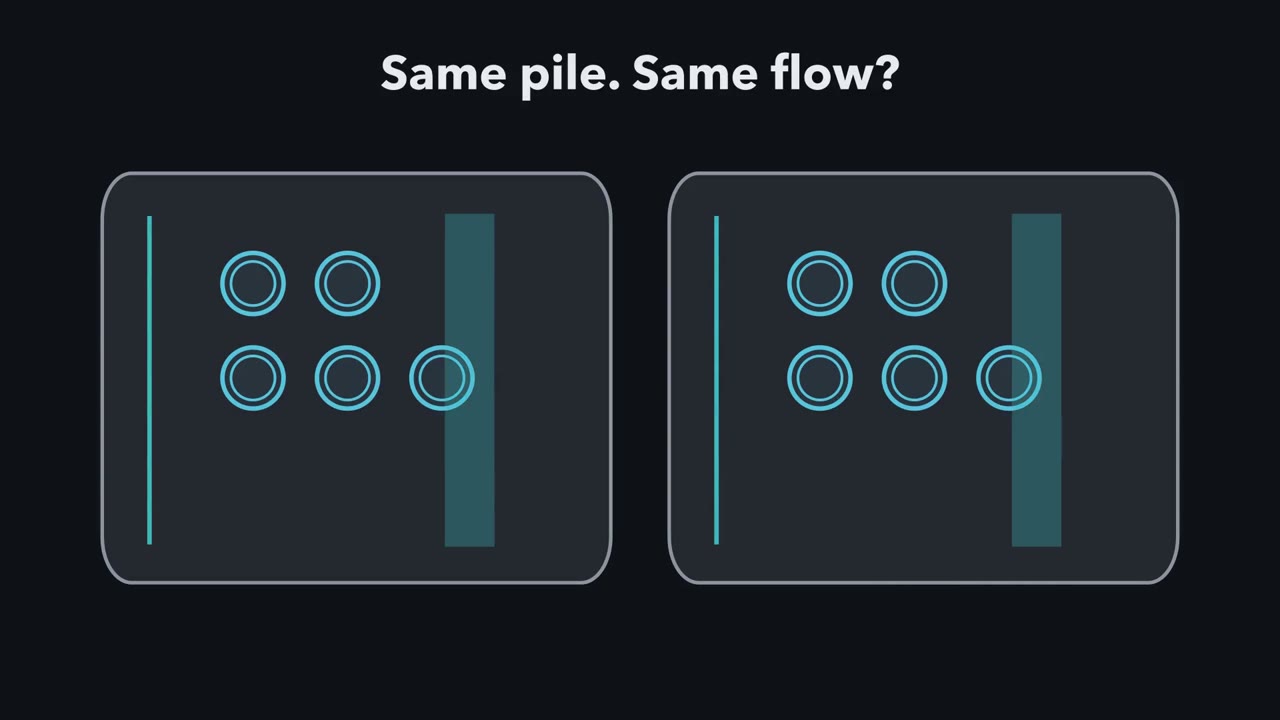
Cdc48 extracts the tagged client for destruction by the proteasome. Now count the flows. Arrival is ER-destined chains entering. Clearance is folding and export, plus removal by ERAD. When chains arrive faster than both exits can take them, unfolded proteins build up. The ER senses that stress and raises an alarm. This alarm is the unfolded protein response. Look at the equation. Which flows could the response change to bring the load down?
It can change both sides. In mammals, a sensor called PERK slows the making of most new proteins, so less arrives. The response also increases folding helpers and removal machinery. Less in and more out let the load fall. Mammals have three branches.
IRE1 splices the XBP1 message. PERK slows translation. ATF6 travels to the Golgi, where proteases release its transcription factor domain. Yeast relies on one ER-stress sensor, Ire1. The response buys time, but has limits. Persistent stress can also drive cell death. The ER can retry clients, remove them, slow arrival, or raise capacity. These moves rebalance arrival and clearance. When folding falls behind, reduce arrival and expand capacity.
When material piles up in a cell, is more arriving or less leaving, and how can you tell?
Continue in the lesson: Protein Quality Control and Organelle Turnover →
2:46 · Free, with captions and a transcript. The lesson has the full text, the questions and the sources.
More films from this lesson
How this film was made. Narration: an AI narrator voice (Kokoro, af_heart) reading narration written from this lesson's text. Animation: AI-generated in code (Manim) by Claude, a schematic with no drawn molecular structures. Captions come from the narration script. See something wrong? Report it.