Press play to start at .
Paid to Let Go
From the film
- Protons ride a ring of c subunits through the membrane, and the gradient makes the ring step mostly one way.
- The ring turns a bent gamma shaft, which holds each beta subunit of the head in a different shape.
- In Boyer's cycle, ATP forms on the enzyme at almost no cost; the turning pays above all to release it, and also drives binding of ADP and phosphate.
- Each 120 degree turn releases one ATP, so the vertebrate ring of eight c subunits spends about 2.7 protons per ATP.
- Exporting ATP and importing phosphate add about one more proton, for about 3.7 protons per exported ATP.
Read the transcript of “Paid to Let Go”
Film transcript: Paid to Let Go
Tap a sentence to play from there.
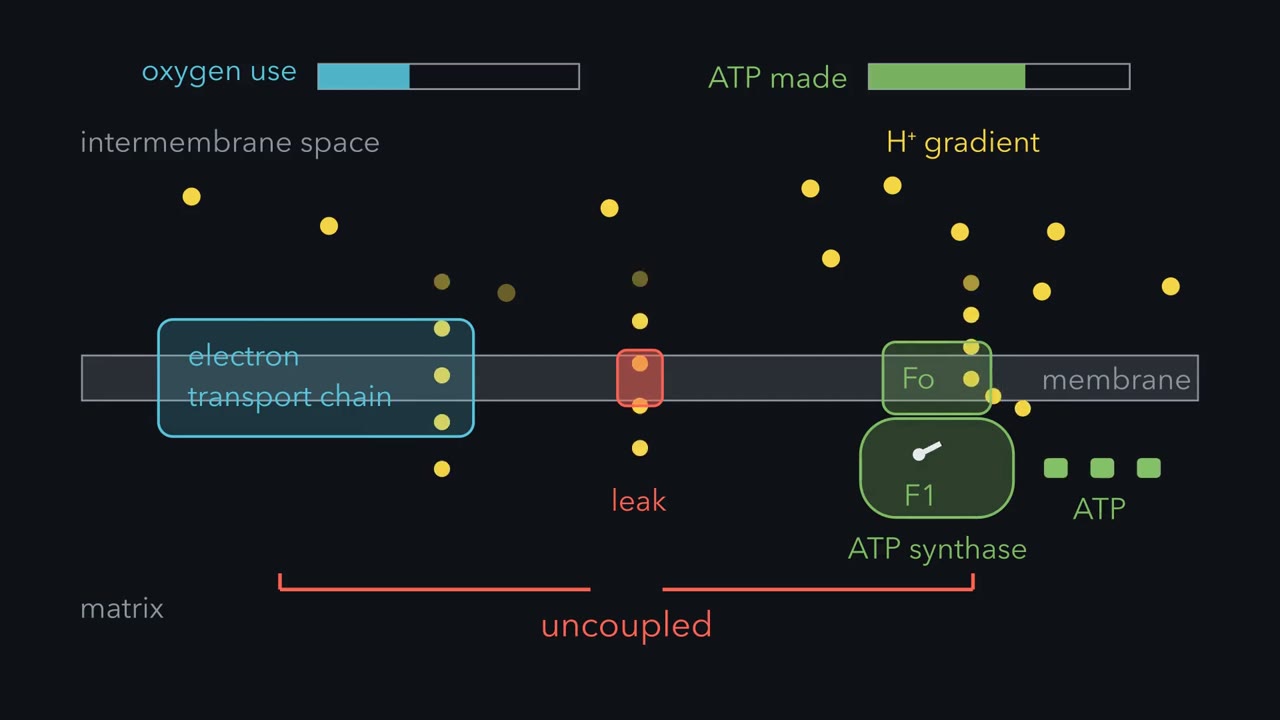
- 0:00 We have watched poisons block the proton flow, or let it leak around ATP synthase.
- 0:06 Now look inside. Protons fall through, and ATP comes out.
- 0:13 How does a falling proton pay for a chemical bond?
- 0:19 In the membrane, a ring of c subunits, the rotor, presses against a fixed subunit.
- 0:25 A proton enters a half channel and lands on an acid on the ring.
- 0:31 Only a loaded subunit can turn into the oily membrane.
- 0:35 The gradient biases the ring's random jostling, so it steps mostly one way.
- 0:41 Nearly a full turn later, the proton leaves into the matrix.
- 0:46 The ring is bolted to a bent shaft, gamma.
- 0:49 The shaft reaches into the head, in the matrix.
- 0:53 Three alpha and three beta subunits sit around it like orange segments.
- 0:58 The bent shaft presses differently on each beta, holding each in its own shape.
- 1:04 Each beta subunit is where ATP is made, from ADP and phosphate.
- 1:10 So what does the proton's energy buy?
- 1:13 Making the bond, or something else?
- 1:20 Paul Boyer turned the question inside out.
- 1:24 As the shaft turns, each beta site cycles through three shapes.
- 1:29 Open takes in ADP and phosphate.
- 1:32 Loose holds them. In Tight, ATP forms on its own, held too firmly to leave.
- 1:39 On the enzyme, making the bond costs almost nothing.
- 1:44 Here is the idea. Protons turn the shaft, and the turning pays above all to pry finished ATP loose.
- 1:52 It also drives the binding of ADP and phosphate.
- 1:56 Each one hundred twenty degree turn moves every site one step and releases one ATP.
- 2:04 John Walker later caught all three in one crystal.
- 2:08 One site held an ATP look-alike, one ADP, and one was empty.
- 2:13 Now count the price.
- 2:16 The vertebrate ring has eight c subunits, the smallest known.
- 2:21 Eight protons make one full turn, which releases three ATP.
- 2:26 That is about two point seven protons per ATP.
- 2:30 A translocase then swaps each ATP out of the matrix for ADP.
- 2:36 That swap moves charge, so the voltage takes a toll.
- 2:40 Phosphate comes in with a proton too.
- 2:43 Together, about three point seven protons per exported ATP.
- 2:48 Follow one proton.
- 2:50 It rides the ring nearly once around, and pays for an eighth of a turn.
- 2:55 The bond costs almost nothing.
- 2:58 What the proton buys, above all, is the moment a finished ATP lets go.
Chemiosmosis: the same idea, other levels
A level is a place to start, not a rank. If this loses you, the rung below teaches the same idea, told more simply.
College, upper level · the level you chose
Oxidative Phosphorylation: The Electron-Transport Chain
Block ATP synthase and oxygen use stops; add an uncoupler and it speeds up.
Biochemistry · about 24 min · film 3:54 · 5 practice questions
The Proton-Motive Force and ATP Synthase · this lesson
ATP synthase is a rotary motor: 8 protons and three ATP per turn.
Biochemistry · about 27 min · film 2:53 · 7 practice questions
Next door
- Electrochemical gradient: Two Pushes, One Hill · 3:29 · College: the core The proton gradient is a concentration difference plus a voltage, pushing protons through ATP synthase.
- Endosymbiosis: A Tap, a Hole, a Level · 3:56 · College: the core Mitochondria make ATP this way because they began as bacteria that did it first.
- Photosynthesis: Why One Photon Is Not Enough · 3:18 Chloroplasts also pump protons across a membrane, and the flow back makes the ATP that builds sugar.
- Active transport: A Path Is Not a Pump · 3:24 Pumps spend energy to push ions uphill, and here ions rolling back downhill make ATP.
More films from this lesson
Continue in the lesson: The Proton-Motive Force and ATP Synthase →
Free, with captions and a transcript. The lesson has the full text, the questions and the sources.
How this film was made. Narration: an AI narrator voice (Kokoro, af_heart) reading narration written from this lesson's text. Animation: AI-generated in code (Manim) by Claude, a schematic with no drawn molecular structures. Captions come from the narration script. See something wrong? Report it.