How Do You Know It Went In?
Read the transcript of “How Do You Know It Went In?”
Film transcript: How Do You Know It Went In?
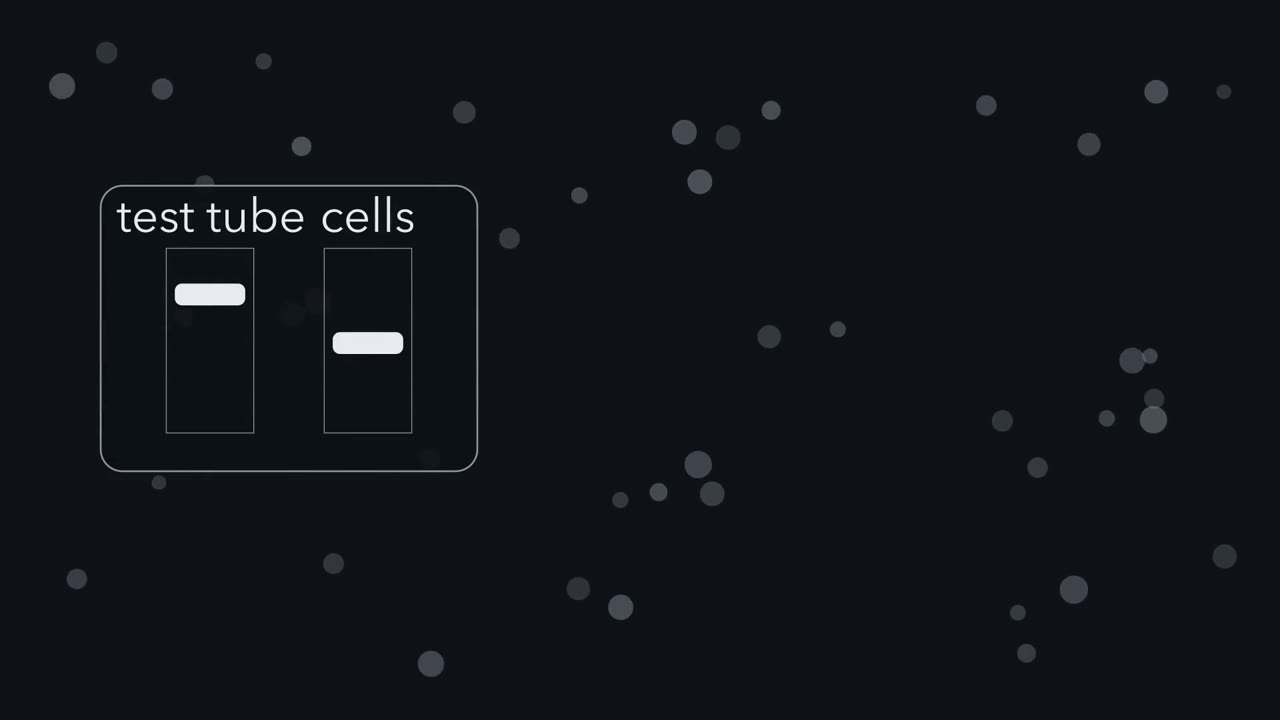
In chapter one, a stretch of the protein's own chain worked as an address. How do you know a protein really went inside? And how do you prove which stretch sent it? Start with the classic test. Make the protein in a test tube that also holds microsomes, sealed vesicles of ER membrane. Then add a protease, an enzyme that chews up exposed protein. The added protease cannot cross an intact microsome membrane. A chain outside the vesicles is chewed up. A chain inside is shielded, so its band survives on the gel. But maybe that protein simply resists protease. So add a detergent, which dissolves membranes. If the band now vanishes, the membrane was the shield.
In 1975, Blobel and Dobberstein tested an antibody light chain, a secreted protein. Globin, which stays in the cytosol, was made the same way. Which survives the protease? The light chain came out trimmed and protected. That happened only when the vesicles were there while it was being made.
Globin was not protected. The parts came from three species: rabbit ribosomes, dog membranes, and mouse messenger RNA. They still worked together. That ruled out a special secretory ribosome and supported an address in the growing protein. So here is the idea. A sorting claim needs two kinds of test. One shows the protein got in; the other shows what sent it. To find the address, there are two tests. Move a stretch onto a protein that stays in the cytosol. If that passenger moves too, the stretch is sufficient. Or delete the stretch from its own protein. If the protein is stranded in the cytosol, the stretch is necessary.
Chapter 1's mouse enzyme was the first kind. Yeast cytochrome oxidase IV precursor's first 53 amino acids carried mouse DHFR into the matrix. Adding SKL to a bacterial enzyme's carboxyl end sent it into mammalian-cell peroxisomes. Now the other test. Deleting luciferase's carboxyl tail, no more than 12 amino acids long, left it in the cytosol. A signal in that tail is necessary. Two cautions. Working for one passenger does not prove it works for every passenger. And SKL is picky. In luciferase, only a few swaps to similar amino acids kept it working. And when a protein carries two signals, only an experiment can say where it goes. Protection shows it got in; moving and deleting show what sent it.
Made in a test tube with no membranes, a secretory protein comes out longer than the one the cell secretes. Why?
Continue in the lesson: Protein Sorting into Compartments →
3:20 · Free, with captions and a transcript. The lesson has the full text, the questions and the sources.
More films from this lesson
How this film was made. Narration: an AI narrator voice (Kokoro, af_heart) reading narration written from this lesson's text. Animation: AI-generated in code (Manim) by Claude, a schematic with no drawn molecular structures. Captions come from the narration script. See something wrong? Report it.