Two Grips, One Decision
Read the transcript of “Two Grips, One Decision”
Film transcript: Two Grips, One Decision
The first film tracked one domain to its target. What changes when one protein carries several binding modules? Those modules can now influence one another's effects. Start with cellular Src as an open strip. It carries an SH3 domain, an SH2 domain, a kinase, and a short tail. Each block keeps a distinct job. Flexible connections let those blocks meet within one protein. A kinase called Csk places phosphate on a tail tyrosine. The tail bends back. Src's own SH2 pocket catches that phosphotyrosine, bringing the tail against the protein. This contact uses the reader internally. The SH3 domain catches the linker at the same time. These internal contacts settle both domains against the kinase.
Together they stabilize in an inactive shape. Neither module performs the kinase reaction itself. Now offer the SH2 domain a better external phosphotyrosine target. Predict what happens. Can Src's own tail still complete the same grip?
Compare the two targets competing for one pocket. No. The external target can occupy SH2 and pull it from the tail. Losing one internal contact loosens the clamp. Other inputs can also disturb the SH3 contact. Opening makes kinase activation more accessible. Viral Src has lost the tail and its regulatory tyrosine, along with other mutations.
Without that tail contact, the full internal clamp cannot form, so the kinase is always on. The missing module target removes an off-switch. The same modular logic can build a conditional detector. Give one protein an SH2 domain for a phosphorylated receptor and a PH domain for a membrane lipid. Join them with a flexible linker. Suppose either contact alone is too weak to retain the detector. With only the receptor mark, it visits and leaves. With only the lipid, it also visits and leaves. One input produces only a brief encounter. When both targets are close, both domains bind at once. Each contact helps keep the other within reach. The detector remains recruited only where the two inputs coincide.
Removing either target again releases it. This joint retention is avidity: two weak contacts together can behave like one much tighter interaction at that location. That is the second rule. Combining modules can make binding conditional on more than one signal. In Src, two internal contacts together hold the kinase off. In the detector, two external contacts together hold the protein in place.
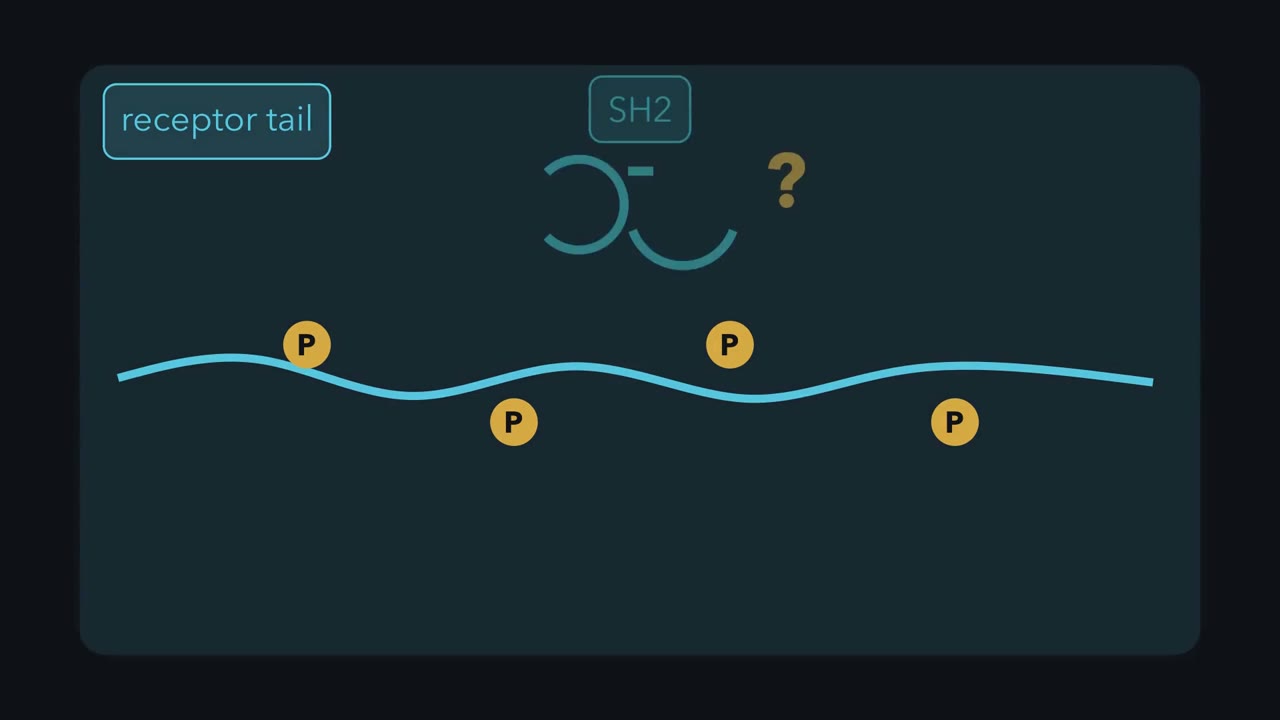
A receptor has just phosphorylated its own tyrosines. What reads the marks, and how does each reader pick its mark?
Continue in the lesson: Protein Modules: SH2, SH3, PTB, PDZ and PH →
3:30 · Free, with captions and a transcript. The lesson has the full text, the questions and the sources.
More films from this lesson
How this film was made. Narration: an AI narrator voice (Kokoro, af_heart) reading narration written from this lesson's text. Animation: AI-generated in code (Manim) by Claude, a schematic with no drawn molecular structures. Captions come from the narration script. See something wrong? Report it.