Read as Stretch
Read the transcript of “Read as Stretch”
Film transcript: Read as Stretch
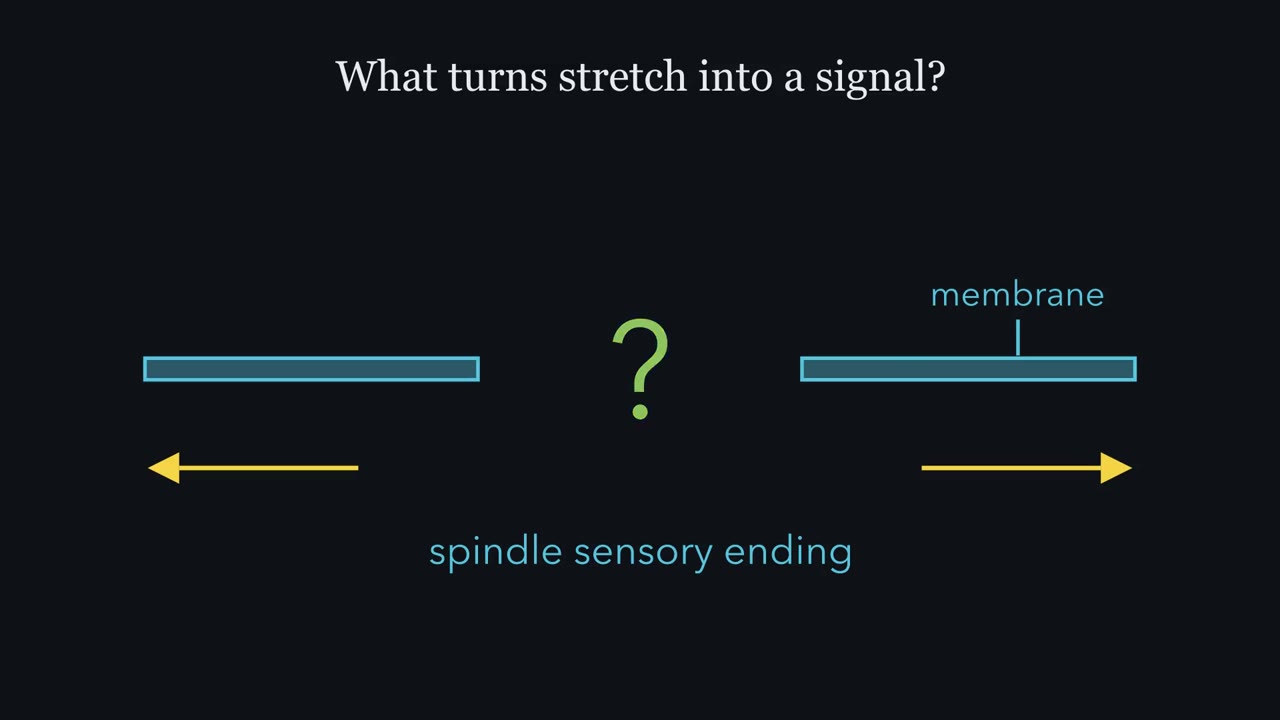
Close your eyes. Where is your elbow? You know without looking. But how? Inside limb muscles lie stretch sensors called muscle spindles. They sit alongside the ordinary fibres. Stretch the muscle, and the spindle stretches too. Its sensory endings fire faster. The primary ending, called type Ia, is especially sensitive to small, rapid stretches. A vibrator on a tendon delivers exactly that. Many tiny stretches, every second. Goodwin, McCloskey and Matthews held a vibrator on the biceps tendon, at 100 Hz. The elbow did not move. The biceps runs in front of the elbow. It gets longer as the arm straightens. Predict. If the brain reads the biceps spindles' firing as biceps stretch, which way should the elbow seem to move?
Toward a straighter arm. Subjects judged the elbow to be where it would be if the vibrated muscle had been stretched. Vibrate the triceps, behind the elbow, and the arm seemed more bent. During contraction, the error could reach 40 degrees in that experiment. It is not a standard size.
A spindle's firing carries no label of its cause. With the arm still and unseen, the brain read it as stretch. The one idea: limb position is an estimate, built mainly from spindle signals of muscle length. Skin, joint and motor-command signals are added to that estimate. So in a still, unseen arm, vibrating one tendon usually biases the estimate toward that muscle being stretched. A typical direction, not a guaranteed response. And when proprioceptive input is severely impaired, accurate movement depends heavily on vision. In touch and pain, capsaicin opened the heat channel TRPV1 on pain fibres. It felt hot, with no heat. Here, a vibrator drives spindle endings while the joint stays still.
One caveat. Primary endings are the likely carriers. In a small leg-muscle sample, they tended to respond more to low-amplitude vibration than secondary endings. But in contracting muscle, secondary endings and tendon organs respond too. So primary endings are not shown to act alone. So vibrating one tendon can make a still limb feel moved. The brain reads the extra spindle firing as stretch.
Vibrate a tendon at 100 Hz and a person with their eyes closed misjudges the position of the elbow, by as much as 40 degrees when the muscle is contracting.
Continue in the lesson: Proprioception: Sensing the Body's Own Position →
2:51 · Free, with captions and a transcript. The lesson has the full text, the questions and the sources.
More films from this lesson
How this film was made. Narration: an AI narrator voice (Kokoro, af_heart) reading narration written from this lesson's text. Animation: AI-generated in code (Manim) by Claude, a schematic with no drawn molecular structures. Captions come from the narration script. See something wrong? Report it.