Why Real Counts Wander
Read the transcript of “Why Real Counts Wander”
Film transcript: Why Real Counts Wander
The first film built a Punnett square for Pp parents. Why might their real offspring counts miss its predicted ratio? A square gives each new plant a chance. A real group records what happened after those separate chances played out.
Think of the square as a chance map, not a packing list. For every new offspring, one box is selected by the parents’ allele contributions. Then the process starts again. Earlier flowers do not remove boxes or force later results. The map resets without remembering the last selection. Watch a small computed example. Several selectors land, and flowers fill the short row. The colors form an uneven group. That does not make the square wrong. A small group leaves plenty of room for chance to swing the count. Another short run could lean differently. The short row has leaned toward one color. The next slot is still empty. Does the earlier run force the next flower to balance the group, or does the same chance map apply again?
Make your prediction. The same chance map applies again. The next result is not a correction chosen by the earlier results. Each offspring is a separate chance. The group may move nearer the prediction or farther away before later results add more evidence. Now extend the computed run. More flower slots stream in while the bars rescale. The observed share still wiggles, but its swings usually shrink. With more separate outcomes, an unusual short streak has less control over the whole group. The curve approaches its target unevenly, not in a straight march.
Mendel tested the pattern with real pea plants. He counted offspring for several traits, not just one small family. Place each dominant-to-recessive ratio beside the square’s target. The rows gather near the target, but they do not land exactly together. That spread is the evidence to examine. A prediction is useful when many real results gather near it, even without an exact match. No single row must sit exactly on the target. In the lesson, you will compare counts, ratios and group sizes yourself. The square remains a one-gene model. Weather, soil, lost seeds, and more complex inheritance are outside it. Within its scope, it gives a clear target for repeated outcomes.
Larger groups usually reveal that target more clearly than small groups do.
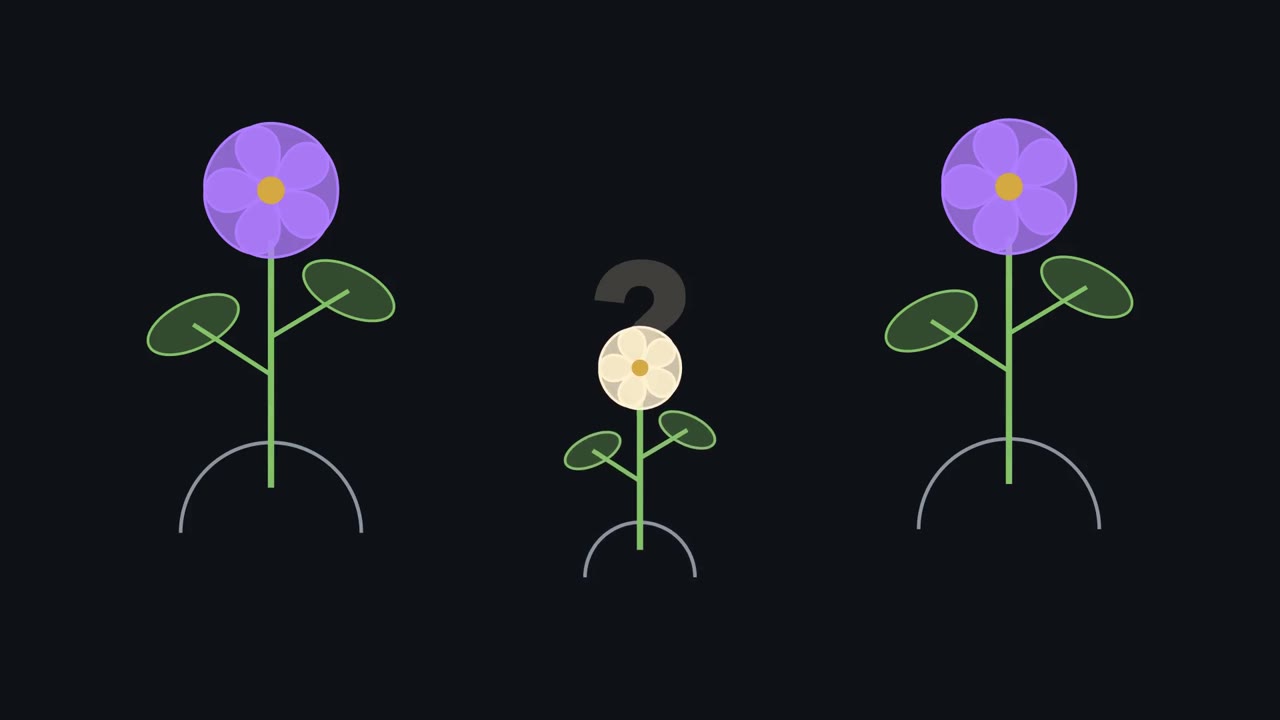
How can two purple-flowered pea plants have a white-flowered offspring?
Continue in the lesson: Predicting Traits with Punnett Squares →
3:08 · Free, with captions and a transcript. The lesson has the full text, the questions and the sources.
More films from this lesson
How this film was made. Narration: an AI narrator voice (Kokoro, af_heart) reading narration written from this lesson's text. Animation: AI-generated in code (Manim) by Claude, a schematic with no drawn molecular structures. Captions come from the narration script. See something wrong? Report it.