Fifteen to Eight
Read the transcript of “Fifteen to Eight”
Film transcript: Fifteen to Eight
The first film showed each kill entered in two ledgers. Now follow the kills one link further, to the species the prey compete with. You might expect every species a predator eats to do better without it. So what happens to a rocky shore when its sea star is gone? On this rocky shore, space on the rock is a limiting resource: its supply caps the populations that use it. Mussels are the strongest competitors for that space. The sea star Pisaster ochraceus eats mussels. It also eats barnacles, chitons, limpets and snails. Follow the orange arrows to each of its prey. In the early 1960s, Robert Paine began keeping Pisaster off one patch of shore at Mukkaw Bay, Washington.
He left a neighbouring stretch alone as a control, and surveyed both along line transects. The predator is gone from the patch. Will the number of species holding space on the rock go up, or down? Down. By his 1966 report, the removal patch held 8 species on the rock instead of 15. The control did not lose species in the same way. Here is how the patch filled. Acorn barnacles settled first and took most of the open rock. Then small mussels and gooseneck barnacles crowded them out. Algae lost their space. With Pisaster eating mussels, space kept opening for weaker competitors. Without it, mussels took the rock. The sea star raised richness by freeing space, not by eating species that harmed the rest.
Now look at one chiton. Pisaster eats chitons, so the sea star costs it some lives. But the sea star also keeps mussels off the rock, which keeps the chitons' space and food. Two arrows, with opposite signs. Without the sea star, chitons left the patch for lack of space and food. So here, the sea star's indirect help to some of its own prey outweighed what it ate. In a short note three years after his report, Paine used the word keystone. A keystone species has an effect on its community that is large relative to its abundance. Eating the dominant competitor, and so helping weaker ones, is called keystone predation. But this was one removal patch and one control.
It was a strong local result, not yet a general law. So a predator's effects can run through the species it eats, to the species they compete with. On Paine's shore, they did.
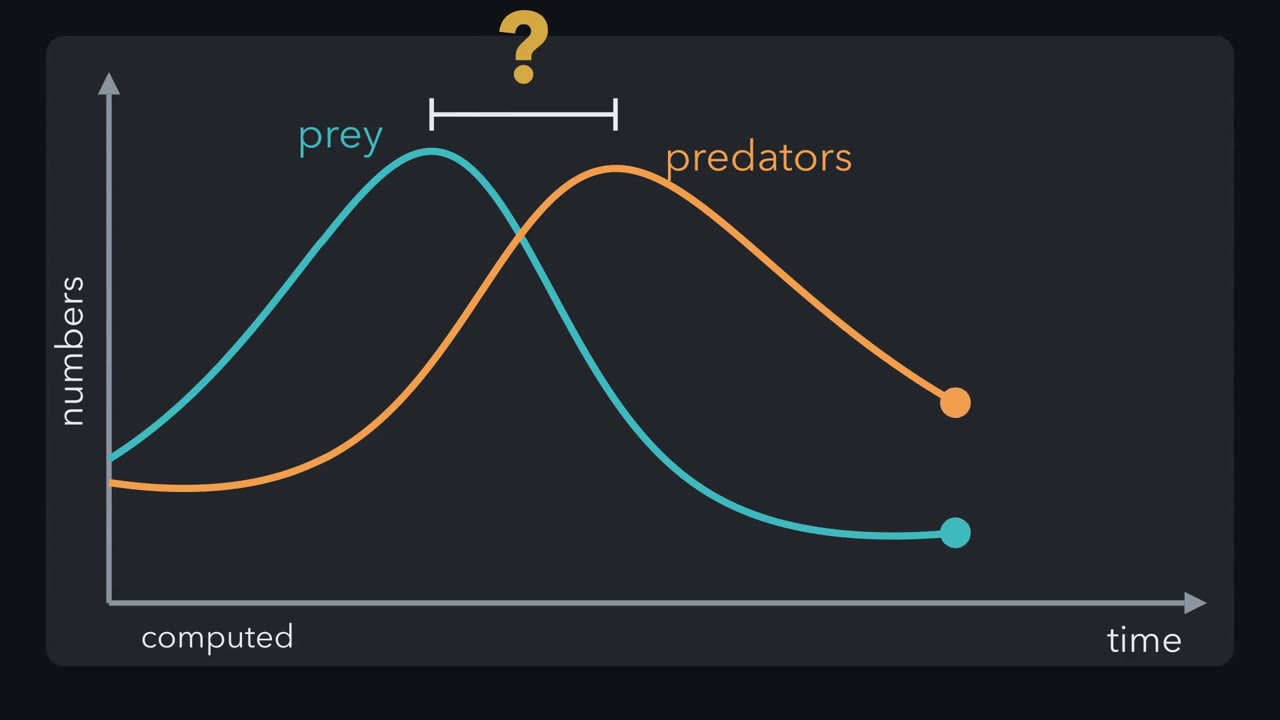
If predators eat prey, why do predator numbers keep climbing after the prey have started to fall?
Continue in the lesson: Predation and Community Effects →
3:07 · Free, with captions and a transcript. The lesson has the full text, the questions and the sources.
More films from this lesson
How this film was made. Narration: an AI narrator voice (Kokoro, af_heart) reading narration written from this lesson's text. Animation: AI-generated in code (Manim) by Claude, a schematic with no drawn molecular structures. Captions come from the narration script. See something wrong? Report it.