Two Ledgers, One Kill
Read the transcript of “Two Ledgers, One Kill”
Film transcript: Two Ledgers, One Kill
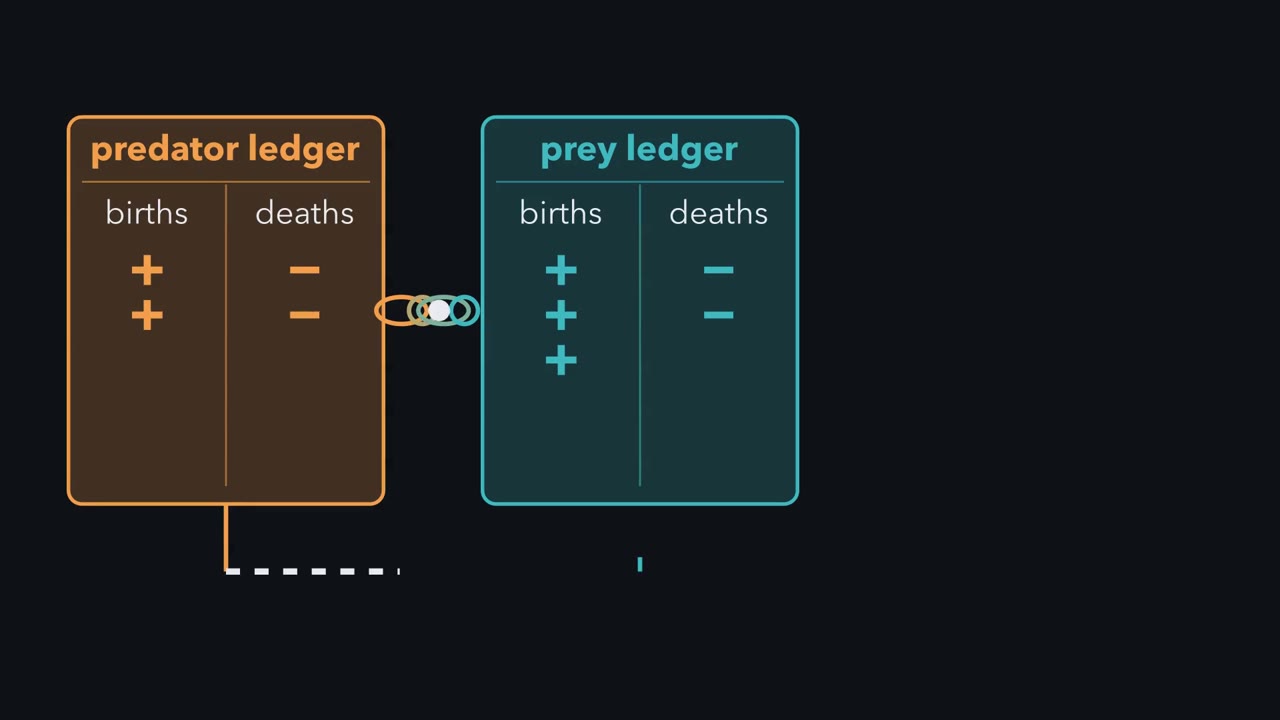
If predators eat prey, why do predator numbers keep climbing after the prey have started to fall? The answer is in how one kill is counted. Every population keeps a ledger of births and deaths. Births push its numbers up, and deaths pull them down. Here are two ledgers, one for prey and one for predators. Now watch the kills. Each is a death in the prey's ledger. Each is also food, and on average, predators turn that food into births. So every kill is entered twice. That double entry ties the two ledgers together. The more predators there are, the faster each prey dies. The more prey there are, the faster predators breed. First ask when the prey stop changing.
Each prey's birth rate stays fixed, but its risk of death grows with every predator. At one predator number, P*, the two balance. Now ask when the predators stop changing. Each predator must eat enough prey to replace itself. That happens at one prey number, N*. With more prey, predators increase. With fewer, they decrease.
Put both thresholds on one picture, with prey across and predators up. The two lines cut it into four zones. Each zone has its own pair of directions. Start a dot in the bottom right, with many prey and few predators. Following the arrows, it circles the crossing point counter-clockwise, and returns to where it began. Stop the dot where the prey curve reaches its top. The prey have just peaked. Are the predators rising or falling?
Still rising. The prey are falling, but there are still more of them than N*. So each predator still eats more than it needs to replace itself. The predators peak only when the prey drop through N*. So the predator peak comes after the prey peak. Nothing in the model builds in a delay. The lag comes from the bookkeeping. Start the dot somewhere else, and it traces a different loop. In this classical model, each start with both populations present and away from the crossing point keeps its own loop. Where it starts sets the size of the cycle. So every kill, entered in both ledgers, ties them together. In this simple model, each population's per capita growth rate is set by the other's numbers.
If predators eat prey, why do predator numbers keep climbing after the prey have started to fall?
Continue in the lesson: Predation and Community Effects →
2:59 · Free, with captions and a transcript. The lesson has the full text, the questions and the sources.
More films from this lesson
How this film was made. Narration: written from this lesson's text and read by an AI narrator voice (Kokoro, af_heart). Animation: AI-generated in code (Manim) by Claude, a schematic with no drawn molecular structures. Captions come from the narration script. See something wrong? Report it.