Four Ways a Population Changes
Read the transcript of “Four Ways a Population Changes”
Film transcript: Four Ways a Population Changes
How can the Bay's crab estimate jump when the Bay has not grown? Watch a survey boat cross the winter water. Its dredge catches some crabs buried in the mud. Those catches become an estimate for the whole Bay. A moving estimate does not require a moving shoreline.
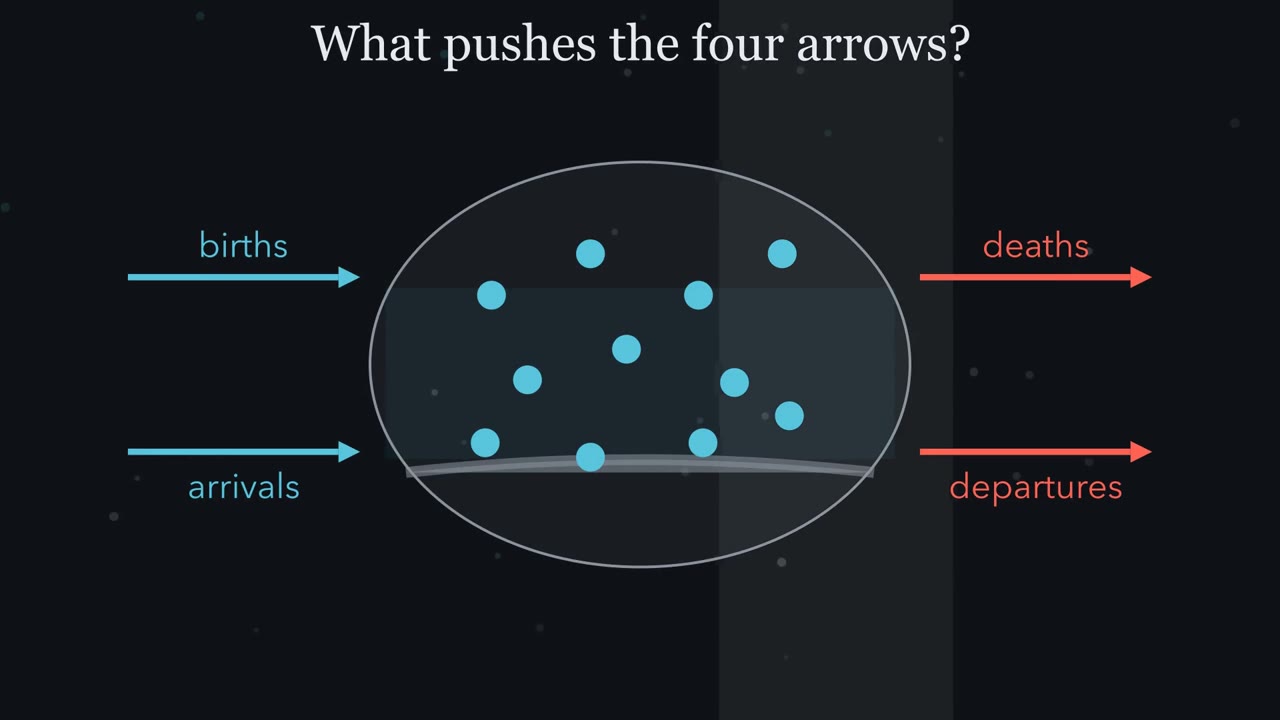
The earlier estimate appears as a bar. The next estimate appears beside it, much taller. These are estimates, not exact counts. The survey pattern is real, but it does not tell us the cause. So read height before hunting for explanations. To explain the change, begin with a population. A population is every member of the same species living in the same place. Put the Bay's crabs inside one window. Now track what enters and leaves that window. The boundary matters because movement crosses it. To explain the change, begin with the bays crabs inside one window. Births add crabs inside the window. Arrivals add crabs moving in. Deaths remove crabs.
Departures remove crabs moving out. Call births and arrivals additions. Call deaths and departures losses. Population change is the balance between them. Additions and losses can occur at the same time while the population changes. Imagine the loss arrows getting wider while the addition arrows stay unchanged.
What should happen to the number of crabs inside? Follow the arrows before you decide. Watch the balance, not any single dot. The number falls because losses now exceed additions. Reverse the balance, and the number rises. Match the arrows, and the number stays steady. This gives the rule: populations rise when additions exceed losses, and fall when losses exceed additions. The dots show direction, not a forecast. A limiting factor changes at least one addition or loss. A very cold winter can increase deaths. Better shelter can lower deaths among young crabs. Heavy harvest increases losses caused by people. Each factor matters through the same balance.
Different factors can push the same arrow. The balance tells whether a population rises or falls over a chosen time. It cannot identify a cause by itself. Scientists need measurements of cold, shelter, predators, harvest, and other factors. The survey gives the pattern. Evidence about the arrows tests explanations. That extra evidence separates a pattern from a tested cause. Return to the winter bars. If the estimates are close to the truth, their jump means additions beat losses during the interval. The bars alone cannot say why. Keep the Bay window in mind. Every explanation must show which addition or loss changed, and what evidence supports it.
How can the Bay's blue crab estimate more than double when the Bay does not get bigger?
Continue in the lesson: Populations Rise and Fall →
3:30 · Free, with captions and a transcript. The lesson has the full text, the questions and the sources.
More films from this lesson
How this film was made. Narration: written from this lesson's text and read by an AI narrator voice (Kokoro, af_heart). Animation: AI-generated in code (Manim) by Claude, a schematic with no drawn molecular structures. Captions come from the narration script. See something wrong? Report it.