Films · Genetics and Molecular Biology
What Moves Allele Frequencies?
Read the transcript of “What Moves Allele Frequencies?”
Film transcript: What Moves Allele Frequencies?
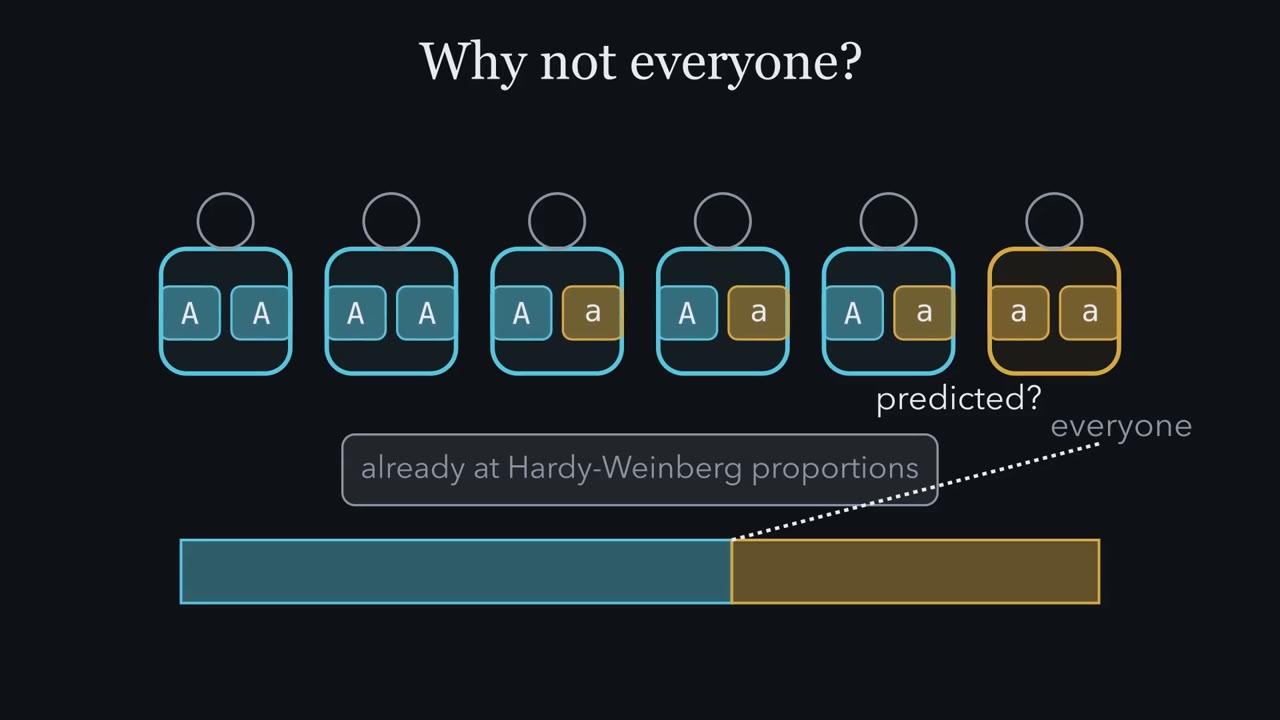
The first film left the blue and gold allele bar unchanged after mating. What must happen to move that boundary? Keep following copies as different processes act on the population. The answer depends on what touches those copies.
Selection acts when genotypes leave different numbers of surviving offspring. Suppose a genotype contributes fewer copies to the next pool. The bar moves predictably toward the copies contributed more often. Which genotype has that advantage depends on the environment. So the direction can change when the environment changes. Migration moves copies between populations. Pour a small stream from a population with a different allele mix into the resident pool. The new frequency becomes a weighted average. It shifts toward the migrants' mix. The amount of movement depends on the migrants' share. Mutation changes the identity of a copy. A blue block flips to gold as it enters the next pool.
That creates a new route between allele states. At a human locus, the immediate frequency change is usually weak. Mutation supplies variation on which other forces act. Now copy the same small population twice. Each copy samples its next generation by chance. Both begin with the same copy inventory.
Predict the result. Must both allele bars move together, or can identical starting populations separate without selection? They can separate. Drift is random sampling of allele copies between generations. One sample happens to take more blue; another takes more gold.
Across many repeats there is no preferred direction, but small populations spread widely. Non-random mating produces a different signature. Relatives, or partners alike in a trait this locus affects, pair more often. So homozygotes can increase while heterozygotes decrease. Yet every blue and gold copy remains. The bar therefore stays in the same place. Mating pattern alone changes genotype frequencies, not allele frequencies. These processes can overlap, so an unusual sample rarely names a cause. A heterozygote deficit might reflect non-random mating, mixed populations, or genotyping error. A pattern can therefore support several explanations.
Population genetics compares predictions with patterns, then asks for independent evidence. Track what each process touches. Selection changes contribution. Migration changes membership. Mutation changes identity. Drift changes the sample. Non-random mating changes pairing. The moving bar is evidence to explain, not a label for one cause. Forces change allele frequencies in distinct, testable ways. Follow the copies, compare the expected signature with the data, and keep alternative causes open until more evidence separates them.
If a trait is dominant, why does it not take over a population?
Continue in the lesson: Population Genetics: Hardy-Weinberg and Evolutionary Forces →
3:48 · Free, with captions and a transcript. The lesson has the full text, the questions and the sources.
More films from this lesson
How this film was made. Narration: an AI narrator voice (Kokoro, af_heart) reading narration written from this lesson's text. Animation: AI-generated in code (Manim) by Claude, a schematic with no drawn molecular structures. Captions come from the narration script. See something wrong? Report it.