One Cut, Two Destinations
Read the transcript of “One Cut, Two Destinations”
Film transcript: One Cut, Two Destinations
How can one cut at a membrane send one signal inward while keeping another at the surface? Follow a single plasma membrane closely around one cell. The answer depends on where each product can go after the cut. The starting block is PIP2, a lipid in the inner leaflet of the plasma membrane. Its oily tails stay buried, while its charged head faces the watery cytosol. The same lipid serves as an address label and a stored signal. Phospholipase C approaches from inside the cell. The enzyme cuts between the head and the glycerol carrying the tails. Both products begin at the same tiny patch of membrane. Which product can leave the bilayer? Choose the phosphate-rich head or the oily pair of tails.
IP3 carries three phosphates, so it dissolves in cytosol and moves away. DAG keeps two oily tails, so it stays in the inner leaflet. Their different chemistry creates a moving branch and a local membrane branch. One cut has created two second messengers in different places. Different receptors can start the same cut. A G-protein-coupled receptor activates Gq, which activates PLC-beta. A receptor tyrosine kinase displays phosphorylated tyrosines, where SH2 domains dock PLC-gamma. Docking places PLC-gamma beside the receptor kinase. The kinase phosphorylates it and releases its internal brake. Both enzymes then make the same cut, producing IP3 and DAG.
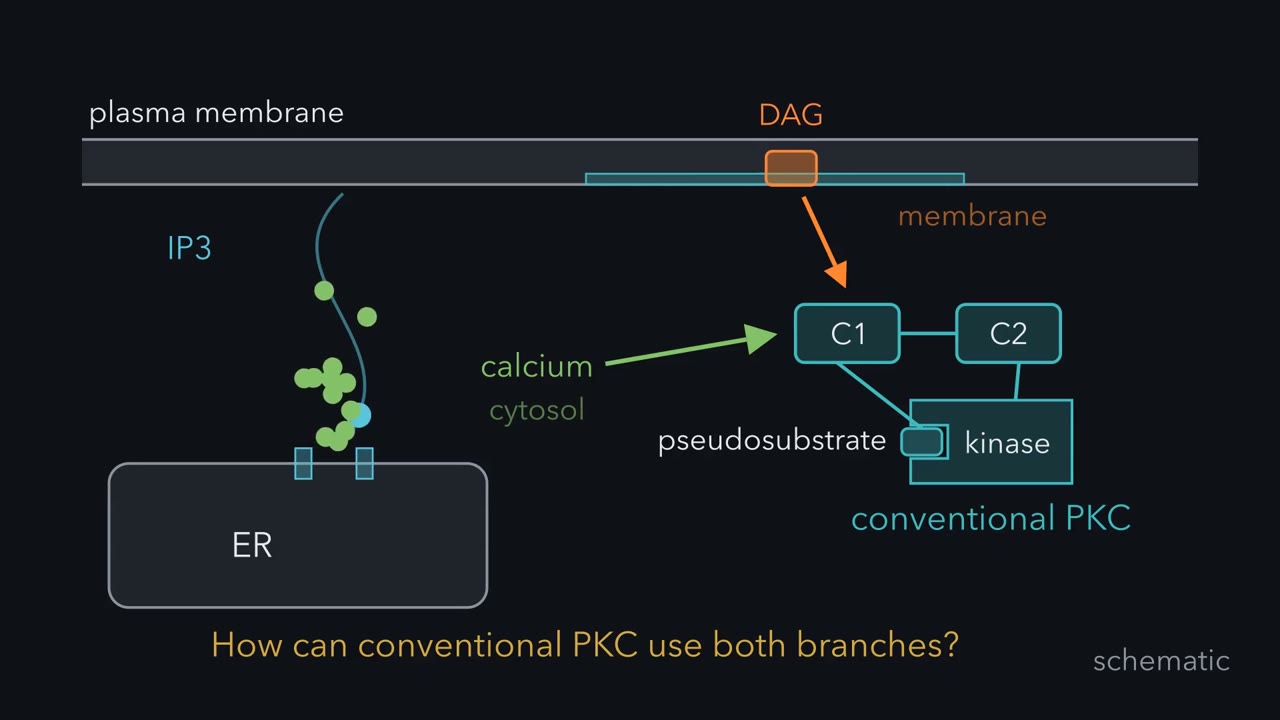
Now follow IP3. It crosses the cytosol and binds an IP3 receptor in the endoplasmic reticulum. That receptor is a calcium channel. IP3 does not carry calcium; it opens the route out. The channel opens, and green calcium dots flow from the store into cytosol. Researchers tested whether IP3 was sufficient without a hormone. They made a cell surface leaky while internal stores stayed sealed. No outside hormone was present. Added IP3 released calcium from a nonmitochondrial store. That separation of cause from hormone made IP3 a true messenger. Later work identified the store as endoplasmic reticulum. Return to the original cell. The moving branch is IP3, which opens the calcium channel.
The local branch is DAG, still marking the membrane. Keep this rule: one PIP2 cut sends IP3 away and leaves DAG at the membrane.
How does a kinase know that a receptor has just cut a lipid, here and now?
Continue in the lesson: PLC, IP3, DAG and Protein Kinase C →
3:16 · Free, with captions and a transcript. The lesson has the full text, the questions and the sources.
More films from this lesson
How this film was made. Narration: written from this lesson's text and read by an AI narrator voice (Kokoro, af_heart). Animation: AI-generated in code (Manim) by Claude, a schematic with no drawn molecular structures. Captions come from the narration script. See something wrong? Report it.