Pushed From the Source
Read the transcript of “Pushed From the Source”
Film transcript: Pushed From the Source
Sugar made in a leaf ends up in a root below it and a shoot tip above it. What moves it both ways, with no heart and nothing pulling? Water in the xylem is pulled toward dry air. Sugar rides in the phloem, in living sieve tubes. And nothing evaporates at a root to pull it. In 1930, Ernst Münch pictured two bulbs joined by a tube. Each is wrapped in a membrane that lets water through but holds sugar back. Both sit in water. Put strong sugar solution in one bulb. The sugar lowers its water potential, so water rushes in by osmosis. The pressure inside rises. That pressure pushes the solution along the tube toward the other bulb. The sap flows in bulk, from higher pressure to lower.
In the plant, a leaf making sugar is the first bulb, the source. A root, a fruit or a shoot tip using sugar is the second bulb, a sink. At a sink, sugar is removed, water leaves, and the pressure falls. The xylem alongside supplies the water at the source. Sap flows from source to sink, wherever the sink sits. So it can run down to the roots or up to a growing shoot tip. For decades there was an objection.
Sieve tubes are narrow, and blocked at intervals by perforated end walls, the sieve plates. Pushing sap through metres of them seemed to need impossible pressures. In 2016, Michael Knoblauch, Michele Holbrook and colleagues tested this in the morning glory. They measured the pressure inside working sieve tubes with tiny probes. Then they made the sugar's path longer, by removing leaves from long vines.
Now the sugar had to travel much farther to reach the roots. With the same narrow tubes, the pressure needed would soar. If you make the path much longer, what must change for the sap still to arrive? Two things changed together. First, source pressure rose with path length. It passed 2.2 MPa in the longest vine. Second, the tubes conducted five to six times better, mainly because the sieve-plate pores were wider. With both changes, the estimated reach of pressure flow matched the length of the vine. That is one species, measured with care. The authors read it as strong support for pressure flow in this plant. Where sugar goes in, water follows and the pressure rises.
Sap is pushed to wherever sugar is taken out.
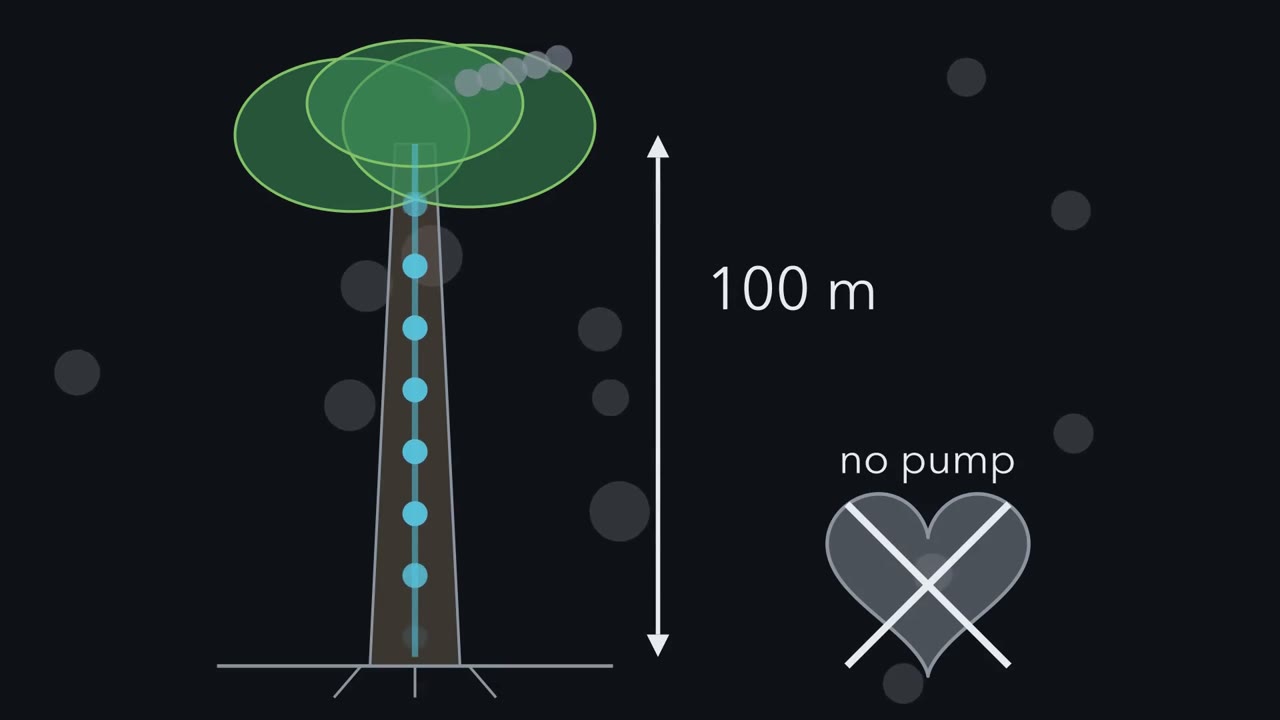
A coast redwood lifts water more than 100 m with no heart or other pump organ. Where does the force come from?
Continue in the lesson: Moving Water and Sugar in Plants →
3:05 · Free, with captions and a transcript. The lesson has the full text, the questions and the sources.
More films from this lesson
How this film was made. Narration: an AI narrator voice (Kokoro, af_heart) reading narration written from this lesson's text. Animation: AI-generated in code (Manim) by Claude, a schematic with no drawn molecular structures. Captions come from the narration script. See something wrong? Report it.