Same Auxin, Opposite Bends
Read the transcript of “Same Auxin, Opposite Bends”
Film transcript: Same Auxin, Opposite Bends
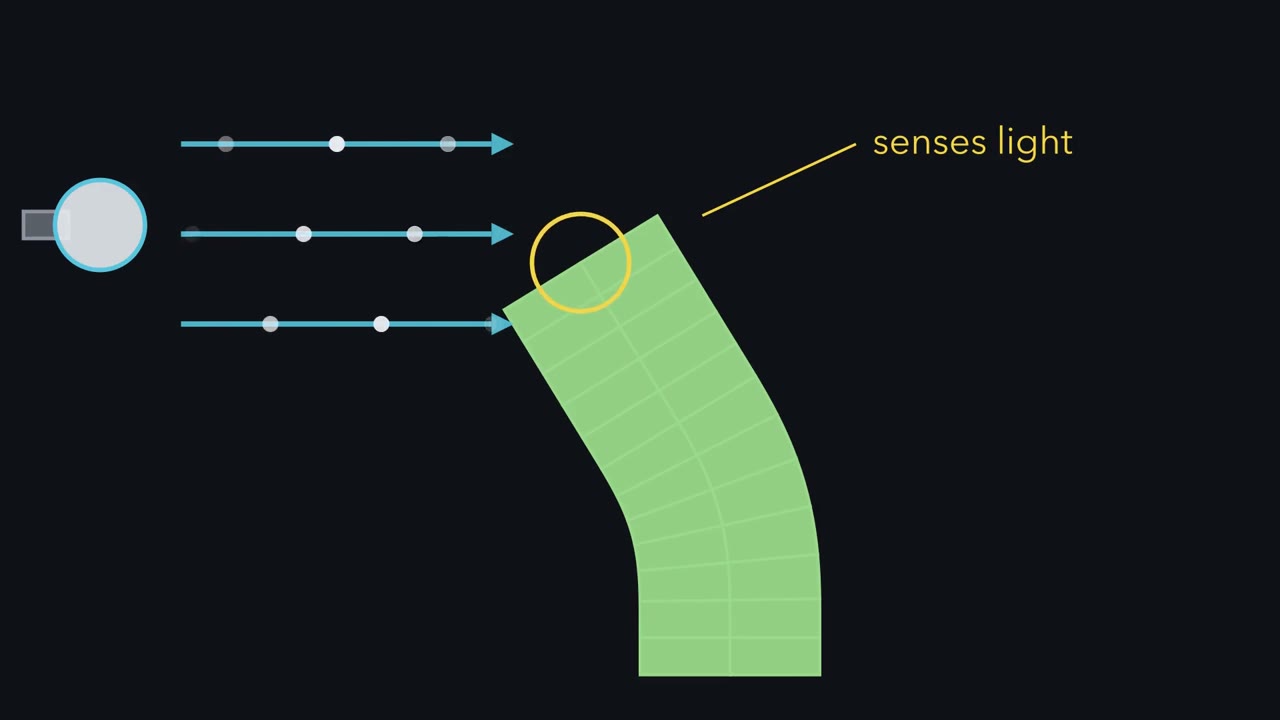
Lay a seedling on its side. Its shoot turns up, and its root turns down. Yet both gather auxin on their lower side. How can one signal give opposite bends? The first film showed light moving auxin to the shaded flank, which grew faster.
Gravity moves auxin too. Same gold dots, new direction. This time, though, the shoot and the root disagree. First, the plant must sense which way is down. In the root cap, central cells called columella cells hold plastids packed with dense starch. Turn the root on its side, and these heavy plastids sink to the new floor of each cell. They act as statoliths, one of the root's gravity sensors. Auxin leaves cells through carriers called PIN proteins. In Arabidopsis root-cap cells, one carrier, PIN3, moves quickly to the new lower face. So auxin flows toward the lower side of the root. In the shoot, extra auxin gathers along the lower flank too.
You met the rule at the start of the lesson. Now apply it to the root. Auxin piles up on its lower flank. Does that flank grow faster or slower than the top? Slower. In the root, this auxin inhibits elongation of the lower epidermal cells. The upper flank outgrows it, and the root curves down. In the shoot, extra auxin speeds elongation of the lower flank. So the shoot curves up. Why opposite answers? Plot growth against auxin level for each organ. Each curve rises to a peak, then falls. Roots respond to much lower auxin levels than shoots. So the root's curve sits far to the left. Where does each organ work on its curve? In the classic picture, a shoot works on its rising slope.
There, more auxin means faster growth. A root works past its peak. There, more auxin means slower growth. So the same kind of signal gives opposite bends. But these curves give the sign of each bend, not its cause. Each tissue turns auxin into growth in its own way. Why roots are so sensitive is still not fully explained. The plant is not reaching for anything. Light or gravity, the rule is the same. The plant moves auxin to one flank. That flank grows faster in a shoot, and slower in a root.
Light an oat seedling from one side and it bends toward the lamp. The tip senses the light, yet the bend forms lower down. What told it?
Continue in the lesson: Auxin and Plant Hormones: How Plants Steer Growth →
2:59 · Free, with captions and a transcript. The lesson has the full text, the questions and the sources.
More films from this lesson
How this film was made. Narration: an AI narrator voice (Kokoro, af_heart) reading narration written from this lesson's text. Animation: AI-generated in code (Manim) by Claude, a schematic with no drawn molecular structures. Captions come from the narration script. See something wrong? Report it.