Which Side Grows Faster?
Read the transcript of “Which Side Grows Faster?”
Film transcript: Which Side Grows Faster?
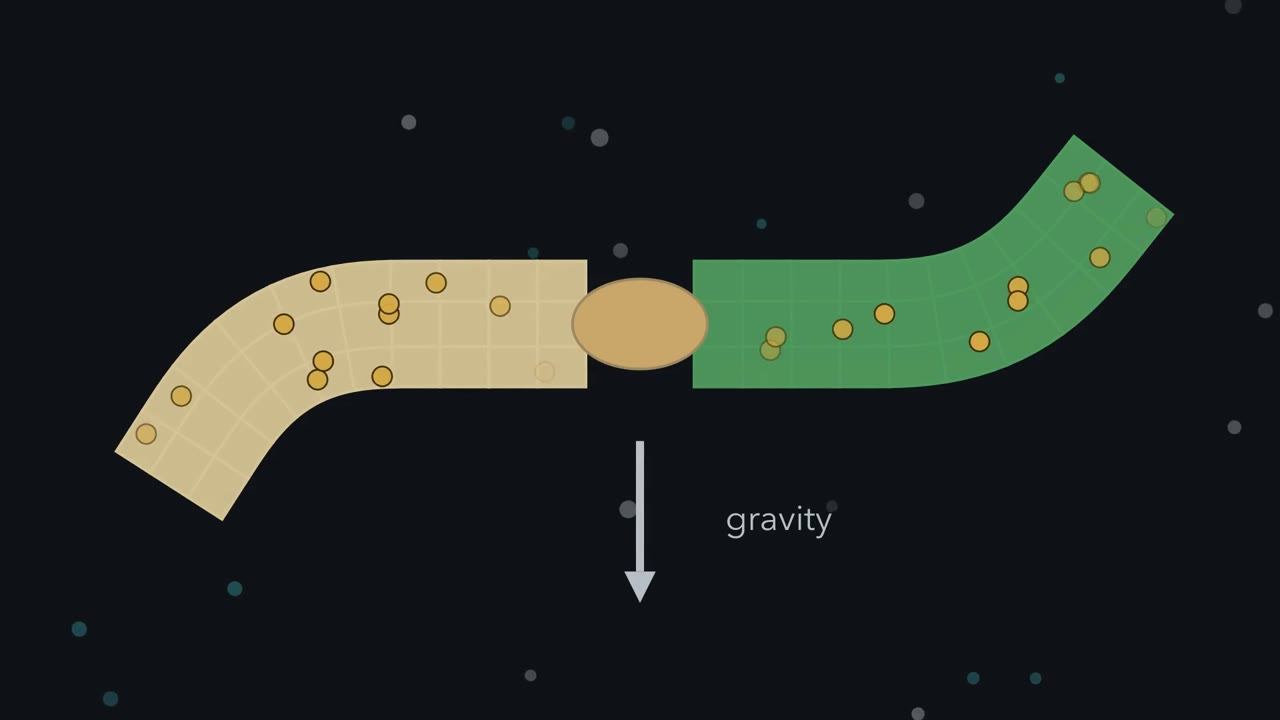
Light an oat seedling from one side, and it bends toward the lamp. The tip senses the light, yet the bend forms lower down. What carries the message? Picture the young shoot as two columns of cells, one on each side. Each side is called a flank. If both flanks lengthen by the same amount, the shoot grows taller. But it stays perfectly straight, however much it grows. Now let the shaded flank lengthen a little more than the lit flank. The shoot curves toward the light. A bend is simply a difference in growth. So what speeds the shaded flank? Charles Darwin and his son Francis lit canary-grass seedlings from one side. An opaque cap over the tip greatly reduced the bending.
The lower part was still lit. So light is sensed mainly near the tip, and something passes down to where bending happens. Peter Boysen-Jensen used oat coleoptiles, the sheath over a grass seedling's first leaf. He slipped thin mica, which dissolved chemicals cannot cross, into a cut below the tip. With mica on the shaded side, the coleoptile stayed straight. With mica on the lit side, it still bent. Boysen-Jensen concluded that the signal runs down the shaded side. Frits Went then stood cut tips on small blocks of agar, a gel. In darkness, he set one block on one side of a coleoptile whose own tip was cut off. The coleoptile curved away from the block.
Something from the tips had sped growth beneath it. We now call that activity auxin. Why does the shaded flank end up with more auxin? Light could destroy auxin on the lit side. Or light could move auxin across to the shaded side. Here is the test. Collect all the auxin from tips lit on one side, and from tips kept dark. If light only moves auxin, how should the totals compare?
Briggs and colleagues split tips with a thin barrier and caught each half in its own block. Lit tips gave the same total as dark tips. But more came from the shaded half. So in these grass tips, the unchanged total supports auxin moving to the shaded side, rather than being destroyed. The auxin-rich shaded flank grew faster, and the shoot bent toward the light. Growth follows the auxin level, but not in strict proportion. It rises to a peak. Past that peak, more auxin slows growth. So a bend is a difference in growth. Light makes that difference by moving auxin to the shaded flank.
Light an oat seedling from one side and it bends toward the lamp. The tip senses the light, yet the bend forms lower down. What told it?
Continue in the lesson: Auxin and Plant Hormones: How Plants Steer Growth →
3:10 · Free, with captions and a transcript. The lesson has the full text, the questions and the sources.
More films from this lesson
How this film was made. Narration: written from this lesson's text and read by an AI narrator voice (Kokoro, af_heart). Animation: AI-generated in code (Manim) by Claude, a schematic with no drawn molecular structures. Captions come from the narration script. See something wrong? Report it.