Whose Cells Are in a Seed?
Read the transcript of “Whose Cells Are in a Seed?”
Film transcript: Whose Cells Are in a Seed?
Break open a maize kernel. Part of it is a baby plant, part is its food, and part is a wrapper. Which parts came from the father? We can answer by counting chromosome sets. One set is the chromosomes of one egg or one sperm. The mother's sets will be magenta blocks. The father's will be teal. Start with the father. A pollen grain is not a sperm. It is a tiny separate generation of the plant, two or three cells, and it makes two sperm. Every cell in the grain carries one set from the father. The grain lands on a stigma, the sticky tip that catches pollen. It grows a tube down to an ovule, and the two sperm ride inside. Inside the ovule waits the mother's tiny generation, the embryo sac.
It comes from one spore, so its nuclei are all copies of one maternal set. Three kinds of cells matter. The egg holds one magenta block. The large central cell holds two identical copies of that same set. Two synergids sit beside the egg. The synergids signal to the tube. The tube bursts into one of them and releases both sperm. One sperm fuses with the egg. That makes the zygote, which grows into the embryo. Its stack is one magenta block and one teal. The other sperm fuses with the central cell. That cell already holds two copies of the mother's set. How many blocks will the new tissue carry? How many are the father's?
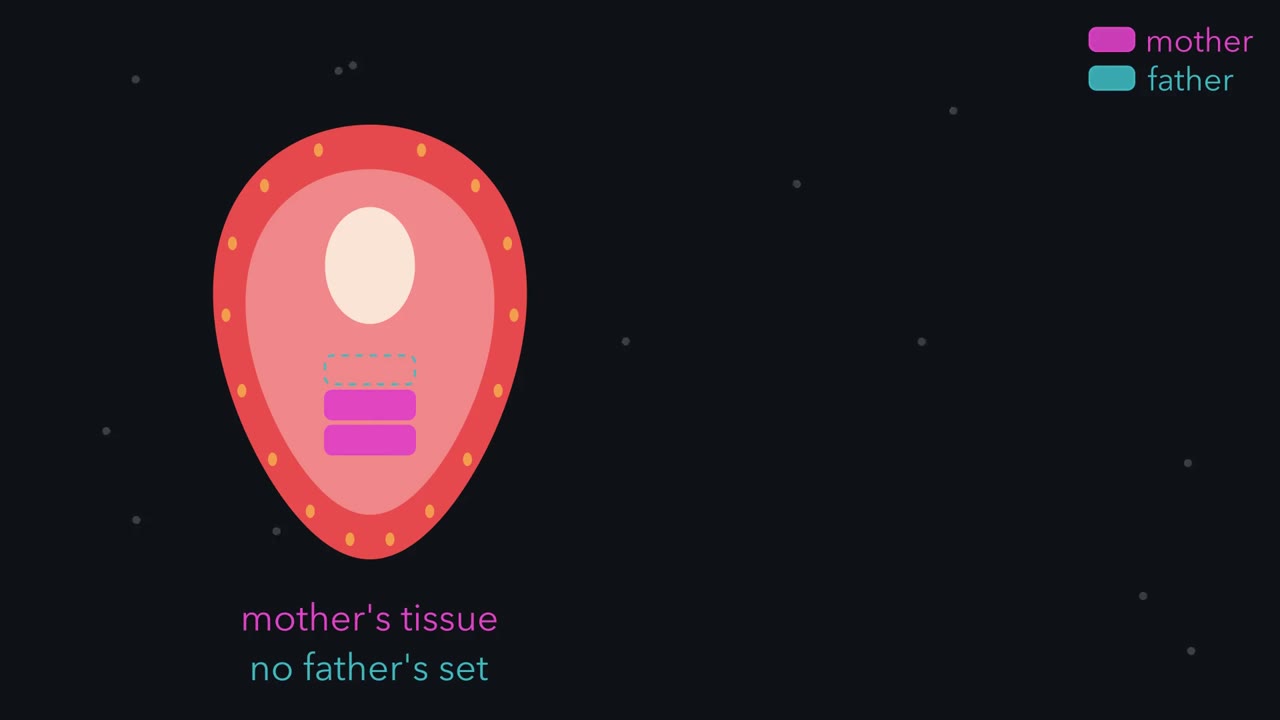
Three blocks, only one of them teal. This is the endosperm, the food store for the embryo: two maternal sets, one paternal. One sperm starts the baby plant, and the other starts its food. This is double fertilization. Layers of the mother's own tissue surround the embryo sac. They become the seed coat, with no teal at all. The ovary wall around the ovule becomes the fruit wall. It is the mother's tissue too. In maize, it is the kernel's thin outer skin. One kernel, three ledgers. Embryo, one and one. Endosperm, two and one. Coat and fruit wall, two and none. This count holds for most flowering plants. Water lilies, for one, change the numbers but keep the logic.
Pollen landing on a stigma is pollination. Fertilization comes later, inside the ovule, and only if a tube arrives. So the father sends one set, twice. His sets enter only the embryo and the endosperm. The seed coat and fruit wall are the mother's own tissue.
Dust a white-kernelled maize plant with pollen from a true-breeding yellow one, and its own ear fills with yellow kernels this season. How can the pollen parent change seeds on the mother's plant?
Continue in the lesson: Double Fertilization: How a Flower Makes a Seed →
3:18 · Free, with captions and a transcript. The lesson has the full text, the questions and the sources.
More films from this lesson
How this film was made. Narration: written from this lesson's text and read by an AI narrator voice (Kokoro, af_heart). Animation: AI-generated in code (Manim) by Claude, a schematic with no drawn molecular structures. Captions come from the narration script. See something wrong? Report it.