Where Does a Seabird's Salt Go?
Read the transcript of “Where Does a Seabird's Salt Go?”
Film transcript: Where Does a Seabird's Salt Go?
A cormorant at sea has salt water all around. Its kidneys cannot make urine as salty as the sea, so where does its extra salt go? The first film balanced a fish's water and salt in a ledger of gains and losses. A sea fish pumps its extra salt out across its gills. A bird has no gills. Clearing seawater's salt through its kidneys alone would cost the bird more water than it drank. The ledger cannot balance that way. Is there another route out? Knut Schmidt-Nielsen, C. B. Jørgensen and H. Osaki tested that question. They worked with double-crested cormorants. They gave the birds a load of salt, by mouth or by infusion. Then they collected two separate fluids from each bird, and compared them.
One vial caught fluid from the cloaca, which is urine mixed with feces. The other caught a clear fluid that dripped from the tip of the beak. Before the results, make a guess. Which vial do you think will be the saltier one?
If the kidney route ran saltier, the cloacal vial would plot higher. Instead, the beak vial filled with a concentrated salt solution. The cloacal fluid stayed much less salty. On the bar, the beak fluid reached about the level of seawater, or somewhat more. And the glands made it fast. Steady secretion could clear the body's salt within hours. The fluid came from paired glands in the head, the nasal salt glands. It ran out through the internal nostrils inside the mouth, and dripped from the tip of the beak. Back to the ledger. Getting rid of salt costs water. The saltier the gland fluid, the less water each bit of salt takes with it. Gulls reach higher salt levels still.
In a later experiment on a gull, the salt gland removed many times as much salt as the cloaca. The experiment showed a second route for salt, one that bypasses the kidney. It did not show how the gland concentrates salt, or that every bird has one. The bookkeeping is the same as the fish's. The bird's second route out is a gland, and how salty it runs sets the water cost.
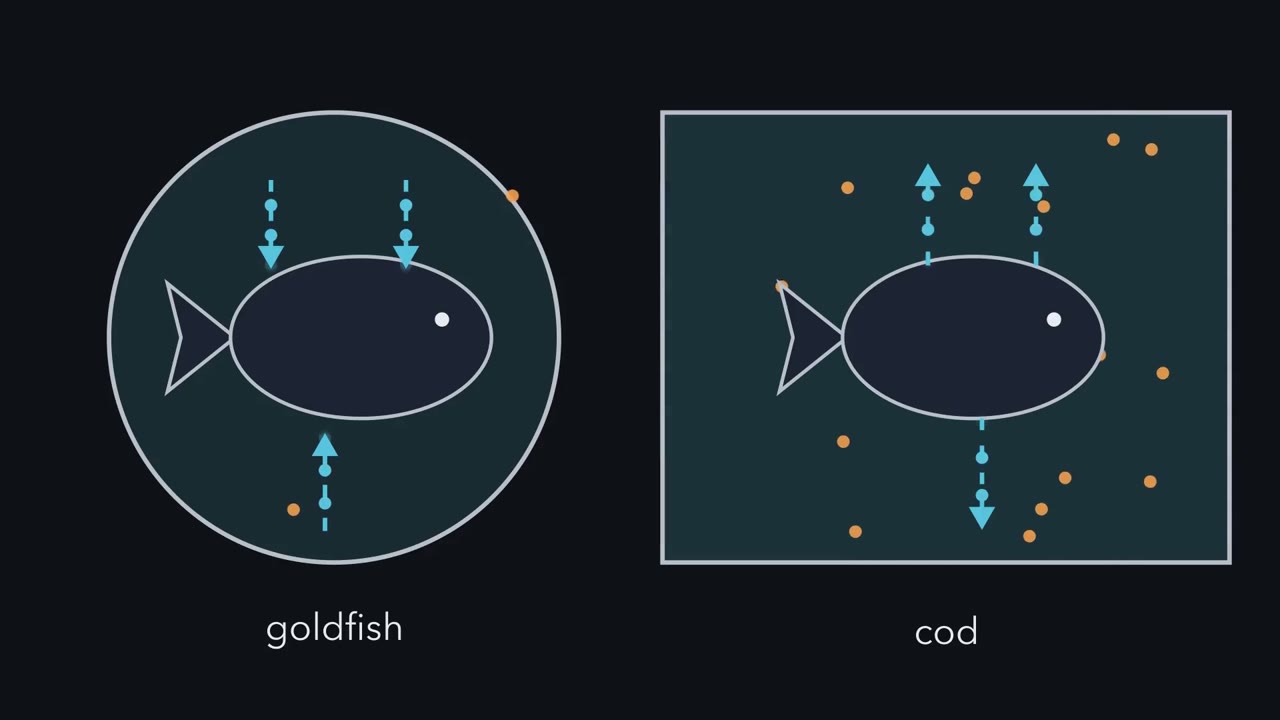
A goldfish in a bowl is soaking up water all day, and a cod in the sea is losing it. How does each one stay the same size?
Continue in the lesson: Osmoregulation and Nitrogenous Waste →
2:48 · Free, with captions and a transcript. The lesson has the full text, the questions and the sources.
More films from this lesson
How this film was made. Narration: an AI narrator voice (Kokoro, af_heart) reading narration written from this lesson's text. Animation: AI-generated in code (Manim) by Claude, a schematic with no drawn molecular structures. Captions come from the narration script. See something wrong? Report it.